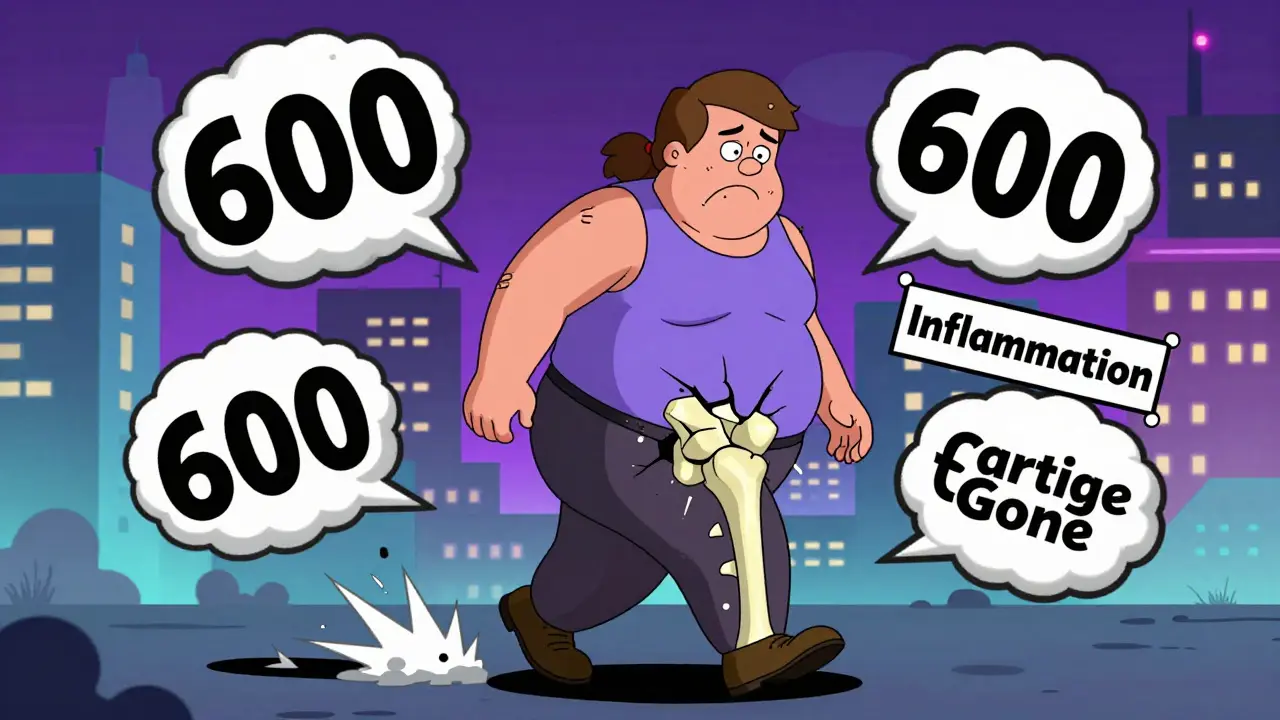
When your hip starts hurting with every step, it’s not just discomfort-it’s your body screaming that something’s wrong. Osteoarthritis of the hip is one of the most common causes of chronic hip pain, especially in people over 50. It’s not just wear and tear. It’s inflammation, cartilage loss, bone spurs, and stiffness that make simple tasks like getting out of a chair or putting on shoes feel impossible. And if you’re carrying extra weight, you’re adding pressure to an already damaged joint. The good news? Losing weight isn’t just about looking better-it’s one of the most powerful tools you have to slow down joint damage and feel better.
Why Weight Matters So Much for Your Hip
Your hip joint carries your whole body weight with every step. When you walk, the force on your hip can be up to three times your body weight. If you weigh 200 pounds, that’s 600 pounds of pressure hitting your hip joint with every step. Now imagine that joint already has worn-down cartilage, exposed bone, and swelling. Extra pounds don’t just make pain worse-they speed up the breakdown.
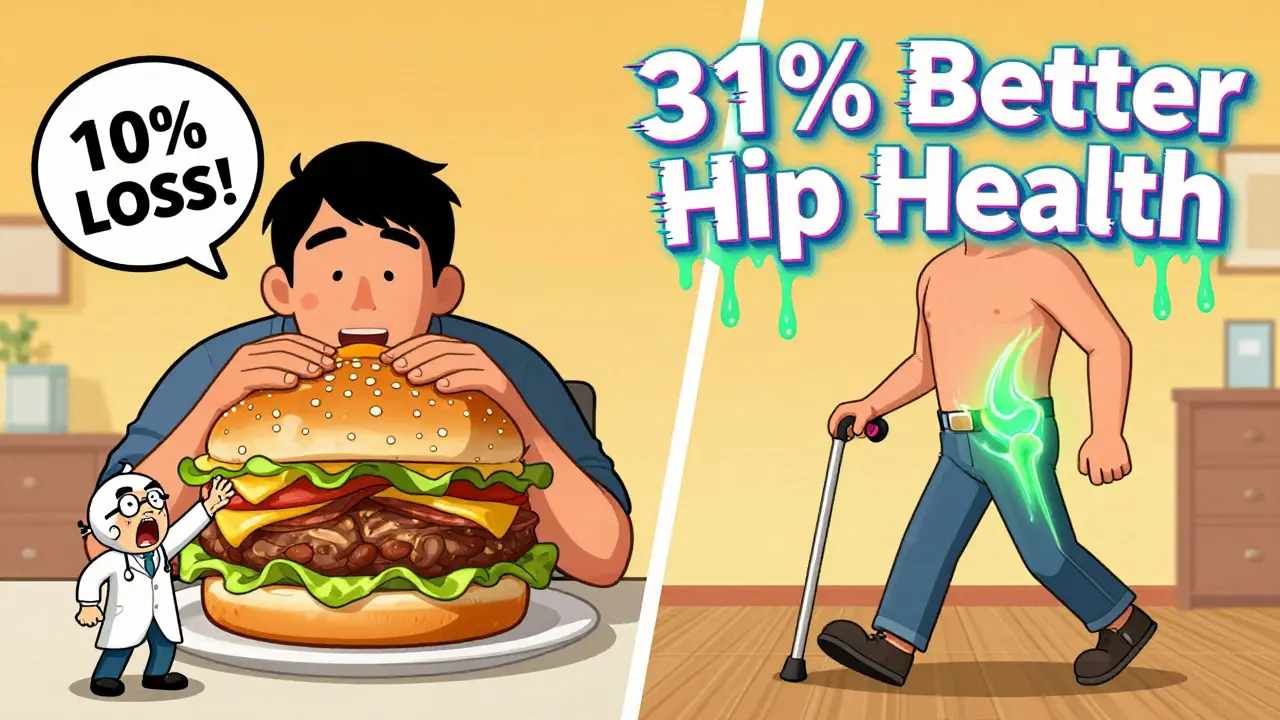
A 2024 study in Nature followed 65-year-olds with hip osteoarthritis and obesity. Those who lost more than 10% of their body weight saw the biggest improvements-not just in pain, but in daily function and quality of life. The biggest jump? A 31% improvement in how they felt about their overall hip health. That’s not a small change. That’s life-changing.
But here’s the catch: hip osteoarthritis doesn’t respond the same way as knee osteoarthritis. For years, doctors assumed what worked for knees would work for hips. It doesn’t. A 2023 clinical trial found that after six months, people who lost weight on a very-low-calorie diet didn’t report less hip pain than those who only exercised. At first glance, that sounds like weight loss doesn’t help. But here’s what happened next: by 12 months, the weight-loss group had better function, less pain, and more mobility. The benefits just took longer to show up.
How Much Weight Do You Actually Need to Lose?
You’ve probably heard “lose 5% of your body weight” as the magic number for arthritis. That advice came mostly from knee OA studies. For hips, it’s not enough. The same Nature study showed that losing 5% gave modest improvements. Losing 7-10%? That’s where the real changes happen. People who hit 10% or more saw improvements across every part of the Hip disability and Osteoarthritis Outcome Score (HOOS)-pain, stiffness, daily activities, sports, and even emotional well-being.
Think of it this way: if you weigh 220 pounds, losing 10% means shedding 22 pounds. That’s not a miracle cure, but it’s enough to reduce the load on your hip by over 60 pounds with every step. That’s like walking around with a heavy backpack removed-every single day.
And it’s not just about numbers. A 2012 study with 35 people with hip OA and excess weight followed an 8-month program of diet and exercise. Participants lost an average of 15 pounds and saw a 32.6% improvement in physical function. Their pain dropped. Their walking speed increased. They could do things they hadn’t been able to do in years.
What Works Best: Diet, Exercise, or Both?
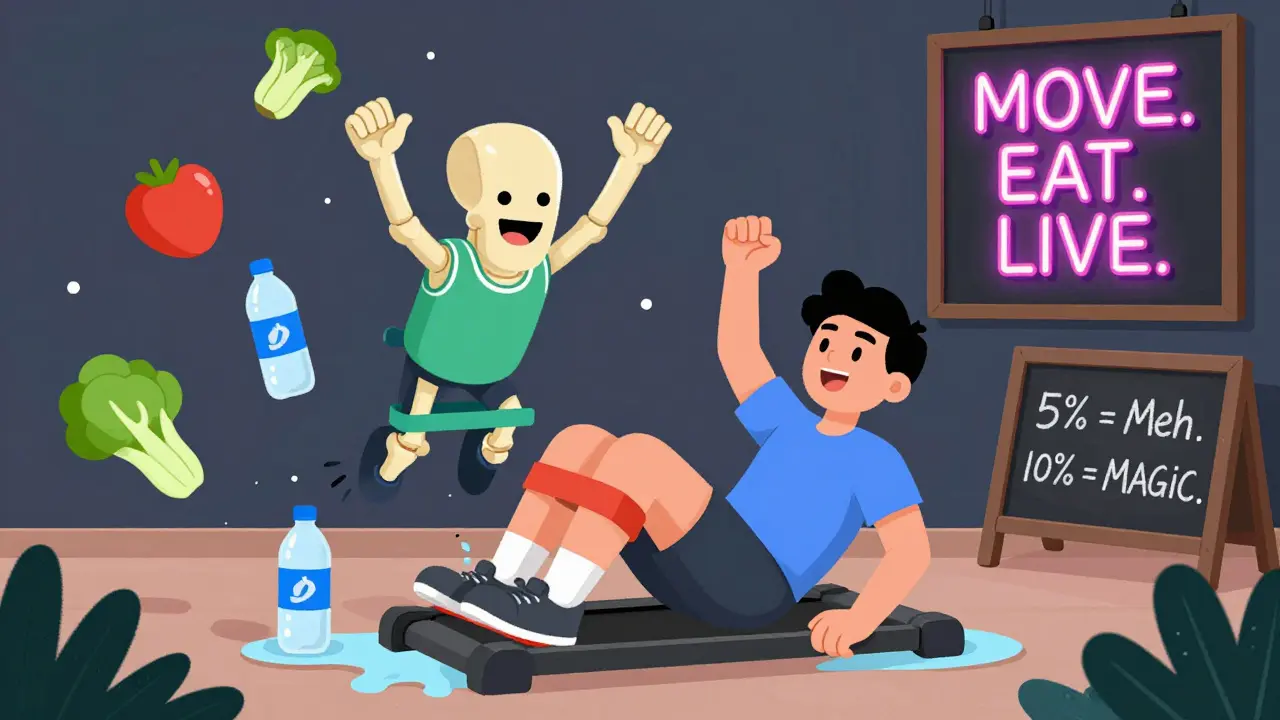
Weight loss alone won’t fix your hip. Exercise is non-negotiable. Why? Because muscle supports your joint. Strong glutes, quads, and core muscles take pressure off your hip and help you move better. But here’s the problem: if your hip hurts, you don’t want to move. That’s where the right kind of movement makes all the difference.
Low-impact activities like swimming, cycling, water aerobics, and stationary biking are ideal. They keep your joints moving without slamming them. Strength training matters too-especially exercises that target the muscles around your hip. Squats (modified if needed), leg lifts, and resistance band work can build stability without aggravating pain.
Combine that with a diet that actually works. Not a fad. Not a 3-day cleanse. Real, sustainable changes. A 2023 review in the Journal of Metabolic Health found that low-carb diets combined with regular exercise led to the best results for hip and knee OA. Why? Because reducing processed carbs and sugars lowers inflammation, which is a big part of why your hip hurts. Adding more vegetables, lean proteins, and healthy fats helps your body heal.
The OAHWFL program in Australia and New Zealand-designed for osteoarthritis-uses an 18-week plan that mixes weekly coaching, meal plans, and exercise routines. People who finished it lost 7-10% of their weight and kept it off. It’s not magic. It’s structure. And it’s working for hips, too.
Why Some Doctors Say Weight Loss Doesn’t Help Hip OA
You might have read headlines like “Osteoarthritis of the Hips Is Unaffected by Weight Loss.” That came from a 2023 commentary in NEJM Journal Watch. It’s true that some studies show weaker results for hips than knees. And yes, the pain relief isn’t always immediate. But that doesn’t mean weight loss doesn’t work. It means the story is more complicated.
Here’s the reality: hip joints are deeper and more stable than knee joints. They’re built for weight-bearing, not bending. So when cartilage wears down, the pain comes from bone-on-bone contact, not just pressure. That’s why pain reduction might be slower. But function? That improves. Mobility? That gets better. And slowing down joint degeneration? That’s the real win.
The American College of Rheumatology still recommends weight loss for people with hip OA who have overweight or obesity. Why? Because even if pain doesn’t vanish, your ability to move, walk, and live independently does. And that’s what matters.
When Weight Loss Isn’t Enough-And What to Do Next
Weight loss isn’t a cure-all. Some people lose 15 pounds and still have pain. That doesn’t mean you failed. It means you need a broader plan.
Physical therapy is a game-changer. A physical therapist can teach you how to move in ways that protect your hip. They can adjust your gait, strengthen weak muscles, and recommend assistive devices like a cane if you need them. Even a small cane in the hand opposite your painful hip can reduce joint load by up to 20%.
Medications? Over-the-counter pain relievers like acetaminophen or NSAIDs can help short-term. But they don’t stop progression. Long-term use has risks. That’s why experts say try lifestyle changes first-for at least six months-before considering drugs.
There are FDA-approved weight-loss medications for people with BMI over 30. But they’re not first-line. They’re for those who’ve tried everything else and still can’t lose weight. Even then, they’re meant to support-not replace-diet and exercise.
And surgery? Total hip replacement is highly effective. But it’s not a free pass to go back to old habits. People who get surgery but don’t lose weight often end up with complications, shorter implant life, and more pain down the road. Weight loss before surgery makes recovery smoother and the results last longer.
Real Steps You Can Start Today
You don’t need a fancy program. You don’t need to run marathons. You just need to start.
- Track your food for one week. Use a free app like MyFitnessPal. Don’t change anything yet-just see what you’re eating. You’ll be shocked.
- Swap one sugary drink a day for water or unsweetened tea. That’s 150-200 calories gone. Do that for a month, and you’ve lost 1-2 pounds without even trying.
- Walk 10 minutes after dinner. If your hip hurts, walk slowly. Use a cane if needed. Movement is medicine.
- Do two 10-minute strength sessions a week. Try seated leg lifts, standing calf raises, and wall squats. YouTube has free videos made for hip OA.
- Set a goal of 5% weight loss in 3 months. That’s 8 pounds if you weigh 160. Celebrate it. Then aim for 10%.
These aren’t drastic changes. They’re sustainable ones. And they add up.
It’s Not About Perfect. It’s About Progress.
There’s no magic number, no overnight fix. But the evidence is clear: if you have hip osteoarthritis and excess weight, losing even a small amount can change your life. Not because it erases the arthritis-but because it gives your joint a fighting chance.
Every pound you lose reduces the load on your hip. Every step you take without pain rebuilds your confidence. Every meal you choose wisely is a step toward keeping your hip healthy longer.
You don’t need to be perfect. You just need to start. And keep going.
man i thought i was the only one who felt like my hip was gonna snap just walking to the fridge
lol steve you ain’t alone. i weighed 240 last year, hip was screaming every morning. lost 28 lbs. now i can bend over to tie my shoes without groaning like a dying walrus. it’s not magic, it’s physics - less weight = less grind. you don’t need a gym, you just need to stop drinking soda and walk around the block. simple as that.
they’re hiding the truth. weight loss doesn’t fix hips - big pharma and the diet industry just want you to think it does. if it really worked, why are so many thin people still getting replacements? it’s the inflammation from processed foods, not the fat. gluten, soy, seed oils - that’s the real enemy. the study they cited? funded by a nutrition startup. look up the funding sources next time.
the nuance here is beautiful - hips are biomechanically different from knees, so of course weight loss effects are delayed. it’s not that the intervention fails, it’s that the joint needs time to remodel. cartilage doesn’t regenerate overnight, but reduced mechanical stress + lowered systemic inflammation = a slower descent into bone-on-bone hell. i’ve seen it in my PT clinic: people who stick with 10% loss over a year don’t just walk better - they *live* better. no hype, just biology.
biggest mistake people make? thinking weight loss = punishment. it’s not about deprivation. it’s about giving your body a chance to heal. swap one soda for water, walk 10 minutes after dinner, do two 10-min strength sessions a week - those aren’t diets, they’re habits. i’ve helped dozens of folks with hip OA do exactly this. results aren’t flashy, but they’re real. you don’t need to be perfect, just consistent.
oh wow, another ‘lose weight and you’ll be fine’ sermon. so let me get this straight - if you’re overweight and have hip OA, you’re just lazy? what about the 40-year-old dancer who’s thin but has severe degeneration? or the guy who’s 180 lbs and still can’t walk without a cane? this post is toxic. it blames the body instead of the system. you think your hips are failing because you ate pizza? no. your hips are failing because your body was never meant to live in a chair and eat ultraprocessed sludge 24/7.
my mom lost 18 lbs after her diagnosis and now she dances with her grandkids again 😭 i used to help her up from the couch now she’s teaching me how to salsa. it’s not about being skinny - it’s about being able to move without crying. thank you for writing this. it gave me hope.
low carb + swimming = my new life 🥹 i used to need a cane to get to the bathroom. now i walk 3 miles on weekends. not because i’m strong - because i stopped eating bread and started floating. also, the water aerobics instructor is a legend. 🏊♀️💪
i am from india and we have many old people with hip pain but no one talks about weight. they say it is old age or bad karma. your post is first thing that makes sense. i will tell my uncle to drink less sweet tea and walk. small steps, yes?
thank you for acknowledging that hips are different from knees. i’ve been told for years to ‘just lose weight like they do for knees’ - but my pain didn’t improve until i stopped comparing myself to others. it took 14 months, but losing 11% changed my life. i can now climb stairs without fear. not because i’m cured - but because i gave my body space to breathe.
to the person who said it’s about systemic issues - you’re right. but individual action still matters. i work with people who can’t afford organic food or personal trainers. that’s why i focus on the 10-minute walks and swapping soda for water. those are free, accessible, and proven. systemic change takes policy. healing your hip starts with one step - even if it’s just to the kitchen for a glass of water.