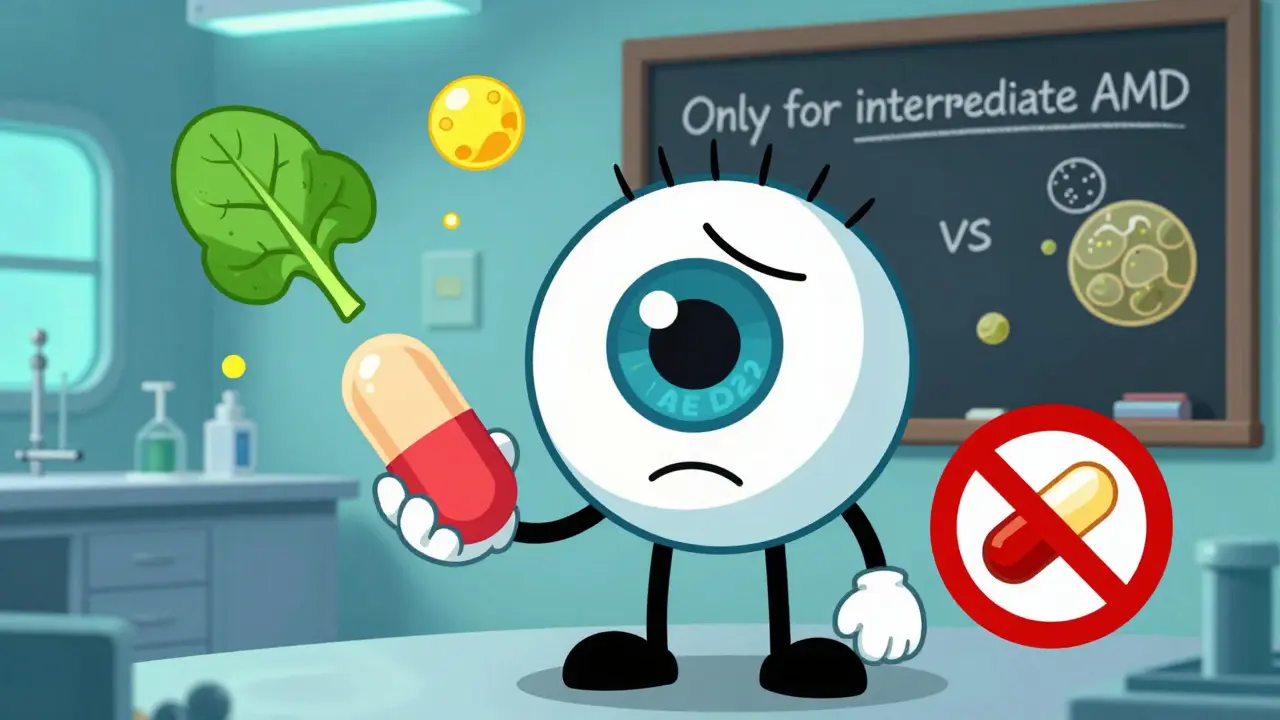
If you’ve been told you have age-related macular degeneration (AMD), you might be wondering if taking vitamins can actually help. The answer isn’t simple - it depends on how far the disease has progressed. Not everyone with vision changes needs these supplements. And for some, taking them could be useless - or even risky. The science is clear: AREDS2 is a specific vitamin formula backed by over two decades of research, but it’s only for a very specific group of people.
What Is AREDS2, Really?
The AREDS2 formula isn’t just any eye vitamin. It’s the result of a massive, 10-year clinical trial led by the National Eye Institute (NEI) that followed nearly 4,000 people with AMD. The study didn’t just test one supplement - it compared multiple versions to find the safest and most effective one.
The original AREDS formula, from 2001, included high doses of vitamin C, vitamin E, beta carotene, zinc, and copper. It cut the risk of AMD worsening by 25% in people with intermediate disease. But then researchers found a problem: beta carotene raised the risk of lung cancer in former and current smokers. That’s when the AREDS2 study was launched - to fix that flaw.
The updated formula replaced beta carotene with two nutrients found in leafy greens: lutein and zeaxanthin. These are carotenoids that naturally collect in the macula - the part of the eye that gives you sharp central vision. They act like internal sunglasses, filtering out harmful blue light and reducing oxidative stress.
The final AREDS2 recipe is precise:
- 500 mg vitamin C
- 400 IU vitamin E
- 10 mg lutein
- 2 mg zeaxanthin
- 80 mg zinc (as zinc oxide)
- 2 mg copper (as cupric oxide)
Copper is included because high zinc levels can lower copper in the body. This isn’t a multivitamin. It’s a targeted, high-dose medical formula. You can’t get this from food or regular supplements.
Who Should Take AREDS2 Vitamins?
This is where most people get it wrong. AREDS2 isn’t for everyone with blurry vision or age-related eye changes. It’s only for two specific groups:
- People with intermediate AMD in one or both eyes - that means many medium-sized drusen (yellow deposits under the retina) or at least one large drusen.
- People with advanced AMD (geographic atrophy) in one eye, and intermediate AMD in the other.
If you only have small drusen - what’s called early AMD - taking AREDS2 won’t help. It won’t prevent the disease from starting. It won’t improve your vision. And it won’t slow anything down. The same goes for people with no AMD at all. A 2023 analysis from Vision-and-Eye-Health.com put it plainly: "The AREDS2 formula does not offer benefits for individuals with early AMD, nor does it prevent the onset of the condition."
Even more surprising: omega-3 fatty acids (like fish oil) were tested in AREDS2. They showed no benefit at all. So if your supplement includes fish oil, you’re paying extra for something science says doesn’t work for AMD.
New Evidence: AREDS2 Might Help Late-Stage AMD Too
For years, doctors said AREDS2 only worked to delay progression from intermediate to advanced AMD. But new data from July 2024 changes that.
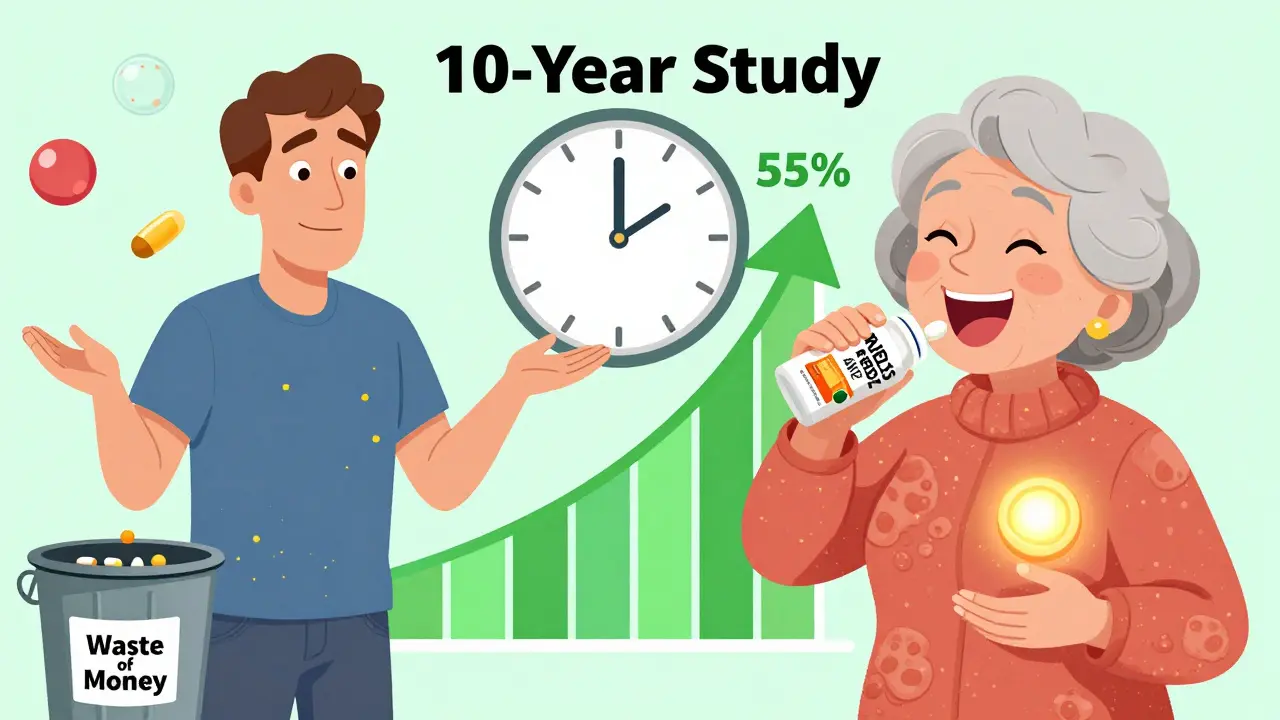
Researchers reviewed retinal scans from 1,209 people in the original AREDS2 trial who had advanced dry AMD - specifically, geographic atrophy (GA). They found that those who took the AREDS2 formula had their disease progress 55% slower over three years - if the damaged area was outside the very center of the macula (the fovea).
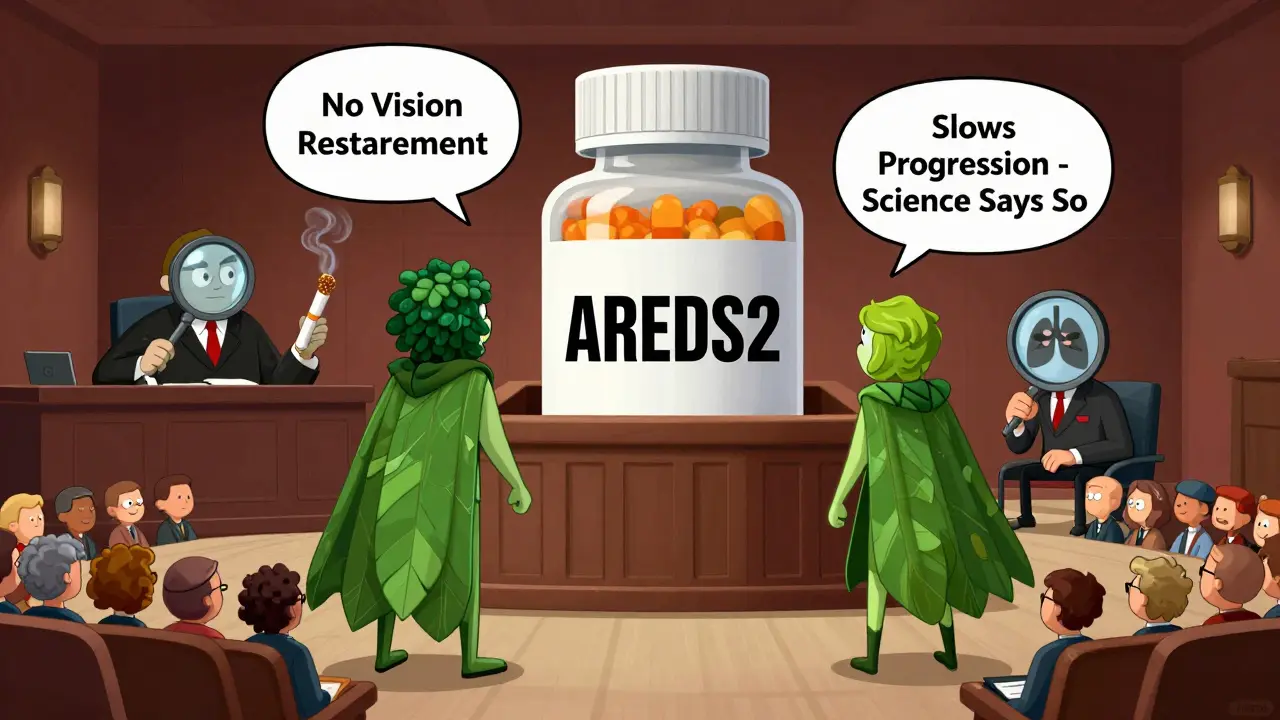
This is huge. For people with late-stage dry AMD, vision loss is often permanent. Slowing progression by over half means they might keep useful vision longer - enough to drive, read, or live independently. As Geraldine Hoad from the Macular Society said, "Until now AREDS2 supplements weren’t thought to be effective for those with late-stage dry AMD. By slowing vision loss, they could help people stay independent longer and improve their quality of life."
But here’s the catch: this finding is still from retrospective data. It hasn’t been confirmed in a new, dedicated trial. So while it’s promising, it’s not yet official guidelines. Still, many eye specialists are now considering AREDS2 for this group - especially if the atrophy isn’t centered in the fovea.
What AREDS2 Can’t Do
It’s just as important to know what these vitamins won’t do.
- They won’t restore lost vision. Dr. Emily Chew, who led the 10-year follow-up, says clearly: "AREDS supplements cannot reverse vision damage that has already occurred."
- They won’t prevent AMD. If you’re in your 50s with perfect vision and no drusen, taking AREDS2 won’t stop you from getting it later.
- They won’t help if you have wet AMD. AREDS2 is only for the dry form. Wet AMD needs injections, not vitamins.
- They won’t work if you don’t take them daily. In the study, 91% of participants reported taking their pills every day. That’s how you get the benefit.
Also, don’t confuse AREDS2 with other "eye health" supplements. Many brands add ingredients like astaxanthin, bilberry, or ginkgo. None of these are in the AREDS2 formula. And none have the same level of evidence. Stick to the exact dosages - no more, no less.
Is It Safe Long-Term?
The 10-year follow-up of AREDS2 participants found no major safety issues. Zinc can cause stomach upset in some people, and high doses may interfere with copper or iron absorption. That’s why copper is included. But overall, the formula held up well over a decade.
People with certain conditions should talk to their doctor first:
- If you have kidney disease - high zinc may not be safe.
- If you’re on blood thinners - vitamin E can interact with them.
- If you’re a smoker - avoid any supplement with beta carotene. Stick to lutein and zeaxanthin only.
Always check with your eye doctor before starting. They’ll confirm your AMD stage and rule out other causes of vision changes.
What About Diet?
While AREDS2 supplements are powerful, they’re not a replacement for food. People who ate more leafy greens, eggs, and orange peppers - foods rich in lutein and zeaxanthin - had the greatest benefit from the supplement. That’s because the body absorbs these nutrients better when they come from both food and pills.
Try adding:
- Kale, spinach, collards
- Broccoli and peas
- Eggs (the yolk has zeaxanthin)
- Orange peppers and corn
Even if you’re taking AREDS2, eating these foods supports overall eye health - and your whole body.
Bottom Line
AREDS2 vitamins are one of the few treatments in eye care with solid, long-term evidence. But they’re not magic. They’re a targeted tool for a specific stage of a specific disease.
If you have intermediate AMD - or advanced AMD in one eye with intermediate in the other - talk to your eye doctor about starting AREDS2. Take it every day. Stick to the exact formula. Don’t switch brands unless they match these exact numbers.
If you have early AMD, or no AMD at all - skip it. You’re not helping yourself. You’re just spending money on something science says won’t work.
And if you’re worried about your vision, get a full eye exam. Don’t guess. Don’t self-diagnose. The right diagnosis is the first step to the right treatment.
Do AREDS2 vitamins improve vision?
No. AREDS2 vitamins do not improve or restore vision that’s already been lost. They only help slow down further vision loss in people with intermediate or certain types of advanced AMD. They are not a treatment for blurry vision or reading difficulty caused by existing damage.
Can I take AREDS2 if I’m a smoker?
Yes - but only if the supplement does NOT contain beta carotene. The original AREDS formula included beta carotene, which raised lung cancer risk in smokers. The AREDS2 formula replaced it with lutein and zeaxanthin, which are safe for smokers and former smokers. Always check the label.
Is it okay to take AREDS2 if I have early AMD?
No. If you only have small drusen (early AMD), taking AREDS2 won’t prevent progression or improve your vision. Studies show no benefit for this group. Taking it won’t harm you, but it’s unnecessary and a waste of money.
Can I get AREDS2 vitamins from my diet?
You can get lutein and zeaxanthin from foods like spinach, kale, eggs, and peppers - but not in the high doses used in AREDS2. The formula requires 10 mg of lutein and 2 mg of zeaxanthin daily, which is far more than most people eat. That’s why supplements are needed for therapeutic effect.
Do I need to take AREDS2 forever?
If your doctor recommends it, yes - as long as you still have intermediate or advanced AMD. The benefits are long-term, and stopping the supplements may allow progression to resume. There’s no evidence that taking them for 10+ years causes harm, and the 10-year follow-up showed continued protection.
Are all "eye health" supplements the same as AREDS2?
No. Many supplements claim to support eye health, but only those matching the exact AREDS2 formula have proven benefits for AMD. Look for the specific dosages: 500 mg vitamin C, 400 IU vitamin E, 10 mg lutein, 2 mg zeaxanthin, 80 mg zinc, and 2 mg copper. If it’s missing any of these or has extra ingredients like omega-3s or antioxidants not in the formula, it’s not the same.
Man, I’ve been taking these AREDS2 pills for like 5 years now after my mom got diagnosed. Honestly? I didn’t think they’d do anything, but my ophthalmologist said my drusen count hasn’t increased since I started. Not a miracle, but not nothing either. I just crush the pills into my morning smoothie-easier than swallowing big capsules. Also, I eat spinach salads every day. Don’t know if it helps, but feels good to do something.
EVERYTHING about this is a scam. The NEI? Government-funded. The ‘study’? Funded by Big Pharma. Lutein and zeaxanthin? Those are just pigments found in corn and egg yolks-why are we paying $50 a bottle for something you can get at Walmart for 99 cents? And don’t get me started on zinc-zinc is a heavy metal. They’re poisoning people under the guise of ‘eye health.’ I’ve been on a raw food diet for 12 years and my vision’s better than my 25-year-old nephew’s. You’re being manipulated.
What I find fascinating is how the science evolved-from AREDS to AREDS2. It’s rare to see a medical recommendation change so clearly based on new evidence. Beta carotene being dropped because it increased lung cancer risk in smokers? That’s science working as it should: self-correcting, cautious, and data-driven. I wish more public health advice had this level of rigor. Even the fact that omega-3s were tested and discarded? That’s humility in research. Most supplement companies would’ve kept them in just to sell more bottles.
Let’s be honest-this isn’t about eye health. This is about institutional inertia. The AREDS2 formula is basically a patent-protected, branded supplement masquerading as science. The NIH didn’t ‘discover’ this-they just standardized what was already on the market. And now every optometrist pushes it like gospel. Meanwhile, the real drivers of AMD-chronic inflammation, poor circulation, metabolic syndrome-are ignored. We’re treating symptoms with a magic pill while the entire system ignores diet, sleep, and stress. The real conspiracy? That nobody talks about the root causes.
Stop wasting your money if you dont have intermediate AMD. Plain and simple. I work in pharma and I see this every day. People buy these supplements because they’re scared of going blind. But if you have early AMD or no AMD at all? You’re just giving money to supplement companies who market like they’re saving lives. The data is crystal clear. No benefit. Zero. And yes I checked the NEI reports myself. Don’t be a sucker.
One thing I’d add-many people don’t realize that the AREDS2 formula has very specific bioavailability requirements. Zinc oxide and cupric oxide aren’t just random choices; they’re the forms proven to be absorbed and retained in the study. Generic brands often use cheaper forms like zinc citrate or copper sulfate, which may not be as effective. Always check the ingredient list down to the chemical form. If it says ‘zinc’ without specifying oxide, it’s probably not the real deal.
Okay but what if the whole study was flawed? What if they didn’t account for genetic variants? I’ve read papers where people with certain CFH gene mutations don’t respond to AREDS2 at all. And what about the fact that most participants were white, middle-class Americans? Does this apply to Asians, who have higher rates of AMD but different dietary patterns? The ‘evidence’ feels like it was built on a very narrow slice of humanity. I’m not saying it doesn’t work-I’m saying we don’t know if it works for everyone. And that’s dangerous.
UK here. We’ve got the NHS prescribing this stuff now. I asked my GP why and she said ‘it’s the only thing with decent data.’ But I looked it up-NICE guidelines say ‘not recommended for routine use.’ So why are people getting it? Because someone in a lab in Maryland said ‘this works’ and now it’s gospel. We’re importing American medical dogma and calling it science. Shame.
I’ve been a ‘vision health’ guru for 15 years and I’ve seen every supplement trend come and go. Astaxanthin? Hype. Bilberry? Anecdotal. Ginkgo? Placebo. But AREDS2? It’s the only one that survived peer review, replication, and a decade-long follow-up. People dismiss it because it’s not sexy. No glowing aura. No ‘ancient wisdom.’ Just hard numbers. That’s why it works. The rest is noise.
Just a heads up-some people get nauseous from the zinc. I did. Switched to a brand with zinc picolinate and it was fine. Also, take it with food. I forgot once and threw up for 3 hours. Lesson learned. And yes, I have intermediate AMD. This stuff helped. Not magically. But enough to feel like I’m not losing ground.
What if vision loss isn’t a disease to be stopped, but a natural evolution? We fear aging because we’ve been conditioned to. What if the body slows down the macula’s function not to fail, but to redirect energy? What if the supplement is just a bandage on a deeper cultural fear of mortality? I don’t take pills. I sit in silence. I watch the light change. My vision isn’t perfect-but my awareness is. Maybe that’s the real cure.
India here. You guys are overthinking this. In our villages, grandmas eat spinach, eggs, and turmeric every day. No pills. No studies. No NEI. And their eyesight is better than your 30-year-olds who stare at phones all day. You want to fix AMD? Stop eating processed junk. Stop staring at screens. Stop believing pills can fix what your lifestyle broke. This whole AREDS2 thing? Just another way for Western corporations to monetize fear.
It’s heartbreaking, really. I’ve been watching my mother’s vision deteriorate over the past 8 years. She took AREDS2 religiously for 6. The doctor said it slowed the progression. But now, after the new 2024 data came out, I’m terrified. She’s in the late-stage group. The atrophy isn’t centered… but what if it moves? What if the 55% slowdown was just luck? What if the next year, it accelerates? I don’t sleep anymore. I just stare at her hands, wondering if she’ll be able to hold my child one day. I wish science had more answers. I wish I had more control.
Wow. That last comment broke my heart. And honestly? That’s why this matters. It’s not about supplements or science or politics. It’s about a mother holding her grandchild’s hand. If there’s even a 55% chance to keep that moment alive, I’d take the pill. Even if it’s not perfect. Even if it’s not magic. Even if it’s just one tiny thread holding onto something beautiful. Don’t dismiss it because it’s not perfect. It’s not supposed to be.