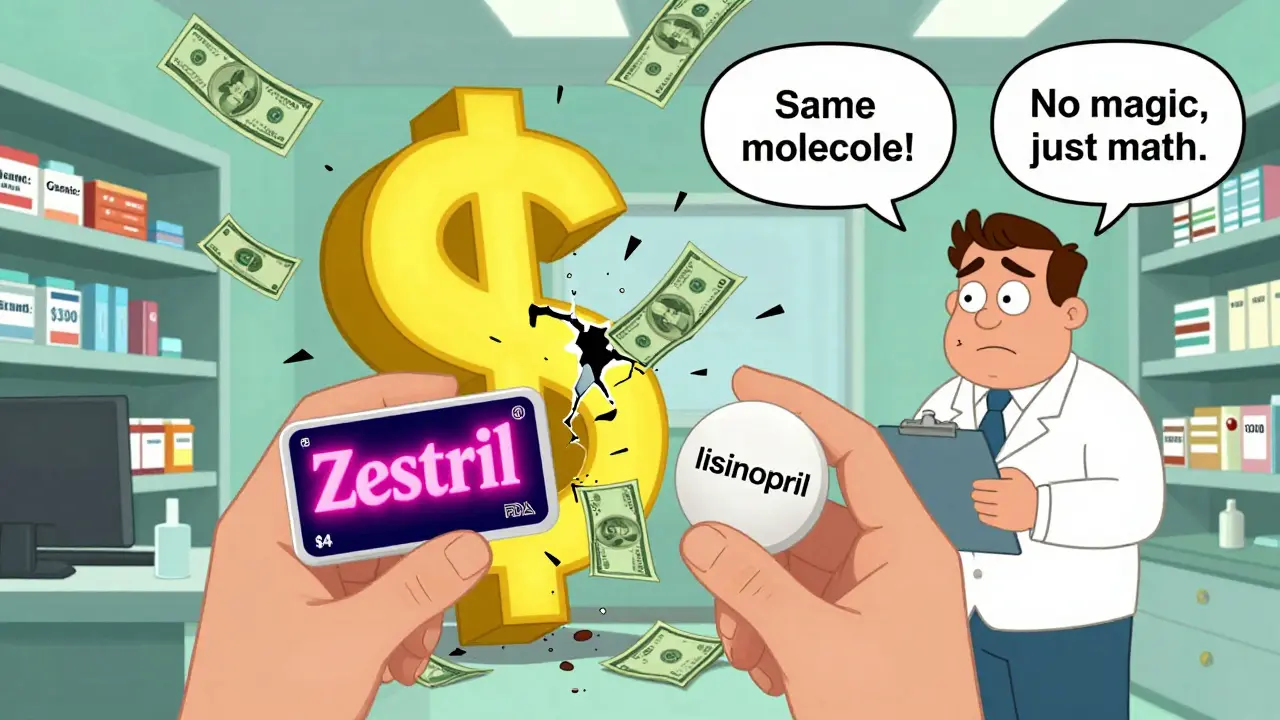
Every year, millions of Americans face a tough choice: pay hundreds of dollars for a prescription or skip doses because they can’t afford it. The solution isn’t a new miracle drug - it’s often the same medicine in a cheaper bottle. Generic medications work just like brand-name drugs but cost a fraction of the price. If you’re still using brand-name prescriptions out of habit or fear, here’s why switching to generics is one of the smartest health decisions you can make.
They’re the exact same medicine
It’s easy to think generic drugs are "weaker" or "inferior." They’re not. By law, the U.S. Food and Drug Administration (FDA) requires generics to contain the same active ingredient, strength, dosage form, and route of administration as the brand-name version. That means if you’re taking lisinopril for high blood pressure, the generic version has the same molecule, in the same amount, doing the exact same job in your body as the brand-name Zestril. The FDA doesn’t just accept claims - they test them. Before a generic drug hits the shelf, manufacturers must prove bioequivalence. That means the generic must deliver the same amount of medicine into your bloodstream at the same rate as the brand. The standard? The concentration of the drug in your blood must fall within 80% to 125% of the brand-name version. That’s not a guess - it’s a strict scientific requirement backed by real data from blood tests. Even the FDA’s own website states: "Generic drugs are just as safe and effective as brand-name drugs." And they don’t say that lightly. Over 1,200 inspections a year are conducted on manufacturing sites - in the U.S. and overseas - to make sure quality stays consistent.Cost savings aren’t just nice - they’re life-changing
Let’s talk numbers. The average brand-name drug costs 85% more than its generic equivalent. That’s not a small difference. It’s the difference between paying $300 a month for Glucophage (brand-name metformin) and $4 for the generic. For someone on a fixed income, that’s not a choice - it’s survival. A 2023 study found patients using generic medications were 68% less likely to skip doses because of cost. That’s huge. Missing doses of blood pressure or diabetes meds doesn’t just mean feeling off - it means higher risk of heart attack, stroke, or hospitalization. Generics keep people healthy and out of the ER. Take warfarin, a common blood thinner. The brand-name version, Coumadin, can cost over $300 for a 30-day supply. The generic? Around $4. Or Lipitor (atorvastatin), used to lower cholesterol. Before generics hit the market in 2011, it cost about $130 a month. Today, the generic version is as low as $4 at Walmart and Target. That’s not a sale - that’s the law of supply and demand kicking in. When five or more companies make the same generic, prices crash. Over the last decade, generic drugs saved the U.S. healthcare system more than $1.6 trillion. That’s not a guess - it’s from the Association for Accessible Medicines. That money stays in people’s pockets, reduces insurance premiums, and lowers overall healthcare spending.They’re not "second choice" - they’re the standard
Here’s something most people don’t realize: 90% of all prescriptions filled in the U.S. are for generic drugs. That’s not a niche market - it’s the norm. Hospitals, pharmacies, insurers, and even the VA use generics almost exclusively. Why? Because they work. And they’re cheaper. Insurance plans encourage generics by making them cheaper. Humana’s 2023 data shows average copays for generics are $1-$10. For brand-name drugs? $25-$75. Some plans won’t cover brand-name drugs at all unless your doctor writes a letter explaining why the generic won’t work for you. That’s not a trick - it’s smart policy. The American Medical Association and the American Heart Association both recommend prescribing generics when appropriate. A 2022 study in the Journal of the American Heart Association followed 186,000 patients taking generic versus brand-name heart medications. No difference in outcomes. No higher risk of heart attack or stroke. Just the same results at a fraction of the cost.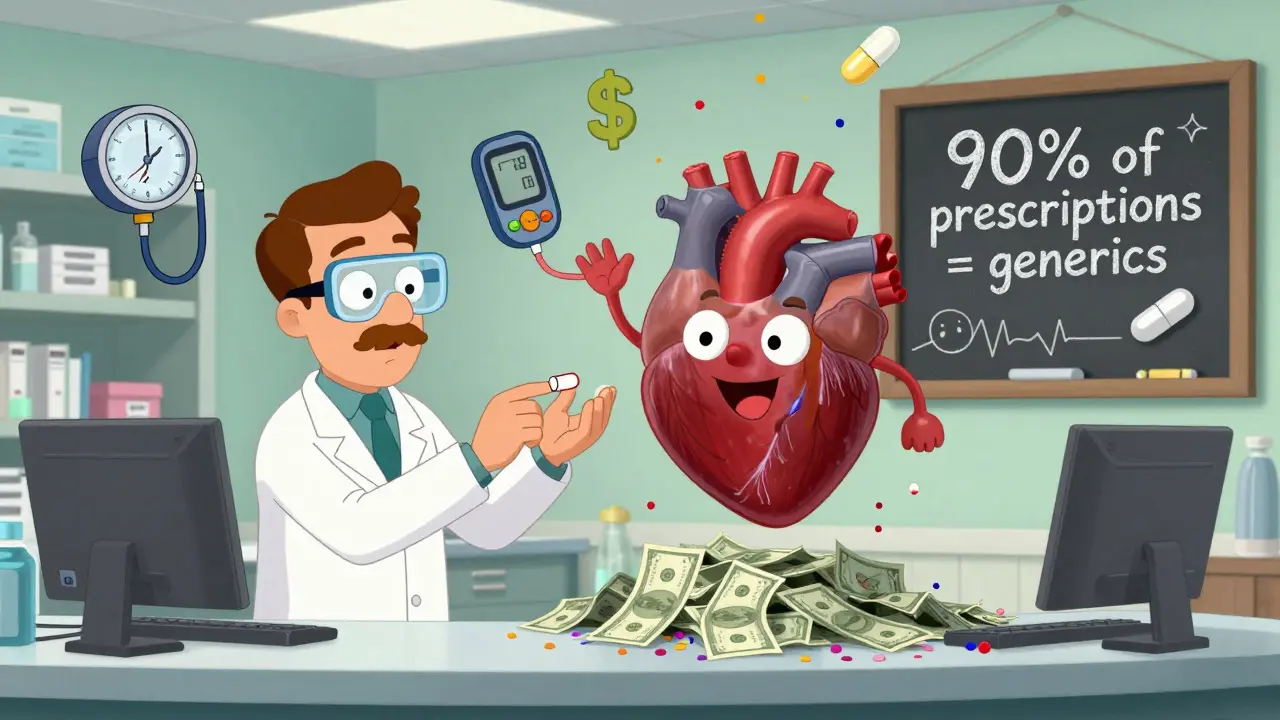
What about those weird-looking pills?
You might notice your generic pill looks different - different color, shape, or size. That’s normal. The FDA only controls the active ingredient. The inactive ingredients - like dyes, fillers, and coatings - can vary. That’s why one generic version of metformin might be white and oval, while another is blue and round. These differences don’t affect how the drug works. But they can cause anxiety. A patient on Drugs.com wrote in 2024: "My pharmacy switched manufacturers and the pill color changed. I panicked. I thought I was getting the wrong medicine." That’s a real concern - and one pharmacists are trained to handle. When you get a new generic, ask your pharmacist: "Is this the same medicine?" They’ll confirm it’s bioequivalent and explain the change. Most pharmacies now offer printed handouts or QR codes that link to FDA-approved info about your generic drug.Are there exceptions?
For almost all medications, generics are a safe, effective, and affordable choice. But there are a few edge cases. Some drugs have a narrow therapeutic index (NTI) - meaning even tiny changes in blood levels can affect safety or effectiveness. Examples include certain seizure meds like phenytoin, thyroid meds like levothyroxine, and blood thinners like warfarin. Even here, the FDA requires generics to meet the same strict bioequivalence standards. Studies show no increased risk of side effects or treatment failure. Still, some doctors prefer to stick with one brand for NTI drugs, especially when a patient is stable. That’s not because generics are unsafe - it’s about minimizing variables. If you’re doing well on a generic, don’t switch back unless your doctor recommends it.
What about biosimilars?
Newer drugs called biosimilars are the generic version of complex biologic drugs - things like Humira, Enbrel, or insulin. These aren’t simple pills. They’re made from living cells, so they’re harder to copy. But they’re still cheaper. As of December 2023, the FDA had approved 37 biosimilars. The Congressional Budget Office estimates they could save $300 billion over the next decade. That’s not just for rich people - it’s for anyone with arthritis, Crohn’s disease, or diabetes who needs these life-changing treatments.How to switch - and what to expect
Switching is simple. When your prescription renews, your pharmacist will usually fill it with the generic unless your doctor says otherwise. You can always ask: "Is there a generic version?" If there is, they’ll tell you the price difference. If you’re worried about side effects, give it a few weeks. Most people notice no difference. If you truly feel worse, talk to your doctor. But don’t assume the generic is the problem. Often, it’s just your brain reacting to the new pill shape. The FDA’s "Orange Book" lists every approved generic and its therapeutic equivalence rating. You can look up your drug there - no login needed. Just search by name.Bottom line: Save money. Stay healthy.
There’s no trick. No hidden catch. Generic medications are the same medicine, approved by the same agency, made to the same standards - just cheaper. For most people, switching saves hundreds - even thousands - of dollars a year with zero trade-off in effectiveness. If you’re paying full price for a brand-name drug, ask your doctor or pharmacist: "Is there a generic?" If the answer is yes, there’s no reason not to switch. Your body won’t know the difference. But your wallet will.Are generic medications as safe as brand-name drugs?
Yes. The FDA requires generic drugs to meet the same strict safety and quality standards as brand-name drugs. They must contain the same active ingredient, strength, and dosage form, and prove they work the same way in the body. Adverse event reports for generics are proportional to their usage - meaning they’re not more dangerous.
Why are generic drugs so much cheaper?
Generic manufacturers don’t have to repeat expensive clinical trials or pay for costly marketing campaigns. They only need to prove their drug is bioequivalent to the brand-name version. Once multiple companies start making the same generic, competition drives prices down - often by 85% or more.
Can I trust generics if they look different?
Absolutely. Differences in color, shape, or size are due to inactive ingredients like dyes or fillers, which don’t affect how the medicine works. The active ingredient - the part that treats your condition - is identical. Pharmacists can confirm the generic is equivalent using the FDA’s Orange Book.
Do insurance plans prefer generic medications?
Yes. Most insurance plans have tiered formularies where generics cost far less - often $1-$10 per prescription - compared to $25-$75 for brand-name drugs. Some plans won’t cover the brand-name version unless your doctor proves the generic won’t work for you.
Are there any drugs where generics don’t work as well?
For nearly all medications, generics perform just as well. A few drugs with a narrow therapeutic index - like levothyroxine or phenytoin - require careful monitoring, but even then, FDA-approved generics meet the same bioequivalence standards. If you’re stable on a generic, there’s no reason to switch unless your doctor advises it.
Man, I just showed this to my uncle back in Delhi-he’s been on blood pressure meds for 15 years and was terrified of generics because they looked different. After reading this, he switched and saved $80 a month. Now he sends me pics of his pills like they’re trophies. 🙌
Stop pretending generics are magic. The FDA’s 80-125% bioequivalence window is a joke. That’s a 45% variance-half the drug could be missing or doubled. You think that’s safe for cardiac patients? Wake up. This is corporate greed dressed up as healthcare.
Really appreciate this breakdown. I’m from India and generics are the norm here-we don’t even think twice. But I’ve seen friends in the US panic when their pill changes color. It’s wild how much marketing shapes perception. The science doesn’t lie, though. 💡
Okay so let me get this straight-some guy in a lab in Hyderabad makes a pill that looks like a blue gumball and somehow it’s the same as Lipitor? And you’re telling me the FDA just says ‘eh, close enough’? I don’t buy it. There’s gotta be something they’re not telling us. Like maybe the inactive ingredients are laced with something? I heard cornstarch can mess with your gut if you’re sensitive. I’m just sayin’.
Think about it: we live in a world where a $10,000 iPhone is a status symbol, but a $4 pill that saves your life is somehow ‘suspicious.’ We worship brands like they’re deities, yet we refuse to trust the same science that put a man on the moon. Generics aren’t cheap-they’re honest. The real tragedy isn’t the pill color-it’s that we’ve been trained to fear value.
Oh wow, another ‘generics are great’ post. How original. Did you get this from a pharmaceutical ad? I’m sure the FDA loves these feel-good stories. Meanwhile, my cousin’s dad had a stroke because his generic warfarin ‘wasn’t quite right.’ Coincidence? Or just the 1 in 1000 who actually *does* have a problem? Oh wait, you didn’t mention that part.
I switched my mom to generic metformin last year and she’s been fine! The pill was a different shape so she cried for a week 😭 But now she says she feels better because she’s not skipping doses to save money. We all win. 💕
Generics work. End of story. Stop overthinking it
My pharmacist gave me a little handout with a QR code that links to the FDA’s page on my generic. I scanned it and saw the exact bioequivalence data. It’s like a science report in my pocket. So reassuring. 📱❤️
How quaint. You Americans think you’re revolutionary for discovering that cheaper medicine exists. In Europe, we’ve been using generics since the 70s. Also, the FDA’s standards are laughably lax compared to the EMA. But sure, let’s pat ourselves on the back for not being total idiots.
The pharmacokinetic parameters for NTI drugs like levothyroxine show higher inter-individual variability with generics due to excipient heterogeneity. This is clinically significant in patients with suboptimal TSH control. You’re conflating population-level efficacy with individual therapeutic stability.
Here in Nigeria, we don’t have brand names. We have medicine. If it works, we use it. If it doesn’t, we find another. Simple. Why make it complicated?
I work in pharmacy benefit management. The data is clear: generics reduce non-adherence by 40-60% across chronic conditions. That’s not anecdotal-it’s actuarial. The savings cascade: lower ER visits, fewer hospitalizations, reduced long-term disability. It’s a systemic win.
So… the government lets some guy in China make my blood pressure pill and calls it ‘equivalent’? And I’m supposed to just… trust it? Like, I’m supposed to believe the same molecule that’s in my $300 bottle is just… chilling in a $4 capsule? I don’t know man. Feels like a cult. 🤔
YOU DON’T KNOW WHAT YOU’RE DOING!! I’VE BEEN ON BRAND-NAME LIPITOR FOR 12 YEARS AND I’M FINE!! WHY ARE YOU TRYING TO KILL ME WITH CHEAP PILLS?!?!?!!??