
It’s 2025, and the factory floor isn’t just louder-it’s more anxious. Every beep from a sensor, every delayed shipment, every missed inspection feels like a potential collapse. Manufacturers aren’t just worried about meeting deadlines anymore. They’re scared their entire operation could unravel because of one small quality lapse. This isn’t paranoia. It’s reality.
Quality Isn’t Just a Step Anymore-It’s the Foundation
Ten years ago, quality assurance was something you checked at the end of the line. A few samples pulled, a pass or fail, then shipped. Today, it’s baked into every decision. A single defective part in a medical device or electric vehicle battery can trigger recalls, lawsuits, and lost trust. That’s why 95% of manufacturing executives now say quality is mission-critical. Not important. Not nice to have. Mission-critical. It’s not just about avoiding mistakes. It’s about survival. Companies that treat quality as a strategic lever are seeing 22% lower rework costs and 18% faster time-to-market. Those still treating it like paperwork? They’re bleeding money. One electronics maker spent $2.3 million on automated inspection systems but didn’t train their staff. The result? Error rates went up 40% in the first year. The technology wasn’t the problem. The mindset was.The Real Culprits Behind the Fear
What’s driving this fear? It’s not one thing-it’s a pile-up. First, material costs are climbing. Forty-four percent of manufacturers say rising material prices are their biggest headache. When every gram of aluminum or copper matters, you can’t afford to scrap parts. That means getting it right the first time isn’t optional-it’s financial survival. Then there’s the labor gap. Nearly half of manufacturers (47%) say they can’t find skilled workers. Not just any workers-people who understand both old-school inspection techniques and new digital tools. You can install AI-powered cameras to spot defects, but if no one knows how to interpret the data, it’s just a fancy camera with no brain. And the complexity? It’s insane. Modern cars have more sensors than a NASA rocket. Medical devices are smaller, smarter, and packed with electronics. Assembly lines that used to handle simple parts now need to align micro-components with micrometer precision. One wrong alignment, and the whole batch is trash. And you can’t slow down. Customers want it fast. Amazon-level speed. But the product demands aerospace-level accuracy.Technology Isn’t the Fix-Integration Is
Everyone’s talking about AI, 3D scanning, and real-time monitoring. And yes, these tools work. A medical device company cut rework costs by $1.2 million a year using precise metrology. Another automotive supplier boosted defect detection by 37% after switching to AI inspection software. But here’s the catch: 61% of manufacturers struggle to connect these new tools with their old systems. You can’t just plug in a fancy sensor and expect magic. If your quality data lives in a spreadsheet, your production team uses a different software, and your supply chain shares info via email, you’re building a house on sand. The winners are those who integrate. Cloud-based Quality Management Systems (QMS) are now used by 68% of new enterprise deployments-up from 52% in 2023. These platforms tie together inspection data, supplier reports, machine logs, and customer feedback into one system. That’s how you catch a problem before it becomes a crisis.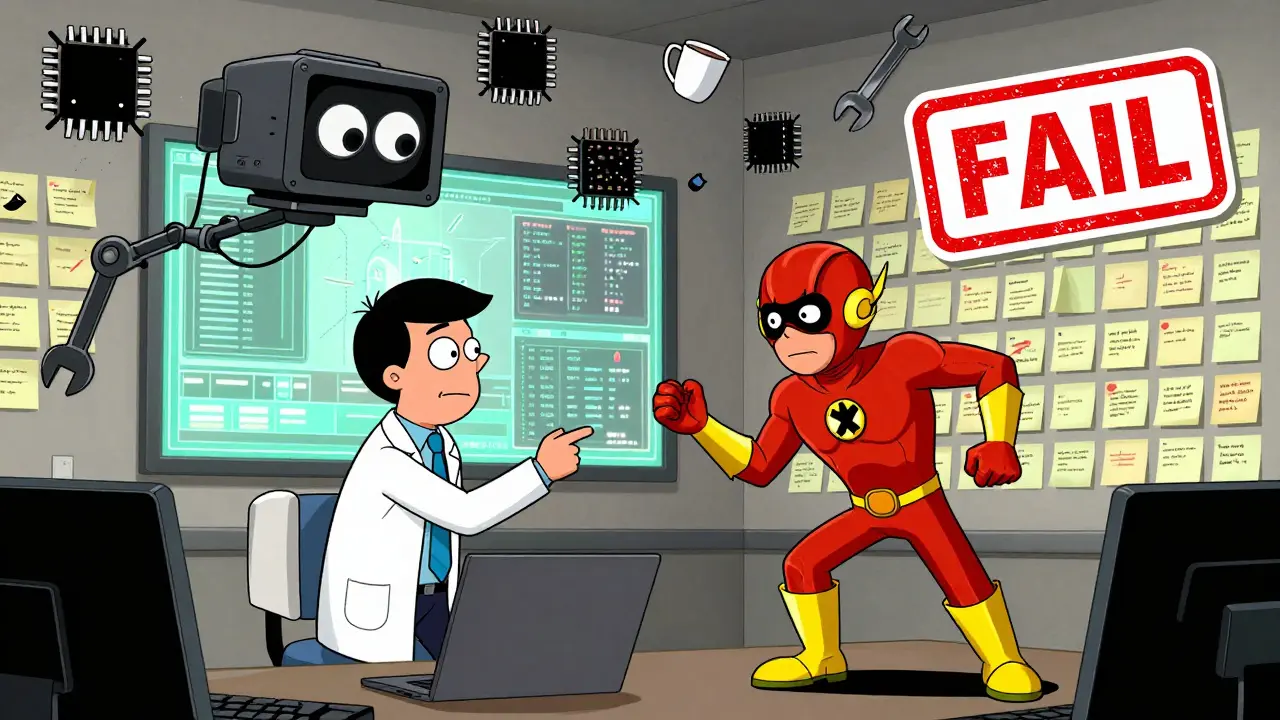
The Human Factor Nobody Wants to Talk About
Here’s the uncomfortable truth: technology can’t fix a culture of fear. On Reddit’s r/Manufacturing forum, 87% of workers said their biggest frustration is inconsistent data between departments. The quality team sees a defect. The production team says it’s fine. The engineering team says it’s a design flaw. No one talks. No one shares. And the product ships anyway. And training? It’s still an afterthought. A survey of 312 manufacturing pros showed 78% feel quality has gotten harder because of pressure to deliver faster. One production manager put it bluntly: “We’re expected to maintain aerospace-grade precision while moving at consumer electronics speed.” The companies thriving aren’t the ones with the most robots. They’re the ones that train their teams. They bring quality engineers into design meetings. They let shop-floor workers flag issues without fear. They treat suppliers like partners, not vendors. One manufacturer shared that by sharing forecasts and planning ahead with suppliers, they boosted supply chain resilience by 31%.What Happens If You Do Nothing?
Ignoring quality isn’t an option. It’s a countdown. Forrester predicts manufacturers who delay investing in predictive analytics will see 23% higher defect rates by 2027. That’s not a typo. It’s a projection. And it’s not just about recalls. It’s about reputation. One bad batch can kill a brand in a market where customers have endless choices. The cost of doing nothing? Higher operational costs-19% more on average, according to Forrester. More wasted materials. More overtime to fix mistakes. More time spent explaining to customers why their order is late. And eventually, fewer orders. Meanwhile, the global quality assurance tech market hit $14.7 billion in mid-2025. North America alone accounts for 38% of that. The money is flowing. The tools are here. The question isn’t whether you can afford to upgrade-it’s whether you can afford not to.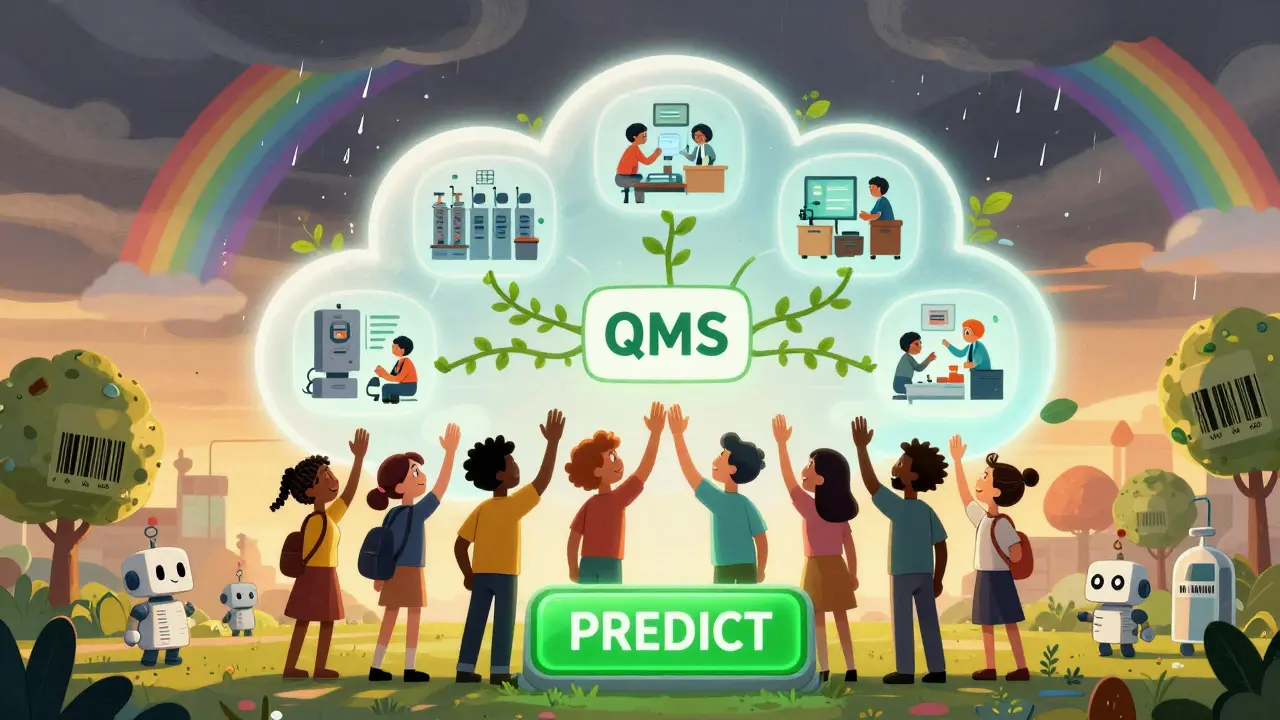
The Path Forward: Real Steps, Not Buzzwords
You don’t need to overhaul everything tomorrow. Start small. But start now.- Find one high-cost, high-error process. Maybe it’s inspecting a specific connector. Map out every step. Time it. Count the reworks. That’s your starting point.
- Bring together quality, production, and IT. Not just for a meeting. For a project. Make them own the outcome together.
- Pick one tool-maybe a cloud-based QMS or an AI inspection system-and pilot it. Don’t go big. Go deep. Measure the results. If it cuts rework by 15% in three months, scale it.
- Train your people. Not just how to use the tool. How to think with it. Data literacy is now a core skill. Salaries for QA pros with AI skills hit $98,500 in 2025-because they’re rare and valuable.
- Talk to your suppliers. Not just about price. About quality. Share your goals. Ask for their input. Build trust, not just contracts.
It’s Not About Perfection-It’s About Predictability
The goal isn’t to make zero defects. That’s impossible. The goal is to know when something’s going wrong before it happens. Predictive analytics can spot patterns-vibrations in a machine, temperature shifts, material inconsistencies-that signal a defect is coming. Early adopters are seeing 41% fewer customer-reported defects. That’s the shift. From reacting to predicting. From fearing mistakes to preventing them. Manufacturing in 2025 isn’t about bigger machines. It’s about smarter minds. Better connections. Stronger teams. And the courage to fix the system before it breaks.Why is quality assurance more stressful now than five years ago?
Because expectations have skyrocketed. Products are more complex-think electric vehicles with hundreds of sensors or tiny medical implants. Customers demand flawless performance, faster delivery, and lower prices. At the same time, labor shortages and supply chain disruptions make it harder to control variables. Quality is no longer a checkmark-it’s a make-or-break business function.
Can small manufacturers afford modern quality systems?
Yes, but not all at once. Cloud-based QMS platforms start under $500/month and scale with your needs. The key is starting with one high-impact area-like reducing rework on your most expensive part. A single saved defect can pay for the software. Many small manufacturers begin with AI-powered visual inspection tools that use off-the-shelf cameras and open-source software, cutting inspection time by half without huge upfront costs.
What’s the biggest mistake manufacturers make when upgrading quality systems?
Buying technology without changing how people work. A $2 million automated inspection system won’t help if your team doesn’t understand the data it produces. Or if the quality team and production team still use different software. The biggest failures happen when leadership thinks tech alone will fix culture. It won’t. Training, communication, and trust do.
How do I know if my quality system is working?
Look at three things: rework costs, time-to-market, and customer complaints. If rework costs are falling, you’re shipping faster, and customer complaints are dropping, your system is working. If one of those is going up, you’ve got a gap. Don’t rely on inspection pass rates-they’re backward-looking. Focus on outcomes, not activities.
Is AI really necessary for quality assurance in 2025?
Not for every shop, but it’s becoming essential for competitive ones. If you’re making complex products-electronics, EVs, medical devices-AI can detect defects humans miss, like microscopic cracks or alignment shifts. But if you’re making simple parts with low volume, manual inspection might still be fine. The question isn’t ‘Do I need AI?’ It’s ‘Am I losing money because I can’t catch defects fast enough?’ If the answer is yes, AI is worth exploring.
What’s the biggest risk if I don’t improve my quality processes?
You become irrelevant. Companies that treat quality as a cost center are seeing 19% higher operational costs and are more likely to lose contracts to competitors who can prove consistent quality. In industries like aerospace and medical devices, a single quality failure can get you banned from supply chains for years. Your reputation doesn’t recover easily. In 2025, quality isn’t just about the product-it’s about your license to operate.
This is why we’re all doomed. 😭 My cousin works at a medical device plant and they just got fined $4M because someone missed a tiny crack. They said it was ‘human error’ but honestly? The system’s broken. People are overworked, underpaid, and told to ‘just fix it later.’ No. Just no. 🚫
The data is clear: manufacturers that integrate quality into their digital workflows see measurable ROI. The 68% adoption rate of cloud-based QMS platforms reflects a structural shift-not a trend. Without interoperability between MES, ERP, and inspection systems, predictive analytics is just noise. The bottleneck isn’t technology-it’s data architecture.
Everyone talks about AI and sensors but no one admits the truth. The real problem is management. They want results without investing in people. You can’t automate trust. You can’t code culture. You can’t scan loyalty. The factory floor isn’t failing. The leadership is.
I mean… I get it. Everyone’s scared. But let’s be real. The ‘mission-critical’ language is just corporate fear-mongering dressed up as insight. I’ve seen plants with zero AI and perfect recall rates. It’s not about tech. It’s about whether the boss actually listens to the guy on the floor.
You think this is bad? Wait till you find out the sensors are being fed fake data by vendors to inflate their KPIs. I’ve seen it. The whole QA tech market is a Ponzi scheme. They sell you $200k systems that just tell you what you already know. The real defect? The system itself. And no one wants to talk about it.
I’ve worked in three different factories. One had a culture where workers were punished for reporting defects. Another had a ‘no-blame’ policy and saw defects drop 60% in six months. The difference? Psychological safety. Not software. Not AI. Just the courage to say, ‘Hey, this thing’s broken.’ That’s the only upgrade that matters.
The commodification of quality assurance is a tragic epistemological collapse. The epistemic rupture between operational pragmatism and strategic foresight has rendered traditional QA paradigms obsolete. One must deploy a holistic, ontology-driven, cloud-native QMS architecture predicated on real-time semantic interoperability to transcend the hermeneutic limitations of legacy systems. Otherwise, one is merely performing performative compliance.
AI is great... until you realize your $1.2M system can’t tell the difference between a scratch and a weld flaw because the training data was scraped from Reddit. 😅 We’re outsourcing judgment to algorithms built by interns. The real ROI? Not in defect reduction. It’s in how much we’ve outsourced our own competence.
In Australia we’ve got small shops using $300 Raspberry Pi cameras with open-source YOLO models to catch defects. No cloud. No vendor lock-in. Just a guy in the shed coding at night. Tech isn’t the barrier. Mindset is. You don’t need a $50k system. You need someone who cares enough to build something cheap that works.
I just want to say… I get why people are stressed. But maybe we’re all trying too hard to fix everything at once? What if we just started by having one honest conversation between QA and production? Like, really talk? Not a meeting. Just… talk?
This whole post is just corporate propaganda. The real reason quality is ‘more stressful’? Because CEOs want to pretend they’re innovating while cutting R&D budgets. They replaced engineers with dashboards. Now they’re surprised the machines are crying. 🎭
LET’S GOOOOO! 🚀 Quality isn’t a department-it’s a MOVEMENT. If you’re not integrating AI-driven predictive analytics with real-time supplier feedback loops and cross-functional agile QA pods, you’re not just behind-you’re already extinct. Stop tinkering. Start transforming. Your customers are waiting. And so is the $14.7B market. Let’s make it happen. 💪🔥