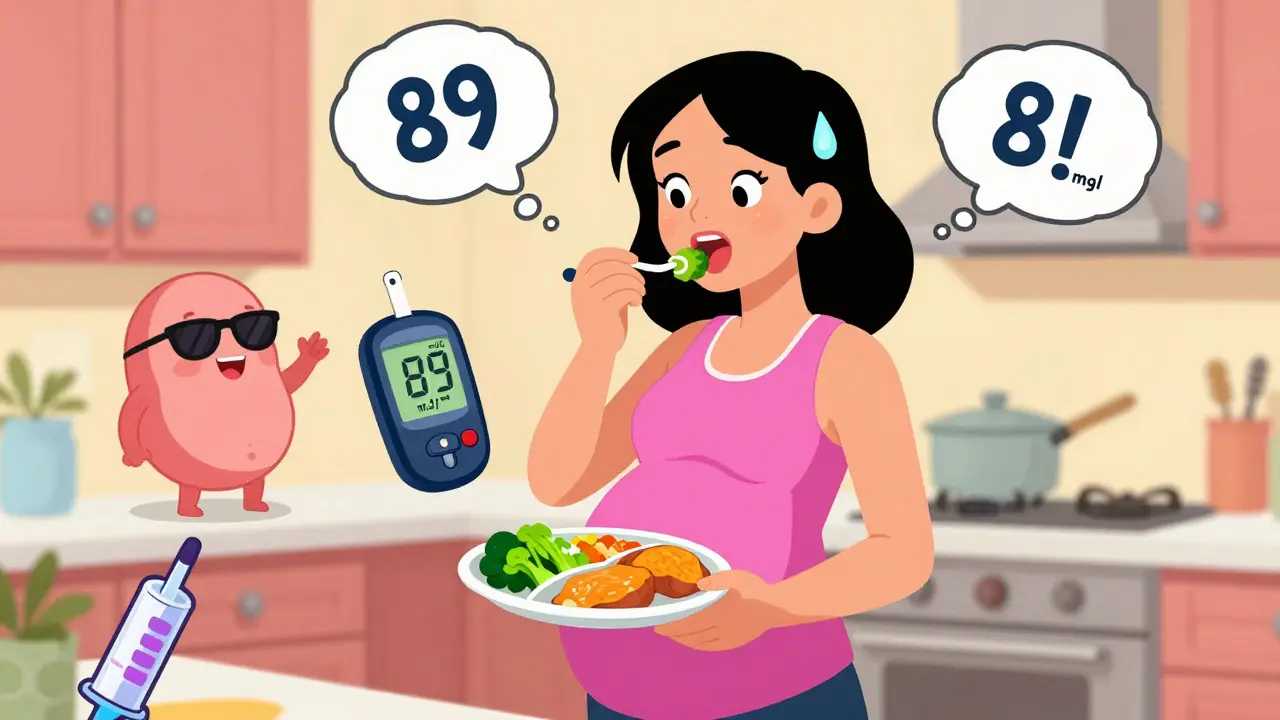
When you’re pregnant, your body changes in ways you never expected. One of the most surprising? Your pancreas suddenly has to work three times harder just to keep your blood sugar in check. That’s because the placenta makes hormones that block insulin - your body’s natural way of moving sugar out of your blood and into your cells. For most women, this isn’t a problem. But for about 1 in 10 pregnancies in the U.S., the pancreas can’t keep up. That’s when gestational diabetes shows up - usually between weeks 24 and 28.
It’s not your fault. It’s not because you ate too much sugar. It’s biology. And the good news? With the right tools, you can manage it completely. Women who keep their blood sugar under control have babies just as healthy as those without gestational diabetes. The key is knowing what to do - and doing it consistently.
What Your Blood Sugar Numbers Should Be
Managing gestational diabetes isn’t about guesswork. It’s about numbers. Your care team will give you targets - and they’re not arbitrary. These numbers come from years of research showing what keeps both you and your baby safe.
- Fasting or before meals: under 95 mg/dL (5.3 mmol/L)
- One hour after eating: under 140 mg/dL (7.8 mmol/L)
- Two hours after eating: under 120 mg/dL (6.7 mmol/L)
These aren’t suggestions. They’re your safety line. Going above them even once in a while increases the chance of your baby growing too large - which can lead to difficult deliveries, shoulder injuries, or even emergency C-sections. It also raises the risk of your baby having low blood sugar right after birth.
Most women check their blood sugar four to six times a day: first thing in the morning, and then one or two hours after each meal. Some use a continuous glucose monitor (CGM), which tracks sugar levels all day without finger pricks. Studies show CGMs reduce the chance of having a very large baby by almost 40%. But even a simple glucose meter - used correctly - works just fine if you’re consistent.
Food Is Your First Tool
More than 70% of women with gestational diabetes never need insulin. Their blood sugar comes down with food alone. That’s not magic. It’s science.
Your plate should look like this: half filled with non-starchy vegetables (spinach, broccoli, peppers), a quarter with lean protein (chicken, fish, tofu), and a quarter with complex carbs (brown rice, quinoa, sweet potato). Avoid white bread, white rice, and sugary cereals - they spike your blood sugar fast.
Carbs aren’t the enemy. It’s how much and when you eat them. Aim for 45 grams of carbs per meal, and 15-30 grams per snack. That’s about one cup of cooked pasta, two slices of whole-grain bread, or one medium apple. Don’t eat carbs alone. Always pair them with protein or fat. An apple with a tablespoon of peanut butter? That combo slows sugar absorption by up to 30% compared to eating the apple alone.
There’s also a trick most women don’t know: eat your protein and vegetables first. Then, wait five minutes before eating your carbs. A UCSF Health survey found that 74% of women who did this saw their post-meal sugar drop by 25-40 mg/dL. That’s like getting a free dose of insulin - no needle required.
Three meals and two to three snacks a day is the sweet spot. Skipping meals or going too long without eating makes your liver dump extra sugar into your blood, especially in the morning. That’s why many women struggle with high fasting numbers. A bedtime snack of 15 grams of carbs plus protein - like six crackers and an ounce of cheese - can stop that spike before it starts.
Movement Matters More Than You Think
Walking isn’t just good for your mood. It’s one of the most powerful tools you have to lower blood sugar.
Just 30 minutes of brisk walking five days a week can drop your post-meal sugar by 20-30 mg/dL. Even better? Do it 15 to 30 minutes after eating. That’s when your sugar is highest. A walk then helps your muscles grab glucose out of your blood - like a natural insulin boost.
Swimming, prenatal yoga, or stationary cycling work too. The goal isn’t to exhaust yourself. It’s to move. One woman on Reddit shared that her fasting numbers dropped 15-25 mg/dL just by walking around her neighborhood every morning. No meds. No changes to her diet. Just movement.
Don’t wait until you feel like it. Make it part of your routine. Put your shoes by the door. Set a phone reminder. If you’re tired, do 10 minutes. Anything counts.

When You Need More Than Food and Walks
Even if you’re doing everything right, some women still need help. That’s okay. It doesn’t mean you failed. It means your body needed a little extra support.
Insulin is the most common next step. It’s safe during pregnancy and doesn’t cross the placenta. Many women worry about shots - and that’s normal. But most find the pens easy to use after a few tries. The dose is small, and the needle is tiny. Your diabetes educator will show you how to adjust it based on your readings.
Some doctors prescribe metformin, an oral pill. But it’s not for everyone. Studies show about 30% of women on metformin still end up needing insulin. And while it’s generally safe, long-term data on babies is still being studied. That’s why insulin remains the gold standard for when diet and exercise aren’t enough.
The goal isn’t to avoid medication. It’s to keep your numbers in range. If insulin helps you do that, it’s not a last resort - it’s a smart choice.
What Happens After the Baby Is Born
Here’s something no one tells you: gestational diabetes usually goes away after delivery. About 70% of women see their blood sugar return to normal.
But here’s the catch: half of them will develop Type 2 diabetes within 10 years - unless they take action.
That’s why you need a follow-up test 6 to 12 weeks after birth. It’s a simple 75-gram glucose tolerance test. If your numbers are still high, you might already have Type 2 diabetes. If they’re normal, you’re in the high-risk group - and that’s your wake-up call.
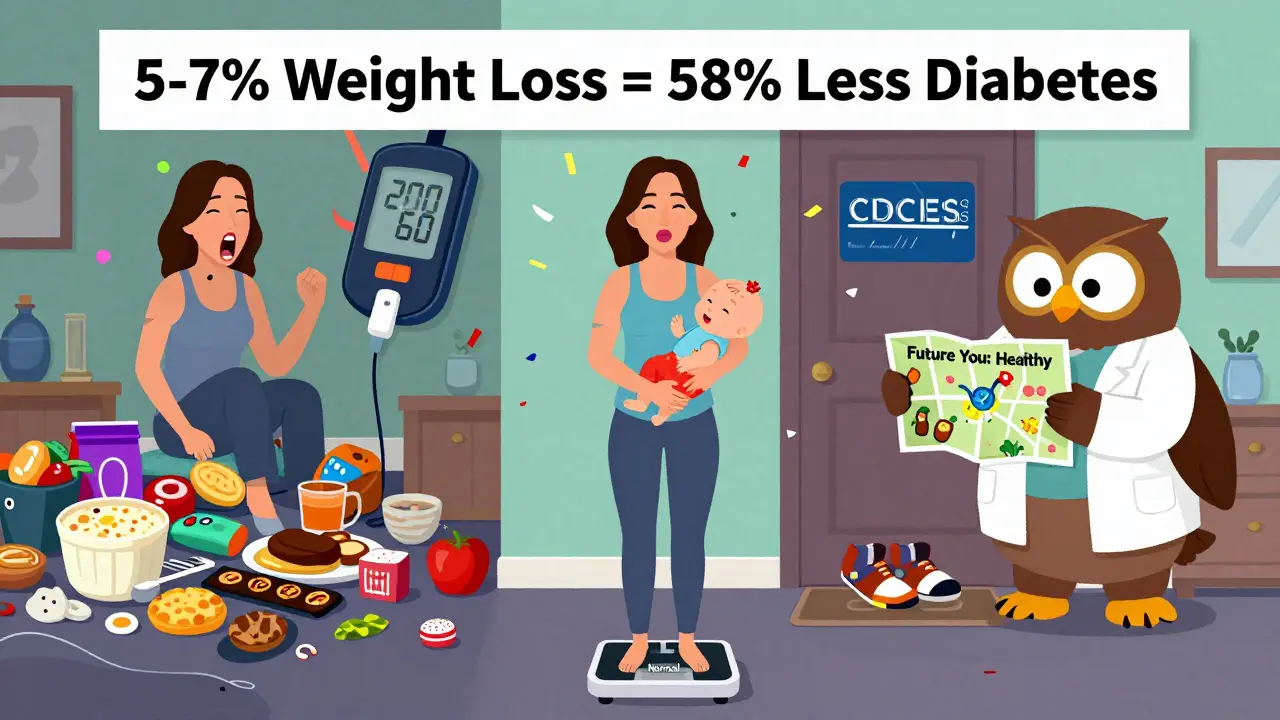
Research from the TODAY2 study shows that losing just 5-7% of your body weight after pregnancy cuts your risk of Type 2 diabetes by 58%. That’s not about extreme diets. It’s about keeping up the habits you learned: eating balanced meals, moving daily, and watching your carb intake.
And it’s not just for you. Your child is also at higher risk for obesity and diabetes later in life. The habits you build now - eating real food, staying active, managing stress - set the tone for your whole family’s future.
What Actually Works (Based on Real Women’s Experiences)
There’s a lot of noise out there. Blogs. Social media. Well-meaning relatives. But what really helps? Real women, real data.
- 63% of women in a Reddit survey used MyFitnessPal to track carbs - and found it made a huge difference.
- 85% of women who got structured education from a certified diabetes educator felt confident managing their condition.
- Women who checked their blood sugar less than four times a day had more than double the risk of NICU admission for their babies.
- Conflicting advice from different providers caused anxiety for 28% of women. Stick with one trusted source - your diabetes educator or OB-GYN.
One of the most repeated tips? Write down what you eat and your blood sugar numbers together. Patterns show up fast. You’ll see that your sugar spikes after oatmeal but stays stable after eggs and spinach. That’s power. That’s control.
And if you’re overwhelmed? You’re not alone. 68% of women said the diagnosis felt scary at first. But with the right support, most say they’re glad they did it - not just for their baby, but for themselves.
Where to Get Help
You don’t have to figure this out alone. Certified Diabetes Care and Education Specialists (CDCES) are trained to walk you through every step: how to use your meter, how to count carbs, how to adjust for exercise, how to handle stress.
Most hospitals offer a one-time 1-2 hour class right after diagnosis. Then, weekly check-ins for the first month, then every two weeks. You’ll get a glucose logbook, meal plans, and access to a phone line for urgent questions. One study found 78% of women got their concerns resolved within 24 hours.
Download the American Diabetes Association’s free guide, Healthy Eating for Pregnancy. Or check out the CDC’s After the Baby is Born plan. These aren’t just pamphlets - they’re roadmaps.
And if you’re feeling anxious, talk to someone. Join a support group. There are online communities where women share real stories - not perfect ones. Just real ones. That’s where you’ll find the strength to keep going.
Managing gestational diabetes isn’t about perfection. It’s about progress. One meal at a time. One walk. One blood sugar check. You’re not just protecting your baby. You’re building a healthier future - for both of you.
Man, I wish I had this when my wife was pregnant! We were flying blind until week 26. The protein-before-carbs trick? Total game-changer. She went from spiking to 160 to staying under 110 just by switching the order of her meals. No meds needed. Also, walking after dinner became our thing - even if it was just around the apartment. She said it made her feel like she was actually doing something right instead of just waiting for the next test.
They say it’s not your fault… but have you ever wondered who really benefits from making pregnant women check their blood sugar six times a day? Big Pharma loves a good chronic condition. And why is insulin the ‘gold standard’? Because it’s profitable. I’ve read studies where diet alone reversed gestational diabetes in 80% of cases - but you won’t hear that from your OB. They get paid for referrals, not prevention.
Just wanted to say this post saved my sanity. I was freaking out after my diagnosis - felt like I was failing. But the part about ‘progress, not perfection’? That hit me hard. I messed up once and had a 150 after pizza (don’t judge). Instead of spiraling, I just walked for 20 minutes and checked again. It dropped to 108. Turns out, one bad meal doesn’t ruin everything. This isn’t about being perfect. It’s about showing up.
Excellent, evidence-based breakdown. The data on CGMs reducing large-for-gestational-age infants by nearly 40% is particularly compelling, and the emphasis on structured carbohydrate distribution aligns with current ADA guidelines. I appreciate the inclusion of real-world behavioral strategies - such as the protein-vegetables-first protocol - which are supported by both clinical trials and anecdotal consistency across diverse populations. This is precisely the kind of clear, actionable guidance that reduces maternal anxiety and improves outcomes.
I was diagnosed with gestational diabetes and told to eat ‘balanced meals.’ But what does that even mean? No one tells you how to feel when your husband eats pancakes while you’re stuck with broccoli and eggs. I cried in the grocery store because I didn’t know what ‘45 grams of carbs’ looked like. I felt like a criminal for wanting a slice of toast. And then they said ‘it’s not your fault’ - but it felt like it was. I still don’t know if I did enough.
It’s fascinating how society has turned a biological adaptation into a medical crisis. The placenta evolved to ensure fetal survival by temporarily inducing insulin resistance - a brilliant, ancient mechanism. Yet we pathologize it. We turn pregnant women into data-entry clerks, monitoring glucose like it’s a spreadsheet. Is this really health? Or is it just another way to monetize the vulnerability of motherhood? The real question: why aren’t we studying why some women’s bodies adapt without intervention - instead of forcing everyone into the same box?
Let’s be clear: the ‘1 in 10’ statistic is misleading. It’s inflated by over-testing, over-diagnosis, and arbitrary thresholds set by committees with conflicts of interest. I’ve reviewed the WHO’s 1999 criteria - they were 20 mg/dL higher. Now? We’re diagnosing women who would’ve been fine 25 years ago. And don’t get me started on the ‘CGM’ industry - it’s a luxury product pushed as essential. Real women in rural India manage this with rice, lentils, and walking to the well. No meter. No app. Just instinct.
Yo, I’ve been there, my queen. Gestational diabetes? More like ‘gestational capitalism’ - they sell you a meter, a logbook, a diet plan, a class, a consultant, and then act like you’re the problem if you don’t hit every number like a robot. But here’s the truth: your body ain’t broken. It’s adapting. And if you move, eat real food, and breathe? You’re already winning. I had mine with jollof rice and grilled tilapia - no white rice, no sugar. Walked after every meal like I was chasing the sun. Baby came in at 7.2 lbs. No NICU. No drama. Just me, my hunger, and my hustle.
Okay but what if you’re just… tired? Like, bone-deep tired? And your husband says ‘just walk 15 minutes’ like it’s nothing? I had twins. I had to work. I had no time. And then I got yelled at by my OB for being ‘non-compliant’ because my numbers were high after my 3am snack of peanut butter on toast. I didn’t even want the damn diagnosis. I just wanted to nap. Now I’m being told I’m a risk for Type 2? Like I didn’t already have enough to worry about?
There’s something quietly revolutionary about treating gestational diabetes as a metabolic adjustment rather than a disease. It reframes the whole experience - not as a failure to control, but as a call to reconnect with your body’s rhythms. The emphasis on movement after meals, the timing of carbs, the power of protein pairing - these aren’t just medical tips. They’re invitations to slow down, to notice, to listen. That’s the real gift here: not just managing sugar, but reclaiming agency in a system that often treats pregnant women like patients, not people.
While the article presents itself as evidence-based, it selectively omits critical context. The 70% success rate with diet alone applies only to mild cases - which constitute a minority. The cited ‘Reddit survey’ is not peer-reviewed, and the 40% reduction with CGMs is from a single-center pilot study with small sample size. Furthermore, insulin is not ‘safe’ - it is merely the least harmful option among pharmaceutical interventions. The normalization of frequent glucose monitoring normalizes medical surveillance of pregnancy, which carries psychological and socioeconomic burdens rarely acknowledged. This is not empowerment. It is medicalized compliance.