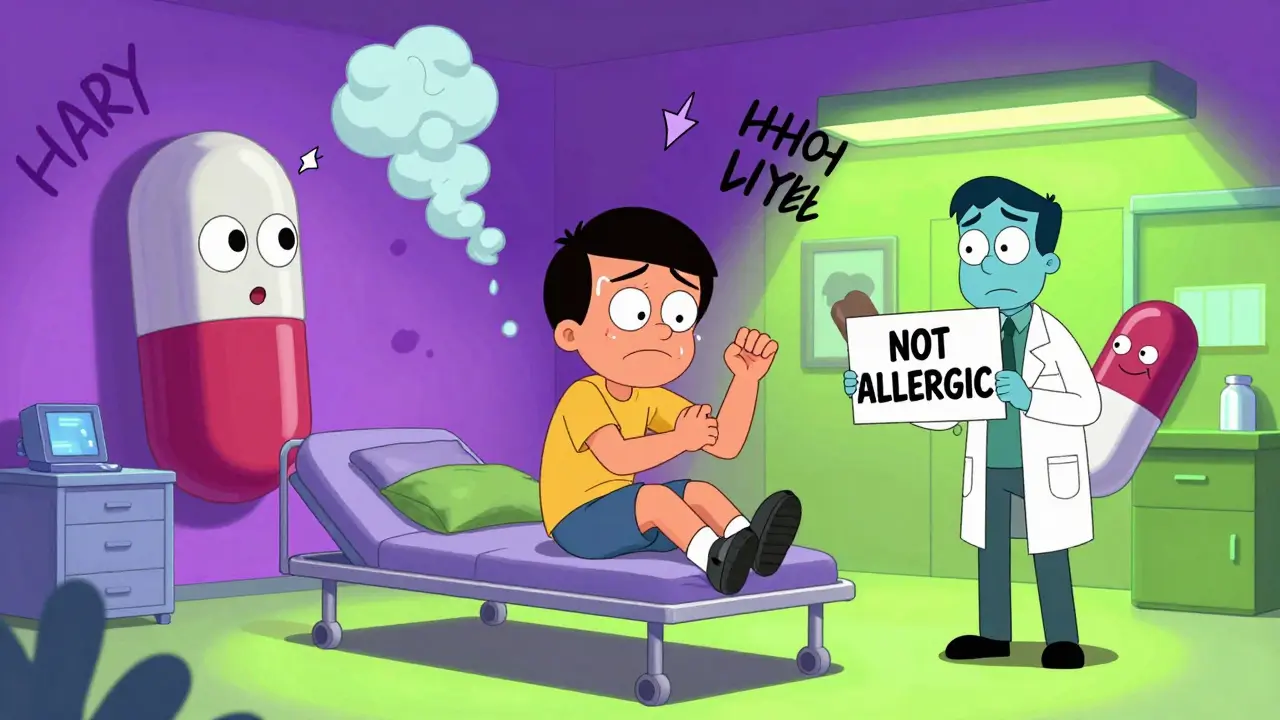
When someone gets itchy after taking an opioid like morphine, it’s easy to assume they’re having an allergic reaction. But here’s the truth: itching is rarely a true allergy. In fact, most people who say they’re allergic to opioids aren’t allergic at all. They’re experiencing a common side effect that looks like an allergy but works completely differently. This misunderstanding leads to unnecessary pain, higher costs, and fewer treatment options - all because the symptoms were mislabeled.
Itching Isn’t an Allergy - Here’s Why
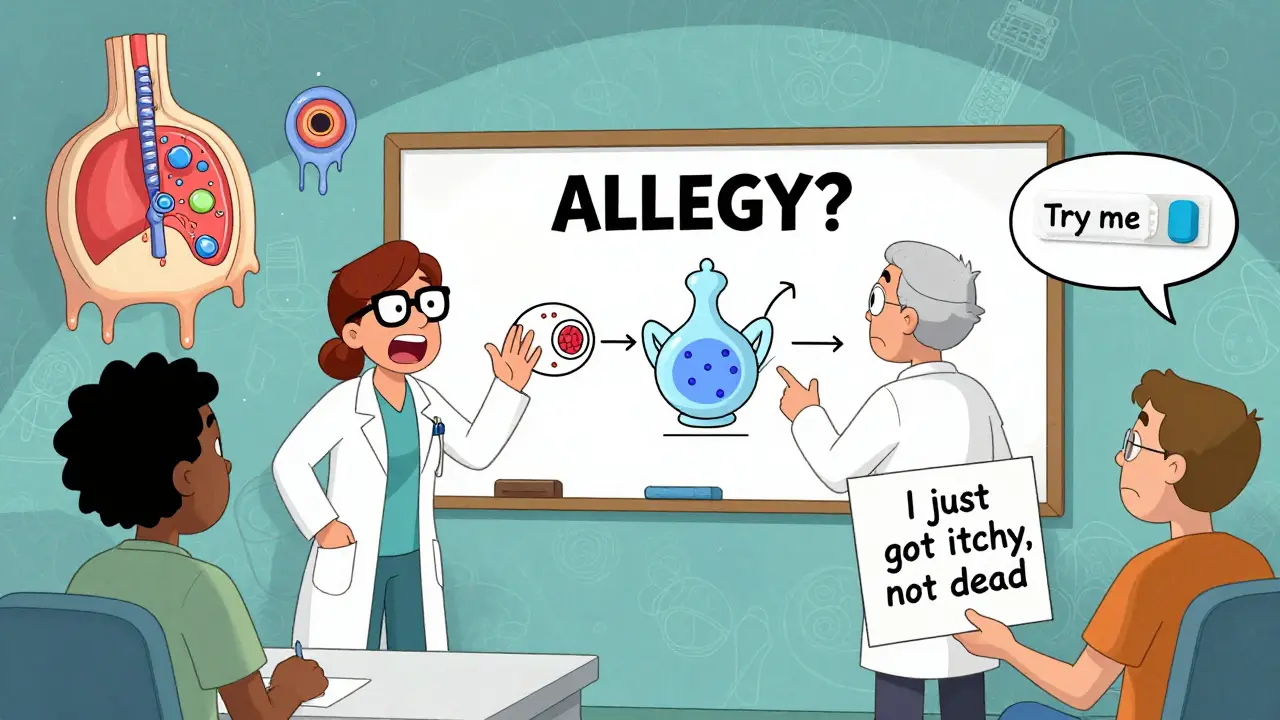
Opioid-induced itching is one of the most frequent complaints after pain relief. Up to 68% of people taking oxycodone report it. But if you dig deeper, you’ll find that less than 1% of these cases are true allergies. Most of the time, it’s a pseudoallergic reaction - meaning your body reacts without involving your immune system. Instead, the opioid directly triggers mast cells in your skin to dump histamine. Think of it like pressing a button that releases itch signals, not like your body fighting off a threat.
This isn’t new science. Back in the 1980s, researchers figured out that morphine and codeine cause histamine release by binding to receptors on mast cells. Later studies showed that itching even happens when histamine is blocked, proving there’s another pathway. In 2007, scientists at Washington University discovered that opioid-induced itching works through gastrin-releasing peptide receptors (GRPR) in the spinal cord. That’s why antihistamines like Benadryl don’t always work - they’re targeting the wrong mechanism.
True Allergy vs. Pseudoallergy: What’s the Difference?
True opioid allergies are rare. They affect only 0.1% to 0.3% of people who take opioids. These reactions involve your immune system recognizing the drug as dangerous, leading to IgE or T-cell activation. Symptoms include hives, swelling of the face or throat, trouble breathing, low blood pressure, or a widespread rash. These can show up within minutes and get worse fast. If you’ve ever passed out or needed epinephrine after an opioid, that’s likely a true allergy.
Pseudoallergic reactions, on the other hand, are more like side effects. They include:
- Itching (most common)
- Flushing or warmth in the face
- Sneezing
- Mild drop in blood pressure
- Sweating
- Worsening of asthma symptoms
These usually happen within 30 minutes to an hour after the dose. And here’s the key: they get worse with higher doses or faster IV pushes. Slow down the infusion, and the itching often disappears. That’s a big clue it’s not an allergy - true allergies don’t care about dose speed.
Not All Opioids Are Created Equal
Some opioids are way more likely to cause itching than others. Morphine? High risk. Fentanyl? Low risk. Why? It comes down to chemistry.
Morphine and codeine have a specific molecular shape that easily triggers mast cells. Studies show morphine releases 3 to 4 times more histamine than an equal pain-relieving dose of hydromorphone. Fentanyl and methadone? Their structure doesn’t trigger mast cells nearly as much. That’s why fentanyl patches or methadone are often used for patients who say they’re allergic to morphine.
Here’s a quick comparison:
| Opioid | Histamine Release Risk | Typical Itching Rate |
|---|---|---|
| Morphine | Very High | 30-40% |
| Codeine | High | 25-35% |
| Oxycodone | Medium | 15-25% |
| Hydromorphone | Low | 5-10% |
| Fentanyl | Very Low | 2-8% |
| Methadone | Very Low | 5-10% |
Switching from morphine to fentanyl or methadone cuts itching by more than half. That’s not a coincidence - it’s science.
What to Do When You Get Itchy
If you’re itching after an opioid, don’t panic. Don’t automatically say you’re allergic. Talk to your provider. Here’s what works:
- Reduce the dose by 25-50%. Often, the itching fades with less drug.
- Slow down the IV drip if it’s being given intravenously. Rapid delivery spikes histamine release.
- Take an H1 antihistamine like diphenhydramine (Benadryl) 25-50 mg 30 minutes before the next dose. It helps about 80% of the time.
- Switch opioids. Try fentanyl, hydromorphone, or methadone. They’re much less likely to cause itching.
- Ask about nalfurafine. This newer drug (approved in Japan, in U.S. trials) blocks itch pathways without reducing pain relief. It’s not widely available yet, but it’s coming.
For cancer patients or those in palliative care, studies show that 78% of people labeled "opioid allergic" can safely switch to another opioid with just antihistamine premedication. Only 5% actually had true allergies.
When You Really Are Allergic
True opioid allergies are dangerous. If you’ve had:
- Swelling of the tongue or throat
- Wheezing or trouble breathing
- Low blood pressure with dizziness or fainting
- A rash with blisters or peeling skin
- then you need to avoid that opioid and possibly others in the same class. Morphine, oxycodone, and hydrocodone are all phenanthrenes and can cross-react. But fentanyl and methadone? They’re structurally different and rarely cause cross-reactions. Only 5% of people allergic to morphine react to fentanyl.
Desensitization is possible if you absolutely need the drug. A 12-step IV protocol over 4-6 hours has a 95% success rate. But this should only be done in a hospital with emergency equipment on hand.
Why This Matters
Every year, doctors write 200 million opioid prescriptions in the U.S. About 10-15% of patients say they’re allergic. That’s 20 to 30 million people who may be avoiding effective pain relief because they were mislabeled.
The cost? About $1,200 extra per person because they’re put on more expensive or less effective drugs. Multiply that across millions - that’s $24 to $36 billion wasted annually. And for patients? It means more pain, longer hospital stays, and worse quality of life.
Electronic health records now have alerts to flag true allergies versus side effects. Hospitals using these tools saw a 45% drop in wrong allergy labels. But the biggest fix? Education. Patients need to know: itching isn’t an allergy. Nausea isn’t an allergy. Dizziness isn’t an allergy. Only swelling, breathing trouble, and collapse are.
What Patients Should Remember
If you’ve been told you’re allergic to opioids:
- Write down exactly what happened. Was it just itching? Or did you swell up?
- Did it happen every time? Or only with high doses or fast IV pushes?
- Did antihistamines help?
- Have you tried another opioid? If not, ask your doctor.
Don’t let a label keep you from pain relief. Most people can safely take a different opioid - even if they got itchy on morphine. Fentanyl patches, methadone, or hydromorphone might be the answer. And if you’re in pain, you deserve to find it.
Is itching from opioids a sign of an allergy?
No, itching is almost never a true allergy. It’s a pseudoallergic reaction caused by histamine release from mast cells. True allergies involve immune system activation and include symptoms like swelling, trouble breathing, or low blood pressure.
Can I still take opioids if I get itchy?
Yes. Most people who get itchy on morphine can safely switch to fentanyl, methadone, or hydromorphone. Lowering the dose and taking an antihistamine like diphenhydramine before the dose often stops the itching completely.
Why does morphine cause more itching than fentanyl?
Morphine has a chemical structure that strongly triggers mast cells to release histamine. Fentanyl’s structure doesn’t activate mast cells nearly as much. Studies show morphine releases 3-4 times more histamine than an equal pain-relieving dose of fentanyl.
Should I get tested for opioid allergies?
Routine skin testing isn’t recommended unless you had a life-threatening reaction like anaphylaxis. Skin tests for opioids have high false-positive rates - up to 30% - and can mislead you into avoiding safe drugs. A supervised trial with a different opioid is safer and more accurate.
What’s the safest opioid if I’m allergic to morphine?
Fentanyl and methadone are the best alternatives. Both have very low rates of histamine release and rarely cross-react with morphine. Hydromorphone is also a good option. Avoid codeine and oxycodone if you reacted badly to morphine, since they’re in the same chemical family.
man i thought i was allergic to morphine til i read this. i got so itchy after my surgery they made me switch to fentanyl and i was like 'finally no more scratchy pain' but turns out i just needed to chill on the dose and take benadryl first. now i'm like 'why did everyone make such a big deal?'
so let me get this straight-people are avoiding life-changing pain meds because they got a little itchy like they're allergic to a mosquito bite? lol. we're out here treating histamine like it's a cult leader. 'NOOOO I CAN'T TAKE OPIOIDS, I GOT A TINGLE!' bro, you're not allergic, you're just vibin' too hard.
It is an alarming and deeply concerning development that the medical community has permitted the conflation of physiological side effects with genuine immunological hypersensitivity. This is not merely a clinical error-it is a systemic failure of diagnostic rigor, one that undermines the very integrity of pharmacological science. The casual dismissal of patient-reported reactions as 'pseudoallergic' is not only scientifically unsound but also ethically reckless. We must restore discipline to nomenclature and enforce precise terminology in all medical documentation.
Interesting. I had no idea morphine was that much worse than fentanyl for itching. My grandma got itchy after her hip surgery and they switched her to hydromorphone-she didn't even notice the difference in pain relief. I guess I always assumed it was just 'how opioids work.'
Yeah but like... what if it's not just itching? What if it's also nausea? Or dizziness? Are those not allergies too? This article feels like it's oversimplifying. Like, maybe people are just sensitive. Not everything has to be a binary.
Bro, I work in hospice. We had a guy who swore he was 'allergic to all opioids' because he got itchy on morphine 10 years ago. We tried methadone with a little Benadryl-he cried. Not from pain. From relief. Said he hadn't slept through the night in 3 years. That's the real story here. Labels don't cure pain. Science does. And sometimes, all it takes is one switch.
Also, nalfurafine? I heard it's a game-changer. Wish we had it stateside. My patients deserve better than 'try this other drug and hope.'
While the article presents a reductive binary between pseudoallergic and true allergic reactions, it fails to account for the epistemic heterogeneity of somatic phenomenology. The histaminergic hypothesis, while empirically supported, is ontologically insufficient. One must interrogate the neuro-immuno-endocrine axis, particularly the role of mu-opioid receptor polymorphisms in non-IgE-mediated mast cell degranulation. Furthermore, the omission of epigenetic modifiers-such as urban air pollution's effect on basophil reactivity-represents a critical lacuna in translational clinical reasoning.
Y'all act like itching is some minor inconvenience. Nah. I got so itchy on morphine I scratched my arm raw. Felt like ants were crawling under my skin for 8 hours. They told me to 'tough it out' like it was a sunburn. Then I tried fentanyl patch? Zero itch. Zero drama. Just pain gone. Why the hell are we still making people suffer because someone in 1998 called it 'allergy' on their chart? That's not science. That's paperwork.
Just a quick note: if you're allergic to morphine and your doctor says 'just take fentanyl,' make sure they know you're not allergic to *all* opioids. Some of us have been told we're allergic to 'all opioids' and it's not true. There are options. Talk to your pain team. You don't have to live in pain.