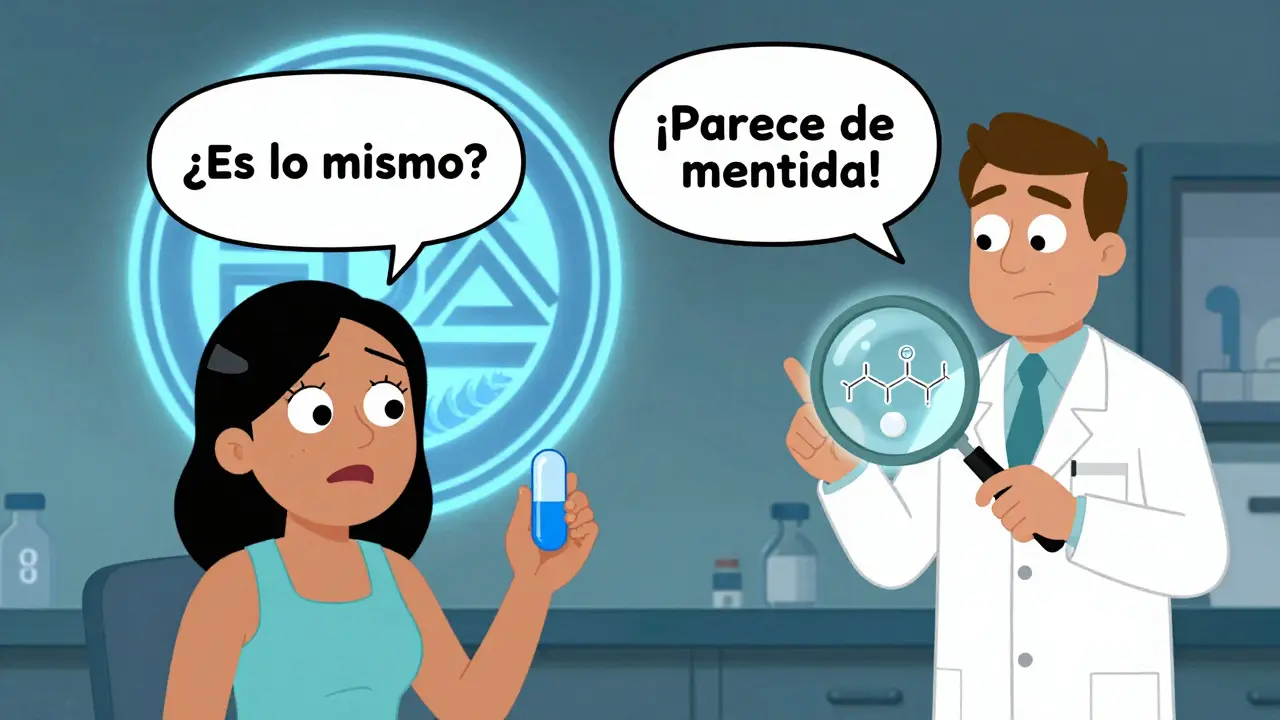
Many Spanish-speaking patients in the U.S. are told they can switch to a cheaper version of their medicine - but they don’t know what that means. They see a pill that looks different - maybe smaller, or a different color - and wonder if it’s still the same drug. This confusion isn’t just about appearance. It’s about trust. And it’s why generic medications remain misunderstood, even when they’re safe, effective, and save patients hundreds of dollars a year.
What Exactly Is a Generic Medication?
In Spanish, a generic medication is called el medicamento genérico. It contains the exact same active ingredient as the brand-name version. The FDA requires it to work the same way in the body, at the same strength, and with the same safety profile. The only differences? The shape, color, flavor, or inactive ingredients - things that don’t affect how the medicine works.
For example, the brand-name drug Lipitor becomes atorvastatin. Advil becomes ibuprofen. Tylenol becomes acetaminofén (or paracetamol, depending on where you’re from). These aren’t copies. They’re legally required to be identical in effect. But many patients don’t know this. A 2023 survey by the California Health Care Foundation found that 63% of Spanish-speaking patients still worry generics are weaker than brand names - even though 90% of prescriptions in the U.S. are filled with generics.
Why Do People Fear Generic Medications?
It’s not just about language. It’s about perception. In many cultures, a more expensive medicine feels more powerful. A bright blue pill might seem like “real medicine.” A plain white one feels like a substitute. That’s why the most common complaint among Spanish-speaking patients isn’t cost - it’s appearance.
A patient might say: “Esta medicina tiene una apariencia diferente, pero es lo mismo.” (This medicine looks different, but it is the same.) But if no one explains that, they stop taking it. A Medscape report in 2023 documented a case where a patient stopped taking a life-saving blood thinner after switching to a generic because the pill looked different. No one told them that generic manufacturers change the look every time they make a new batch.
Another issue? Regional differences. In Spain, acetaminophen is called paracetamol. In Mexico, Colombia, and most of Latin America, it’s acetaminofén. The same drug. Different names. If a patient moves between regions - or sees doctors in different clinics - they might think they’re getting two different medicines. That confusion leads to missed doses or double-dosing.
Where Can Spanish Speakers Find Reliable Information?
Several trusted resources exist - but not all are easy to find or use. Here are the most reliable ones:
- My Medicines List (AHRQ): Available in Spanish since 2023, this free tool helps patients track both brand and generic names, dosage, and why they’re taking each drug. It’s used in clinics across the U.S. and scored 4.7 out of 5 in patient clarity tests.
- MedlinePlus.gov (Spanish): Offers bilingual PDFs comparing brand and generic names. Updated quarterly, it includes side effects, interactions, and storage tips.
- Wake AHEC Pharmacy Translation Card: Designed for healthcare workers, this card includes 15 common phrases to explain generics to patients. Example: “El medicamento genérico es igual de efectivo y cuesta menos.” (The generic medicine is just as effective and costs less.)
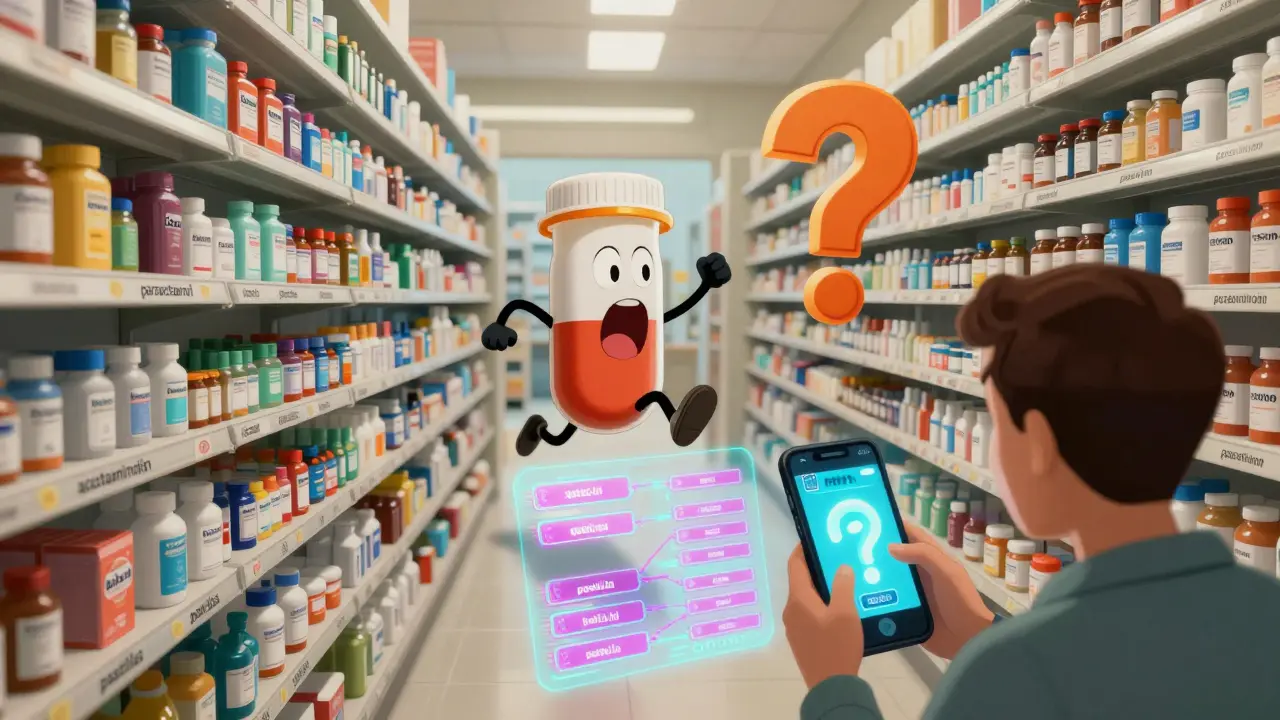
- Medicamento Genérico App (NIH): Launched in September 2023, this free app lets users scan a pill, compare it to brand versions, see cost savings, and hear audio pronunciations. It’s been downloaded over 147,000 times.
- Spanish Academy Pharmacy Vocabulary Guide: Lists 27 key terms like medicamentos de venta libre (over-the-counter), receta médica (prescription), and efectos secundarios (side effects). Updated monthly.
These tools aren’t perfect. Some don’t explain bioequivalence. Others don’t show images. But they’re the best available.
How Healthcare Providers Can Help
Pharmacists and doctors play the biggest role in reducing confusion. Training matters. Wake AHEC’s 2022 guide says providers need 10-15 hours of training to use translation tools effectively. But even small changes make a difference:
- Always say both names: “This is the generic version of Lipitor. Its name is atorvastatin.”
- Show pictures. A University of Miami study found visual aids reduce confusion by 37%.
- Use audio clips. Kaiser Permanente’s portal plays pronunciation guides for drug names like atorvastatina - helping patients say them correctly at the pharmacy.
- Ask: “¿Tiene la versión genérica de esa medicina? La original es muy cara.” (Do you have the generic version of that medicine? The original is too expensive.)
One nurse on Reddit shared: “I’ve had patients refuse generics because they thought different color pills meant different medicine. We need better visual resources.” That’s exactly what the NIH app now provides.
What’s Missing From Most Resources?
Despite progress, big gaps remain:
- Only 28% of community health centers have resources that specifically explain generic equivalence.
- Most materials use “neutral Spanish,” which avoids regional words - but that doesn’t help someone from Puerto Rico who hears pastillas and thinks it means birth control.
- Very few explain how the FDA tests generics for safety. Patients don’t know that generics must match brand drugs within 98-102% of active ingredient absorption.
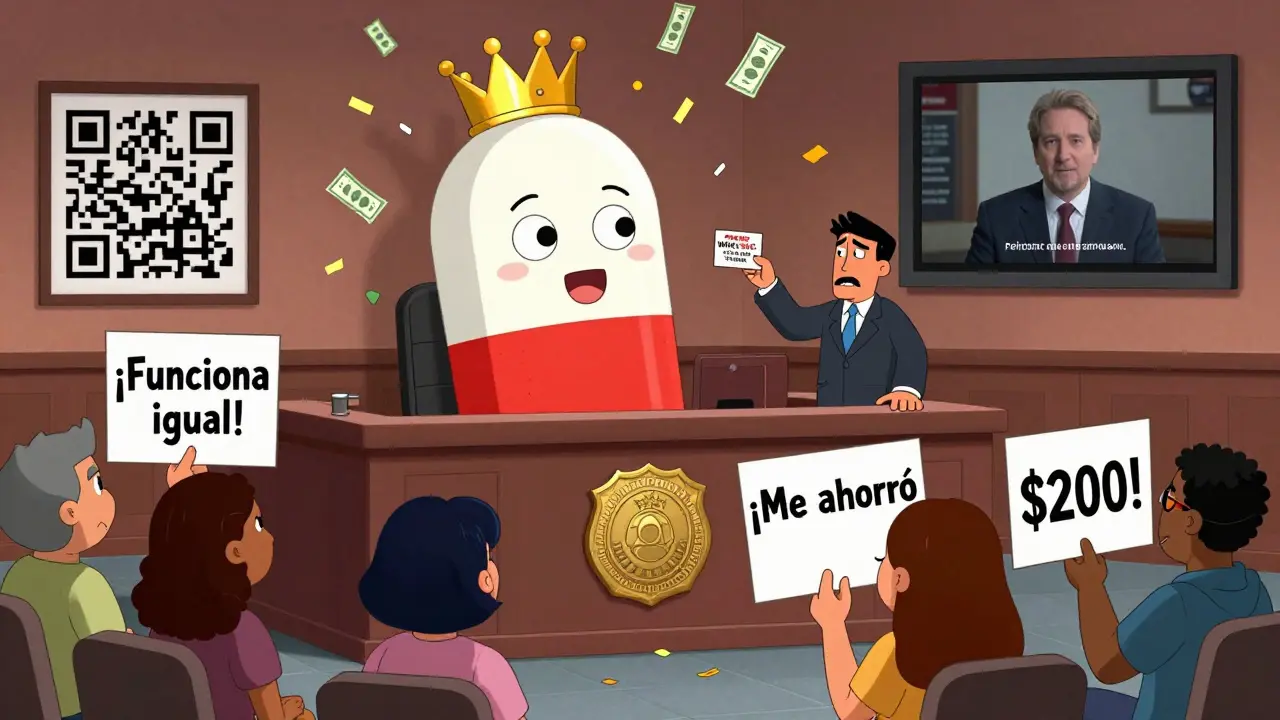
- Cost savings aren’t always clear. A patient might save $200 a month - but if they don’t understand why, they might think they’re getting “less medicine.”
Dr. Maria Hernandez from Harvard Medical School says bilingual resources have cut medication errors by 23% since 2015. But generic confusion remains one of the top three reasons patients stop taking their meds.
What’s Changing in 2025?
Technology is closing the gap. In early 2024, MedlinePlus added side-by-side images of brand and generic pills. AHRQ’s My Medicines List now includes QR codes that link to short videos explaining generics in Mexican, Puerto Rican, and Colombian Spanish dialects.
Epic Systems, the biggest electronic health record company, is testing AI tools that automatically generate personalized Spanish explanations based on where a patient was born. If someone’s from El Salvador, they get terms used there. If they’re from Miami, they get terms common in Florida.
And the demand is growing. The U.S. Hispanic population is now over 62 million - and will reach 111 million by 2060. Generic medications make up 90% of prescriptions but only 22% of drug spending. That means millions are overpaying - not because they don’t want to save money, but because they don’t know how.
What You Can Do Today
If you’re a Spanish-speaking patient:
- Ask your pharmacist: “¿Es esta la versión genérica?” (Is this the generic version?)
- Use the NIH Medicamento Genérico app to compare pills.
- Write down both the brand and generic name on your My Medicines List.
- Don’t stop a medicine just because the pill looks different.
If you’re a caregiver, nurse, or provider:
- Keep a printed copy of the Wake AHEC translation card in your clinic.
- Print and hand out the AHRQ My Medicines List in Spanish.
- Use the NIH app during visits to show patients what the same drug looks like in different forms.
- Never assume they understand - ask them to repeat back what they heard.
Generic medications aren’t second-rate. They’re science-backed, cost-effective, and approved by the same agency that approves brand names. The problem isn’t the medicine. It’s the message. And with the right tools, that message can change - one pill, one conversation, at a time.
Are generic medications safe?
Yes. The U.S. Food and Drug Administration (FDA) requires generic medications to have the same active ingredient, strength, dosage form, and route of administration as the brand-name version. They must also meet the same strict standards for purity, stability, and how quickly they’re absorbed into the body. Generics are tested in the same labs and follow the same rules as brand-name drugs.
Why do generic pills look different?
By law, generic medications can’t look exactly like the brand-name version - so they use different colors, shapes, or markings. But those changes are only in the inactive ingredients, like dyes or fillers. They don’t affect how the medicine works. The active ingredient - the part that treats your condition - is identical.
Is there a difference between generic medications from different companies?
All FDA-approved generics must meet the same effectiveness and safety standards. However, different manufacturers may use slightly different inactive ingredients, which can cause minor differences in how quickly the drug is absorbed. These differences are tiny - usually less than 4% - and not clinically significant. If you switch between generic brands and notice side effects, talk to your doctor or pharmacist.
What if I don’t understand the Spanish words on my prescription?
Ask your pharmacist to explain it. Many pharmacies have bilingual staff or access to translation services. You can also use the NIH Medicamento Genérico app to scan your pill and see its generic name, brand name, and pronunciation. Don’t guess - get help. Misunderstanding your medicine can be dangerous.
Why do some clinics use different Spanish words for the same medicine?
Spanish varies by region. In Spain, acetaminophen is called paracetamol. In Mexico and most of Latin America, it’s acetaminofén. The same drug. Different names. That’s why resources like the NIH app now include regional variations. Always confirm the active ingredient - not just the name - when switching clinics or pharmacies.
Can I trust generic medications for chronic conditions like high blood pressure or diabetes?
Absolutely. Generics are used daily for life-threatening conditions like heart disease, diabetes, epilepsy, and HIV. Studies show they work just as well as brand-name drugs. In fact, most doctors prescribe generics for chronic conditions because they’re reliable and affordable. If your doctor prescribed a generic, it’s because it’s the right choice for you.
How much money can I save with generic medications?
On average, generics cost 80-85% less than brand-name drugs. For example, a 30-day supply of brand-name Lipitor might cost $300. The generic version, atorvastatin, often costs under $15. One patient reported saving $200 a month after switching to generics - that’s $2,400 a year. Those savings add up, especially for people on fixed incomes.
Are there any generic medications that aren’t safe?
All FDA-approved generics are safe. But unregulated products sold online or from unlicensed vendors may be counterfeit. Only get medications from licensed pharmacies - whether in person or online. If a price seems too good to be true, it probably is. Always check the pharmacy’s license and avoid websites that don’t require a prescription.
Wait… so the FDA just lets ANY company slap a label on a white pill and call it ‘atorvastatin’?!!
Who’s really controlling the supply chain?!!
I’ve seen pills that look like they were made in a garage with food coloring and glitter-now you’re telling me it’s ‘bioequivalent’??
Where’s the audit trail?? Who’s verifying the fillers??
What if the ‘inactive ingredients’ are actually neurotoxins disguised as ‘stabilizers’??
I’ve got a cousin in Arizona who stopped taking his blood pressure med after the generic turned purple-he said it ‘felt wrong’… and he was RIGHT.
They’re not testing absorption-they’re testing paperwork.
And don’t get me started on the app… QR codes? Audio clips? That’s not medicine-that’s a TikTok ad for pharmaceuticals.
They’re selling placebo confidence, not science.
98-102%? That’s not ‘identical’-that’s a loophole with a badge.
They’re not saving you money-they’re saving Big Pharma from having to innovate.
I’m not paranoid-I’m informed.
And if you’re still taking generics? You’re one FDA inspection away from a medical nightmare.
Ask yourself: Who benefits when you believe a white pill is the same as a blue one?
…Not you.
Honestly? This is one of the most hopeful things I’ve read all year.
Imagine a world where a grandma in Texas can scan a pill, hear her cousin’s voice say ‘acetaminofén’ in Mexican Spanish, and realize she’s been overpaying for years.
That’s not just tech-that’s dignity.
People don’t need jargon-they need to feel seen.
The NIH app? Brilliant.
The Wake AHEC card? Genius.
And the fact that someone finally made a resource that doesn’t assume everyone speaks ‘neutral Spanish’? That’s the kind of innovation that fixes systems-not just symptoms.
Let’s not just share this-we should make it mandatory in every clinic, every pharmacy, every hospital waiting room.
Because medicine shouldn’t be a language test.
It should be a lifeline.
As someone who works with Spanish-speaking patients daily, I can’t stress this enough: appearance isn’t just about color-it’s about identity.
A patient once told me, ‘I don’t trust this pill because it doesn’t look like the one my abuela took.’
That’s not ignorance. That’s cultural memory.
When we show them side-by-side images, say both names aloud, and let them hold the pill? The fear melts.
The NIH app? I’ve handed out QR codes like candy.
And the audio pronunciations? Game-changer.
One woman cried when she heard ‘atorvastatina’ spoken in her Puerto Rican accent-she said, ‘Now I know I’m not crazy for thinking it sounded different.’
Validation matters more than we realize.
Don’t just hand out pamphlets-listen. Show. Speak their language-literally.
And yes, generics are safe.
But trust? That’s the real prescription.
OKAY SO I JUST READ THIS ENTIRE THING AND I HAVE TO SAY-
THIS IS THE MOST IMPORTANT PIECE OF HEALTHCARE CONTENT I’VE SEEN IN YEARS
AND I’M NOT EVEN SPANISH SPEAKING
WHY ISN’T THIS ON EVERY PHARMACY COUNTER??
WHY DOESN’T THE GOVERNMENT FUND THIS LIKE IT’S A NATIONAL EMERGENCY??
I JUST GOT MY KID’S ASTHMA MEDS SWITCHED TO GENERIC AND I THOUGHT ‘WELL IT’S CHEAPER SO IT’S FINE’
UNTIL I READ THAT A PATIENT STOPPED A LIFE-SAVING BLOOD THINNER BECAUSE THE PILLS WERE WHITE NOT BLUE
MY GOD
WE ARE LETTING PEOPLE DIE BECAUSE OF A COLOR
AND SOMEONE MADE AN APP THAT SCANS PILLS??
WHY ISN’T THIS ON THE FRONT PAGE OF EVERY NEWS SITE??
THIS ISN’T A BLOG POST-THIS IS A CIVIL RIGHTS ISSUE
AND I’M SHARING THIS TO EVERYONE I KNOW
PLEASE-IF YOU’RE A DOCTOR, PHARMACIST, OR JUST A HUMAN BEING-DO SOMETHING
WE CAN’T KEEP IGNORING THIS
The pill is a symbol and symbols are sacred in medicine. We’ve turned healing into a commodity and now we’re surprised people don’t trust it. The real crisis isn’t misinformation-it’s the erosion of meaning. When a pill loses its ritual, its story, its weight-it becomes just another object. And objects can be replaced. People can’t.
i used to think generics were just cheaper versions but now i see theyre the same science with different packaging and that makes me feel bad for all the people who stopped taking their meds because they looked different. the app sounds like it could help so many. i wish more clinics had these tools. i dont know much about meds but i know trust matters more than price and this post made me realize how easy it is to miss that
I’m from the U.S.A. and I don’t need some app to tell me what a pill is. If you can’t read your prescription, learn English. We’re not a bilingual country-we’re a country that pays people to translate for you. And if you think a white pill is ‘less safe’? That’s your problem. Not ours. We’ve got real issues-like illegal immigration and border security-not people who can’t tell the difference between blue and white pills. Get over it. #AmericaFirst #StopThePillPanic
90% of prescriptions are generics. That’s not a win-it’s a failure of innovation. If brand-name drugs were so overpriced, why didn’t pharma just lower prices instead of outsourcing to generics? This whole ‘trust gap’ narrative is just PR to distract from the fact that the system is rigged. Also, ‘bioequivalence’ is a statistical illusion. 98-102%? That’s a range wide enough to hide a whole class of side effects. And the app? Cute. But if you need an app to understand your medicine, you shouldn’t be taking it.