Imagine starting a new medication for back pain or a fungal infection. You feel fine for the first week. Then, on day ten, you wake up with a fever and a spreading rash. It feels like your body is betraying you. But this isn't an immediate allergy. This is a delayed drug reaction.
Most people think of allergies as instant events-hives within minutes of eating peanuts or swelling after a bee sting. Those are immediate reactions. Delayed drug hypersensitivity reactions are different. They sneak up on you. Symptoms can appear days, weeks, or even months after you start taking a medicine. Because of this time gap, it is easy to miss the connection between the pill in your hand and the illness in your body.
Understanding these reactions is critical. While many are mild rashes that fade on their own, some are severe conditions that require urgent hospital care. Knowing the signs, the timeline, and the specific drugs involved can help you catch these issues early and avoid serious complications.
How Delayed Reactions Differ From Immediate Allergies
To understand why symptoms take so long to show up, we need to look at how your immune system works. Your body has two main ways of reacting to foreign substances: antibodies and T-cells.
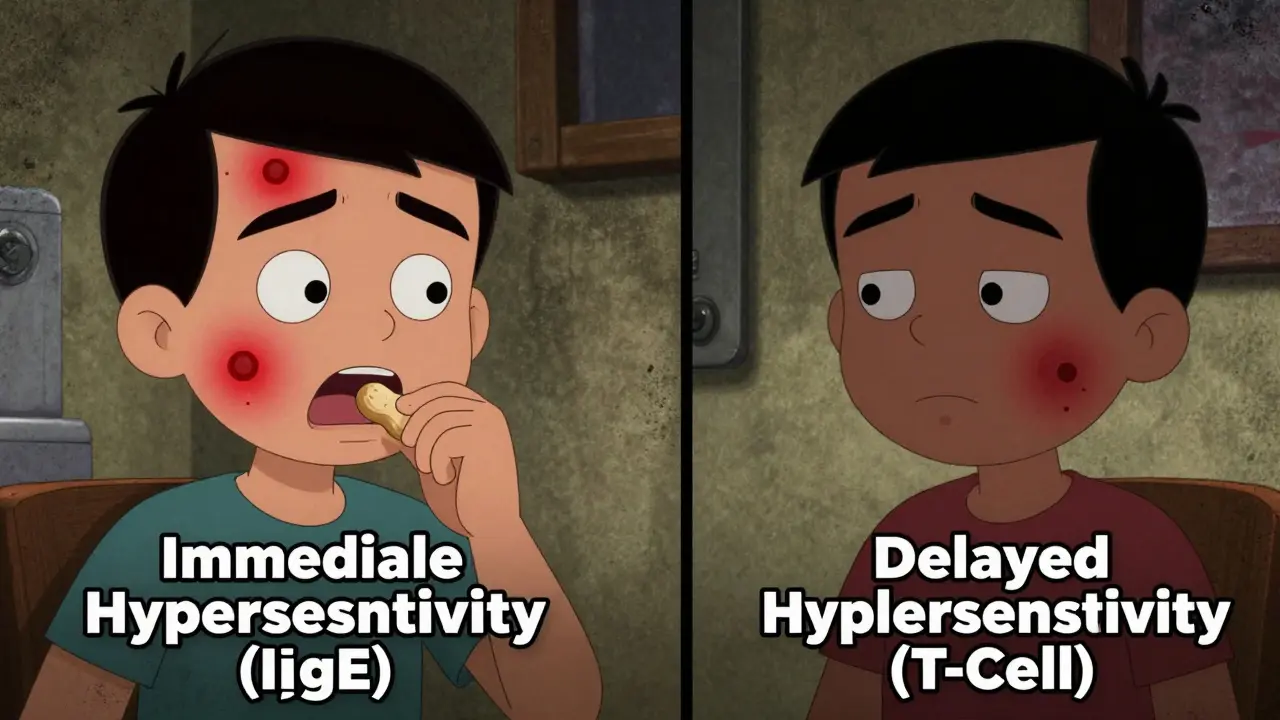
Immediate hypersensitivity is an allergic reaction mediated by IgE antibodies that occurs within minutes to hours of exposure. Think of this as your body's rapid-response team. When they see a threat, they sound the alarm instantly. This causes hives, wheezing, or anaphylaxis quickly.
Delayed hypersensitivity, on the other hand, is a T-cell-mediated immune response that takes days to weeks to develop. This is more like a specialized investigation unit. The T-cells have to recognize the drug, multiply, and then attack the cells affected by the drug. This process takes time. According to guidelines from the American Academy of Allergy, Asthma & Immunology (AAAAI), these reactions typically present between 5 days and 8 weeks after initial exposure. This delay is what makes them so tricky to diagnose.
In fact, delayed reactions account for about 80% of all drug hypersensitivity events. Yet, because they don't happen right away, doctors often misdiagnose them as viral infections or unrelated skin conditions.
The Timeline: When to Expect Symptoms
Timing is everything when it comes to delayed drug reactions. Different types of reactions have different "latency periods"-the time between starting the drug and seeing symptoms.
- Mild Rashes (Maculopapular Exanthema): These are the most common form, occurring in 80-90% of delayed cases. The median onset is around 8 days, but it can range from 4 to 14 days. If you stop the drug, the rash usually fades within 1 to 3 weeks.
- SJS/TEN (Stevens-Johnson Syndrome / Toxic Epidermal Necrolysis): These are severe, life-threatening conditions. They tend to appear earlier than other severe reactions, with a median onset of 1 to 2 weeks (range 4-28 days). Symptoms include painful blisters and peeling skin.
- DRESS Syndrome: Also known as Drug Reaction with Eosinophilia and Systemic Symptoms, this condition has a longer latency. The median onset is 3 weeks, ranging from 2 to 8 weeks. Most cases present before 6 weeks. It involves fever, rash, and internal organ inflammation.
- AGEP (Acute Generalized Exanthematous Pustulosis): This presents with thousands of small, sterile pustules. It often resolves quickly, within 15 days of stopping the medication, but leaves behind dark spots (hyperpigmentation) that can last for months.
If you start a new antibiotic and get a rash on day 12, that fits the pattern for a delayed reaction. If you get hives on day 1, that is likely an immediate allergy. Recognizing this window helps you connect the dots.
Common Culprit Medications
Not all drugs cause delayed reactions equally. Some classes of medications are much more likely to trigger these immune responses. Based on data from the FDA Adverse Event Reporting System (FAERS), antibiotics, anticonvulsants, and NSAIDs are the leading causes.
| Drug Class | Specific Examples | Typical Onset Time | Risk Factors |
|---|---|---|---|
| Beta-Lactam Antibiotics | Amoxicillin, Penicillin | Within 2 weeks (85% of cases) | High frequency of use; broad spectrum |
| Anticonvulsants | Carbamazepine, Phenytoin, Lamotrigine | >2 weeks (92% of cases) | Genetic markers (HLA-B*15:02) |
| NSAIDs | Ibuprofen, Naproxen | Variable | Often mistaken for viral rashes |
| Allopurinol | Allopurinol (for gout) | 2-8 weeks | Genetic marker (HLA-B*58:01) |
| Sulfonamides | Sulfamethoxazole (Bactrim) | 1-2 weeks | Common in UTI treatments |
Note the difference in timing. Beta-lactam antibiotics like amoxicillin often trigger reactions relatively quickly, within two weeks. Anticonvulsants like carbamazepine take longer, often more than two weeks. If you are taking lamotrigine for mood stabilization or seizures, be extra vigilant during the first month of treatment or dose increases.
Severe Reactions: SJS, TEN, and DRESS
While a simple red rash is uncomfortable, it is rarely dangerous. However, some delayed reactions escalate into Severe Cutaneous Adverse Reactions (SCARs). These are medical emergencies.
Stevens-Johnson Syndrome (SJS) and Toxic Epidermal Necrolysis (TEN) are severe blistering conditions where the top layer of skin dies and detaches. In SJS, less than 10% of the body surface is affected. In TEN, more than 30% is involved. Mortality rates can reach 5-10%, rising to 30% if over 50% of the body is covered. Symptoms include flu-like feelings followed by a painful red or purple rash that spreads and blisters. The skin becomes sensitive to touch, and eyes, mouth, and genitals may become inflamed.
DRESS Syndrome is a complex reaction involving fever, rash, and internal organ damage. To be diagnosed, a patient typically needs three of four features: fever above 38.5°C, swollen lymph nodes, high eosinophil count (>1,500 cells/μL), and atypical lymphocytes. DRESS is particularly dangerous because it can affect the liver, kidneys, and lungs. About 42% of DRESS patients develop severe hepatitis, and 28% experience renal impairment. The mortality rate is around 8%. What makes DRESS unique is its biphasic course: patients often improve after two weeks, only to relapse at three to four weeks if not treated aggressively.
If you experience a rash accompanied by high fever, swollen glands, or difficulty breathing, seek emergency care immediately. Do not wait to see if it goes away.
The Role of Genetics in Drug Reactions
Why do some people react severely while others take the same drug without issue? Genetics play a huge role. Specific variations in human leukocyte antigen (HLA) genes can make individuals highly susceptible to certain drug reactions.
For example, the HLA-B*15:02 allele is strongly linked to carbamazepine-induced Stevens-Johnson Syndrome in Han Chinese populations. Studies show an odds ratio of over 1,000 for this association. Similarly, the HLA-B*58:01 allele is associated with allopurinol-induced DRESS in Thai and other Asian populations, with nearly 100% positive predictive value in some studies.
This has led to a shift in medical practice. The FDA now recommends pharmacogenomic testing for HLA-B*58:01 before prescribing allopurinol to patients of Asian descent. This simple test can prevent up to 80% of severe reactions. If you have a family history of drug allergies or belong to a population with higher risk alleles, ask your doctor if genetic screening is appropriate before starting high-risk medications like anticonvulsants or allopurinol.
Diagnosis and Management Strategies
Diagnosing a delayed drug reaction is challenging because there is no single quick test. Doctors rely on clinical judgment, timing, and sometimes specialized testing.
- Stop the Suspect Drug: This is the most critical step. Immediate discontinuation reduces mortality by 35% in severe cases. Even if you are unsure, stopping the medication is safer than continuing it.
- Clinical Evaluation: Doctors will assess the rash type, check for fever, and review blood work for eosinophils and liver enzymes. Tools like the RegiSCAR criteria help standardize diagnosis.
- Allergy Testing: Skin tests (patch testing) and blood tests (lymphocyte transformation tests) can identify the culprit drug. Patch testing has 40-60% sensitivity, while LTT has 75-85% sensitivity. However, these tests are not always available in general practice and should be done by specialists.
- Treatment: For mild rashes, antihistamines and topical steroids may suffice. For severe reactions like DRESS or SJS, systemic corticosteroids (e.g., prednisone 0.5-1 mg/kg/day) are often used. In cases of renal involvement, cyclosporine may be added. Supportive care, including wound management and fluid replacement, is vital for SJS/TEN.
A common pitfall is misdiagnosing early DRESS as a viral exanthem. Up to 32% of early DRESS cases are initially thought to be viral. If a "virus" doesn't go away after a week and gets worse, reconsider the possibility of a drug reaction.
Living With a History of Drug Reactions
Having a delayed drug reaction can be frightening. Many patients report anxiety about future medications. Here is how to manage life after a reaction:
- Keep a Record: Document the drug name, dose, and symptoms. Carry this information with you. Update your electronic health record and medical alert bracelet if necessary.
- Avoid Cross-Reactions: Some drugs share chemical structures. For example, if you reacted to one sulfa antibiotic, you might react to others. Consult an allergist to determine safe alternatives.
- Desensitization: In rare cases where no alternative exists, allergists can perform drug desensitization. This involves giving tiny, increasing amounts of the drug under strict supervision to build tolerance. This is risky and only done in hospitals.
- Monitor Long-Term Health: Survivors of SJS/TEN may have chronic ocular complications or autoimmune disorders. Regular follow-up with dermatologists and ophthalmologists is recommended.
Remember, a delayed reaction does not mean you are "allergic" to everything. It means your immune system had a specific, unfortunate interaction with one molecule. With proper identification and avoidance, you can continue to receive effective medical care safely.
How long does a delayed drug rash last?
The duration depends on the severity. Mild maculopapular rashes typically resolve within 1 to 3 weeks after stopping the medication. More severe conditions like AGEP may resolve within 15 days but leave hyperpigmentation for months. DRESS syndrome can take several weeks to months to fully resolve due to potential organ involvement and relapses.
Can a drug reaction happen 2 weeks after stopping the medication?
Yes, though it is less common. Delayed reactions are defined by their onset relative to *starting* the drug, not just stopping it. However, if you stopped a drug recently and then restarted it, the reaction can occur much faster (within hours or days) due to prior sensitization. If symptoms appear weeks after complete cessation without re-exposure, consider other causes like viral infections or new medications.
What are the first signs of a severe drug reaction?
Early signs often mimic the flu: fever, fatigue, and malaise. This is followed by a rash that may start on the face or upper body and spread. Look for painful blisters, peeling skin, swelling of the lips or eyes, and difficulty swallowing. If you have a rash plus fever and swollen lymph nodes, seek immediate medical attention.
Is there a test to predict if I will have a delayed drug reaction?
For specific high-risk drugs, yes. Genetic testing for HLA-B*15:02 (carbamazepine) and HLA-B*58:01 (allopurinol) is recommended for certain ethnic groups. For most other drugs, there is no routine predictive test. Diagnosis is usually made after the reaction occurs through patch testing or lymphocyte transformation tests performed by an allergist.
Can antibiotics cause delayed reactions?
Yes, antibiotics are the most common cause of delayed drug reactions, accounting for about 32% of reports. Beta-lactams like amoxicillin and penicillin frequently cause mild rashes appearing within 2 weeks. Sulfonamides like Bactrim can cause more severe reactions like SJS or DRESS.