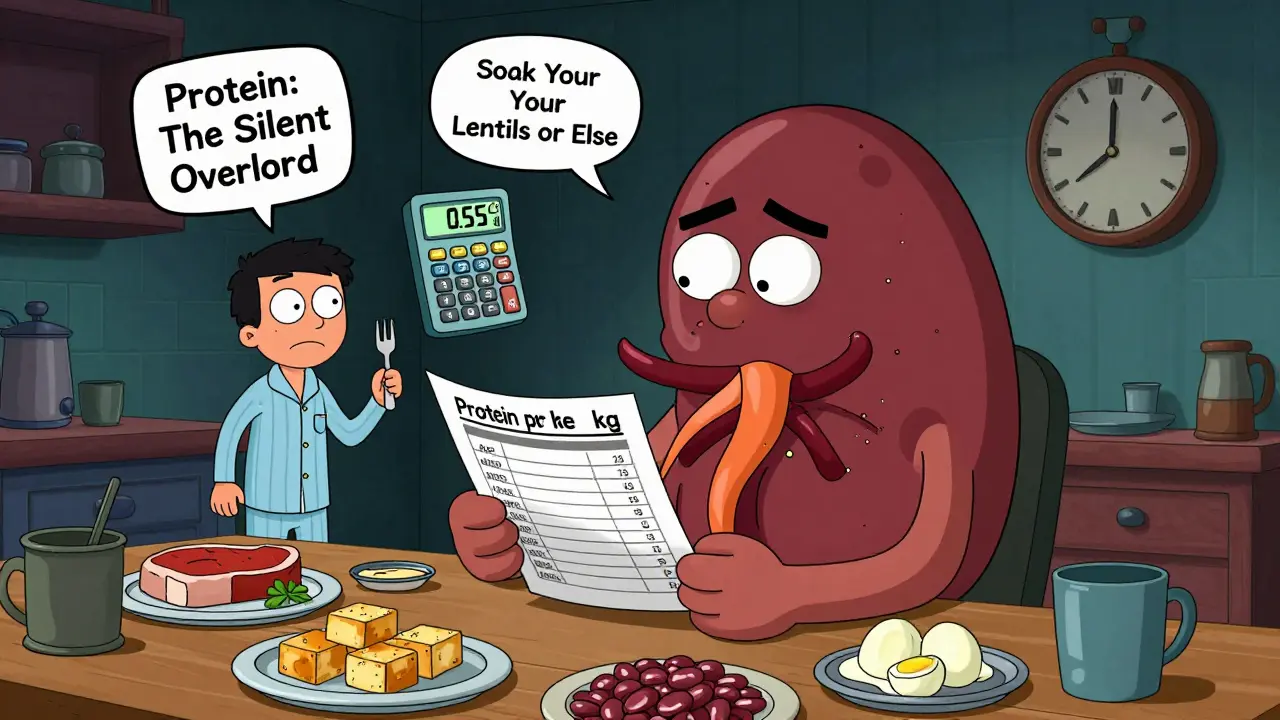
When you have chronic kidney disease (CKD), what you eat isn’t just about comfort or preference-it’s about survival. Too much protein can overload your kidneys, but too little can leave you weak, malnourished, and at risk for muscle loss. The right amount? It changes depending on how far your kidney function has declined. And that’s where things get tricky.
What Protein Does to Your Kidneys
Your kidneys filter waste from your blood. When you eat protein, your body breaks it down into nitrogen-based waste like urea. Healthy kidneys handle this easily. But when they’re damaged, that waste builds up. That’s why doctors have long advised cutting back on protein in CKD. It’s not about starving yourself-it’s about reducing the workload so your kidneys don’t wear out faster.
Studies going back to the 1920s showed that lowering protein intake helped reduce symptoms like fatigue and nausea in advanced kidney disease. More recent research, like the 2022 Cochrane Review, found that sticking to a lower-protein diet can delay the need for dialysis by 6 to 12 months. That’s not a small win. For many, it means more time at home, less hospital visits, and better quality of life.
Protein Targets by CKD Stage
There’s no one-size-fits-all number. Your protein needs depend on your kidney function, measured by your GFR (glomerular filtration rate). Here’s what the latest guidelines say:
- CKD Stage 1-2 (GFR ≥60): Aim for 0.8 grams of protein per kilogram of ideal body weight. For someone weighing 150 pounds (68 kg), that’s about 54 grams per day. This isn’t a strict limit-it’s a ceiling. If you’re active or older, you might need closer to this amount to stay strong.
- CKD Stage 3 (GFR 30-59): Drop to 0.55-0.60 grams per kg. For a 150-pound person, that’s 40-54 grams daily. This is where most people start noticing the need to plan meals more carefully.
- CKD Stage 4 (GFR 15-29): Stick to 0.6 grams per kg. Half of your protein should come from high-quality sources: eggs, milk, chicken, fish, lean beef, or soy. These provide all the essential amino acids your body can’t make on its own.
- CKD Stage 5 (GFR <15, not on dialysis): Still 0.55-0.60 g/kg. But many patients here are at high risk for malnutrition. That’s why some doctors may slightly raise the target if weight loss or muscle wasting is happening.
These numbers aren’t arbitrary. They’re based on decades of clinical trials, including the landmark MDRD Study and updated guidelines from the Kidney Disease Outcomes Quality Initiative (KDOQI) in 2023. But here’s the twist: newer research, like the 2024 JAMA Network Open study, shows that for older adults, eating a bit more protein-even above 0.8 g/kg-might actually help them live longer. Why? Because many die from heart disease before their kidneys fail completely.
Plant vs. Animal Protein: The Real Difference
Not all protein is created equal when it comes to kidney health.
Animal proteins-like steak, chicken, and cheese-produce more urea and phosphate per gram. They also create more advanced glycation end products (AGEs), which cause inflammation and speed up kidney damage. One study in the American Journal of Kidney Diseases found red meat generates up to 50% more AGEs than plant proteins.
Plant proteins-beans, lentils, tofu, nuts, and whole grains-put less strain on your kidneys. They release 20-30% less urea and phosphate. A 2021 meta-analysis in the Clinical Journal of the American Society of Nephrology showed that replacing just 30% of animal protein with plant protein lowered the risk of CKD progression by 14% and cut death risk by 11%.
But here’s the catch: plant proteins are often missing key amino acids like lysine and methionine. If you eat mostly plants, you need to combine them smartly-like rice with beans, or hummus with whole wheat pita-to get a complete profile. That’s harder than just eating an egg or a chicken breast.
And there’s another problem: plant foods are often high in potassium. For someone in Stage 4 or 5 CKD, too much potassium can be dangerous. A sweet potato might be healthy for a person without kidney disease, but for someone with advanced CKD, it could cause a heart rhythm problem. That’s why dietitians often recommend soaking and boiling legumes and vegetables to reduce potassium before eating them.
Special Cases: Diabetes and Older Adults
If you have both diabetes and CKD, the balance gets even harder. You need to control blood sugar, but you also need to protect your kidneys. The American Diabetes Association recommends 0.8-0.9 grams of protein per kg for these patients. Going lower than that might hurt your muscle mass and make it harder to manage glucose.
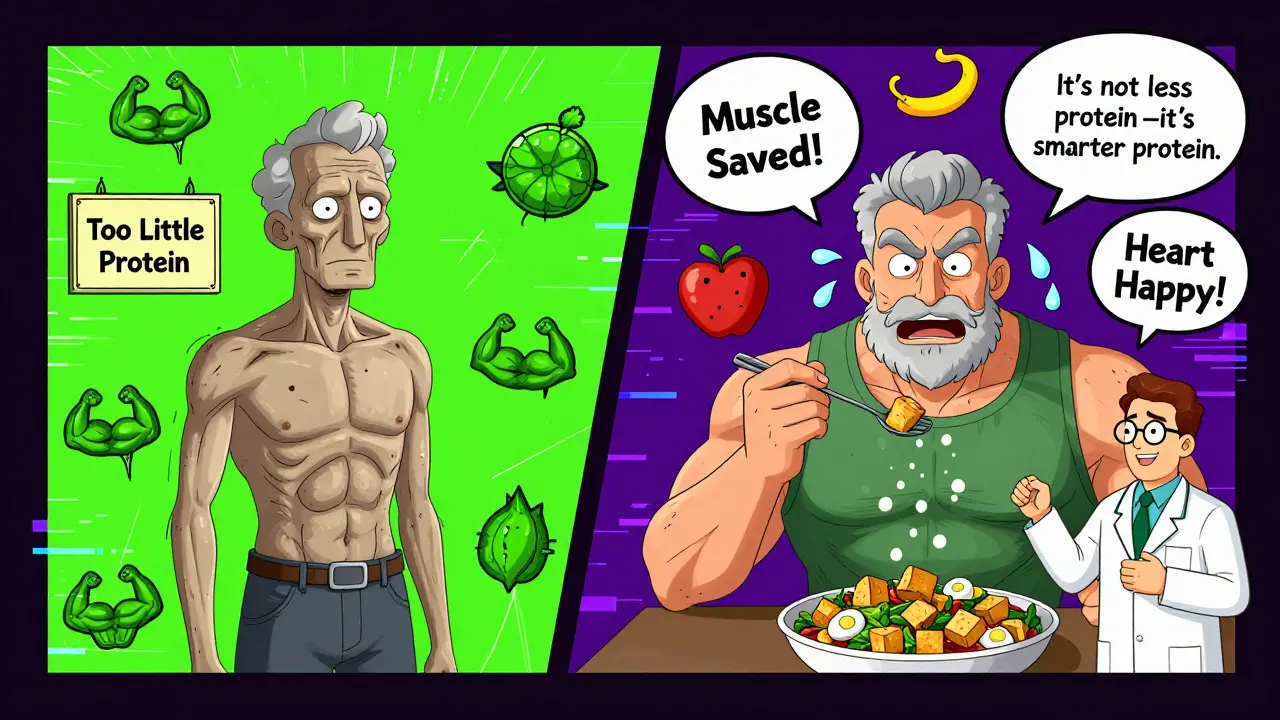
For older adults (65+), the rules shift again. Many are losing muscle naturally as they age. A 2024 study found that older CKD patients who ate more protein (up to 1.0 g/kg) had lower death rates. Why? Because their biggest threat isn’t kidney failure-it’s heart disease, falls, or infections. Muscle loss makes all of those worse.
So the answer isn’t always “less protein.” It’s “the right protein, for the right person.” That’s why guidelines now say: individualize.
Why People Struggle (And How to Succeed)
Most people don’t fail because they don’t understand the rules. They fail because they’re hungry, tired, and isolated.
A 2024 survey by the American Kidney Fund found that 74% of CKD patients on low-protein diets felt constantly hungry. 62% said they felt weak. 58% avoided social meals because they couldn’t eat what everyone else was having.
But those who worked with a renal dietitian? 82% said their quality of life improved. Why? Because dietitians don’t just give numbers-they give solutions.
- They help you pick high-quality proteins that fill you up: egg whites, cottage cheese, lean turkey, tofu.
- They teach you how to use apps like MyFitnessPal with renal databases to track protein in mixed dishes (like lasagna or stir-fry).
- They show you how to prep meals ahead so you’re not tempted by high-protein snacks.
- They might recommend keto acid analogues (like Ketosteril), which provide essential amino acids without the waste burden-used in 15% of advanced CKD patients in Europe.
One patient on Reddit wrote: “Cutting my protein from 100g to 45g made me feel like I was fading away.” But after working with a dietitian, he learned to replace bread and pasta with low-protein versions, added egg whites to meals, and started eating smaller, more frequent meals. Within weeks, his energy came back.
Tools and Resources That Actually Work
You don’t have to guess your protein intake. There are tools made for this:
- The NKF Protein Target Calculator app, downloaded over 47,800 times since 2023, lets you enter your weight, stage, and activity level to get a daily target.
- Kidney Kitchen, run by the National Kidney Foundation, offers over 500 free recipes with protein counts already calculated. It gets 1.2 million visits a month.
- Many hospitals now offer Medical Nutrition Therapy covered by Medicare-3 hours of initial counseling and 2 hours of follow-up per year.
But here’s the sad truth: only 35% of nephrologists refer patients to dietitians, even though guidelines say they should. That gap leaves thousands struggling alone.
The Future: Personalized Protein Plans
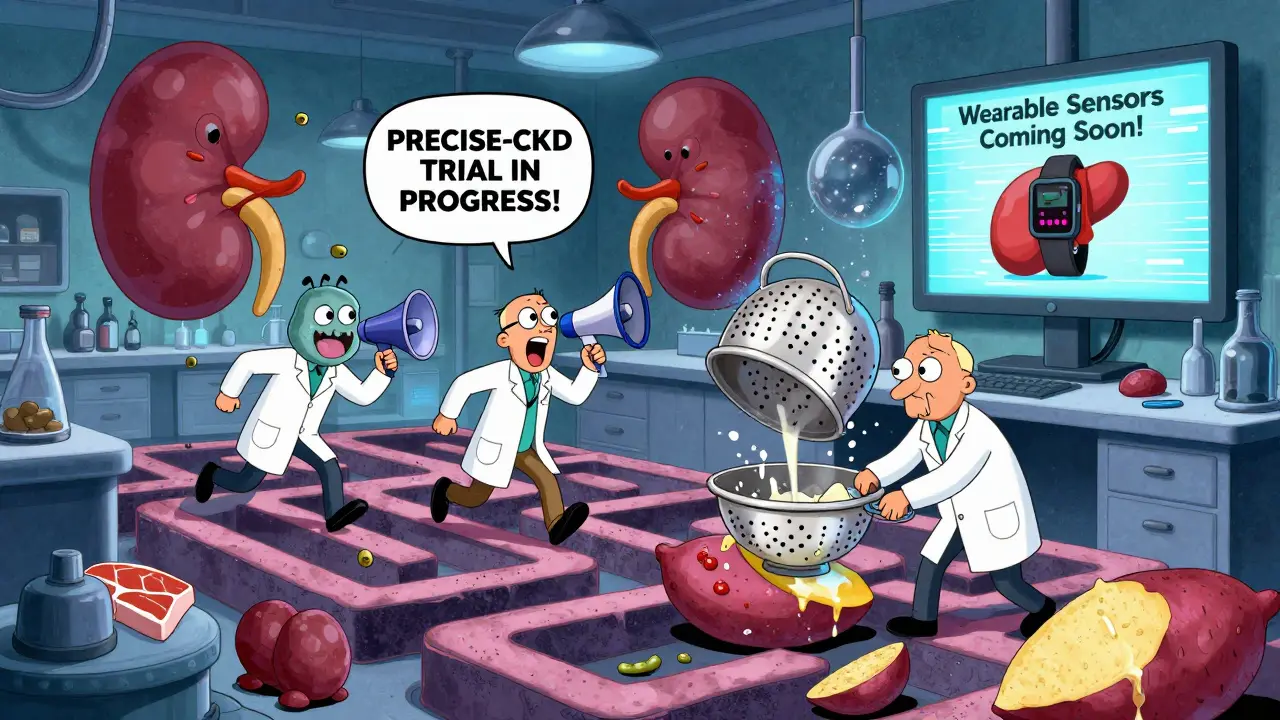
Scientists are moving beyond weight-based formulas. The NIH-funded PRECISE-CKD trial (2023-2024) is testing whether protein targets should be based on how much urea your body actually makes-not just your weight. Some people naturally produce more waste than others, even at the same stage.
Future tools might use wearable sensors to track protein metabolism in real time. Others are developing plant-based protein powders with reduced potassium, so you can get the benefits of plants without the risks.
One thing’s clear: the focus is shifting from “how much” to “what kind” and “who you are.”
Final Takeaway
Protein isn’t the enemy. Poorly managed protein is.
If you’re in early CKD, you don’t need to panic. Stay around 0.8 g/kg. If you’re in Stage 3 or beyond, aim for 0.55-0.60 g/kg-but only if you’re not losing weight or muscle. If you’re older or diabetic, talk to your doctor. You might need more.
Focus on quality. Swap out some red meat for tofu or beans. Soak your lentils. Use egg whites in place of whole eggs. Track your intake with an app. And don’t do this alone.
Find a renal dietitian. Ask your nephrologist for a referral. Use the NKF’s resources. Your kidneys aren’t the only thing at stake-you are.
How much protein should I eat if I have CKD Stage 3?
For CKD Stage 3, aim for 0.55 to 0.60 grams of protein per kilogram of your ideal body weight daily. For a person weighing 150 pounds (68 kg), that’s about 40 to 54 grams of protein per day. Half of that should come from high-quality sources like eggs, milk, poultry, fish, or soy. This helps reduce waste buildup in your blood while keeping you strong. If you’re losing weight or feel weak, talk to your dietitian-you may need a slight increase.
Can I eat beans and lentils with CKD?
Yes, but with caution. Beans and lentils are plant-based proteins that put less strain on your kidneys than meat. But they’re also high in potassium and phosphorus. If you’re in Stage 4 or 5, soak them overnight, rinse well, and boil them in fresh water to reduce these minerals. Portion control matters-stick to 1/2 cup cooked per meal. Pair them with low-potassium foods like white rice or cabbage to balance your meal.
Is a low-protein diet safe for older adults with CKD?
Not always. While low protein helps slow kidney decline, older adults are more likely to lose muscle and strength. A 2024 JAMA Network Open study found that older CKD patients who ate more protein (up to 0.8-1.0 g/kg) lived longer because they were less likely to fall or get infections. If you’re over 65, your goal should be to maintain muscle mass. Work with a dietitian to find the balance between protecting your kidneys and staying strong.
Why do I feel hungry all the time on a low-protein diet?
Protein helps you feel full. When you cut it back, you may feel hungrier. To fix this, add healthy fats like olive oil, avocado, or butter to your meals. Eat more low-potassium, low-phosphorus carbs like white bread, pasta, or rice. Have small snacks between meals-like a slice of low-protein bread with jam, or a cup of apple sauce. Drinking water won’t help with hunger, but eating the right foods will.
Do I need to see a renal dietitian?
Yes, especially if you’re in Stage 3 or beyond. Renal dietitians know how to make low-protein meals taste good and keep you nourished. They can help you track protein in mixed dishes, adjust for diabetes or high potassium, and avoid malnutrition. Medicare covers 3 hours of initial counseling and 2 hours of follow-up each year. Ask your nephrologist for a referral-it’s one of the most important steps you can take.
Protein isn't the enemy but the way we think about it sure is
I've seen people starve themselves on low protein diets then wonder why they can't stand up without help
It's not about cutting back it's about swapping the wrong stuff for the right stuff
My uncle in Stage 4 was eating chicken every meal and dropping like a stone
Switched to tofu egg whites and soaked lentils and he's been hiking again
Doctors give numbers but they don't tell you how to live with them
The real win is not the grams it's the quality of life you get back
Also soaking beans isn't optional it's a survival skill at this point
And yes I know it's annoying but boiling them twice makes a difference
Don't let perfect be the enemy of good enough
Just do better than yesterday
I'm in stage 3 and this post saved me from ordering pizza last night
Had no idea plant protein could help so much
Just swapped my chicken stir fry for tofu and beans and my energy is way better
Yessssss!!! Finally someone gets it!!!!
I've been telling my nephrologist for months that I'm starving on 40g of protein a day
He just kept saying 'follow the guidelines' like I'm a robot
Then I found a renal dietitian and she had me add egg whites and low-protein bread
Now I'm not passing out at 3pm and I can actually enjoy dinner with my family
Also the keto acid analogues? Game changer if you can afford them
My insurance covered it after I begged
Don't suffer in silence people
Ask for help
It's not weak it's smart
Oh so now we're supposed to be nutritionists too?!!!
Great
So I'm supposed to soak beans
Count grams
Track AGEs
And still pay for my insulin and blood pressure meds
Thanks for the extra work, medical industrial complex
At least I can still cry into my low-protein oatmeal
Let me tell you something about protein and kidneys that no one talks about
It's not just about quantity it's about timing and distribution
Most people eat 70% of their protein at dinner
That's a disaster for waste buildup
The real hack? Spread it out
Three small meals with 10-15g each plus two snacks
That's how you keep your urea levels stable
I learned this from my dietitian after I kept failing blood tests
Also forget the idea that plant protein is always better
For some people the fiber in beans causes bloating so bad they stop eating
That's when you pivot to egg whites cottage cheese or even whey isolate if your phosphorus is okay
And yes I know that sounds like a supplement ad but it's science
My GFR went from 42 to 48 in six months just by rearranging when I ate
Not how much
When
It's the difference between surviving and thriving
Also don't forget to hydrate
Water flushes out the junk
But don't overdo it
That's another trap
Balance is everything
And no
There's no app that replaces a good dietitian
Ask for that referral
It's covered
It's your right
It is with profound solemnity that I address the moral imperative embedded within the dietary management of chronic kidney disease
Our society has become so enamored with the quantification of nutrition that we have forgotten the human being behind the grams
To reduce a person's sustenance to a mathematical equation is not merely clinical
It is dehumanizing
Yet the very same institutions that impose these restrictions offer no adequate emotional or psychological support
The loneliness of the low-protein plate is a silent epidemic
How many families have abandoned Sunday dinners because the grandmother cannot eat the roast?
How many children have grown up believing that love is measured in protein grams?
And while we debate the merits of plant versus animal protein
We neglect the dignity of the person who simply wants to taste their mother's cooking one last time
Guidelines are necessary
But compassion is non-negotiable
Let us not mistake precision for humanity
Let us not confuse survival with living
The kidneys may fail
But the soul must not
Oh please
You think you're clever swapping beans for steak
But you're just trading one problem for another
Soak your lentils? Great
Now you're still eating a food that spikes your potassium
And you think you're being healthy
Meanwhile your heart is quietly screaming
And your nephrologist is rolling their eyes
Everyone wants the easy win
But there is no easy win
There is only discipline
And if you can't handle that
Then maybe you're not ready for this
Don't blame the diet
Blame your unwillingness to change
You think you're fighting for your life
You're just being lazy
In the African tradition we say a man is known by the strength of his bones
But in this modern age we have forgotten that bones are built by more than meat
My grandfather in Nigeria survived on beans rice and groundnuts
He lived to 92 with no dialysis
He never counted grams
He ate what was there
And he moved
He walked
He laughed
He did not fear food
He respected it
Today we turn meals into math problems
And call it medicine
But medicine without joy is poison
Find your balance
Not in a spreadsheet
But in your grandmother's kitchen
Where food is love
And love is medicine
And if you need to add a little butter to your rice
So be it
Let your soul be nourished too
Wow
Finally a post that doesn't treat CKD patients like lab rats
And yes I'm talking to you Dr. Guidelines
Who decided that 0.55g/kg was the universal magic number?
Did they test it on a 65-year-old woman with diabetes and osteoporosis?
Or a 30-year-old single dad who works two jobs?
Oh right
They didn't
They just made a chart
And now we're all supposed to live by it
Meanwhile the dietitians are the real MVPs
They're the ones turning tofu into something that doesn't taste like cardboard
And yes I said it
Low-protein bread is a miracle
Who knew?
Also if your nephrologist hasn't referred you to a dietitian
Fire them
Just kidding
But seriously
Ask again
And again
And then ask a third time
It's your life
So let me get this straight
My kidneys are failing
So I have to eat less protein
But if I eat too little I get weak
And if I eat too much I die faster
And I can't have potatoes
Or beans
Or cheese
Or chicken
Or bread
Or really anything that doesn't taste like wet cardboard
And if I cry
That's just emotional
Not a sign the system is broken
Right
Okay
Thanks for the mental health check
Now I'm going to go eat my 48 grams of egg whites
With a side of existential dread
The data is clear
The guidelines are evidence-based
Any deviation from the 0.55–0.60 g/kg range in Stage 3 is not only unsupported
It is dangerous
Those who advocate for higher protein intake are ignoring the MDRD and KDOQI studies
And the JAMA study you cite? It was observational
Correlation is not causation
Also
Plant proteins are not inherently safer
They contain phytates
Which inhibit mineral absorption
And lead to long-term deficiencies
So you are trading one risk for another
Do not be misled by trendy nutrition blogs
Stick to the science
Or suffer the consequences
Hey I just saw your comment about plant proteins and phytates
You're right
But here's what you're missing
Soaking and boiling reduces phytates by 50-80%
And pairing with vitamin C (like bell peppers or lemon juice) boosts iron absorption
It's not about avoiding plants
It's about preparing them right
Same with animal protein
Red meat has more AGEs
But if you grill it at low heat
And trim the fat
It's not the villain you think
It's not about perfection
It's about smart swaps
And I'm not some blogger
I'm in Stage 3 too
I've been doing this for five years
And I'm still standing
Not because I followed a rule
But because I learned how to adapt