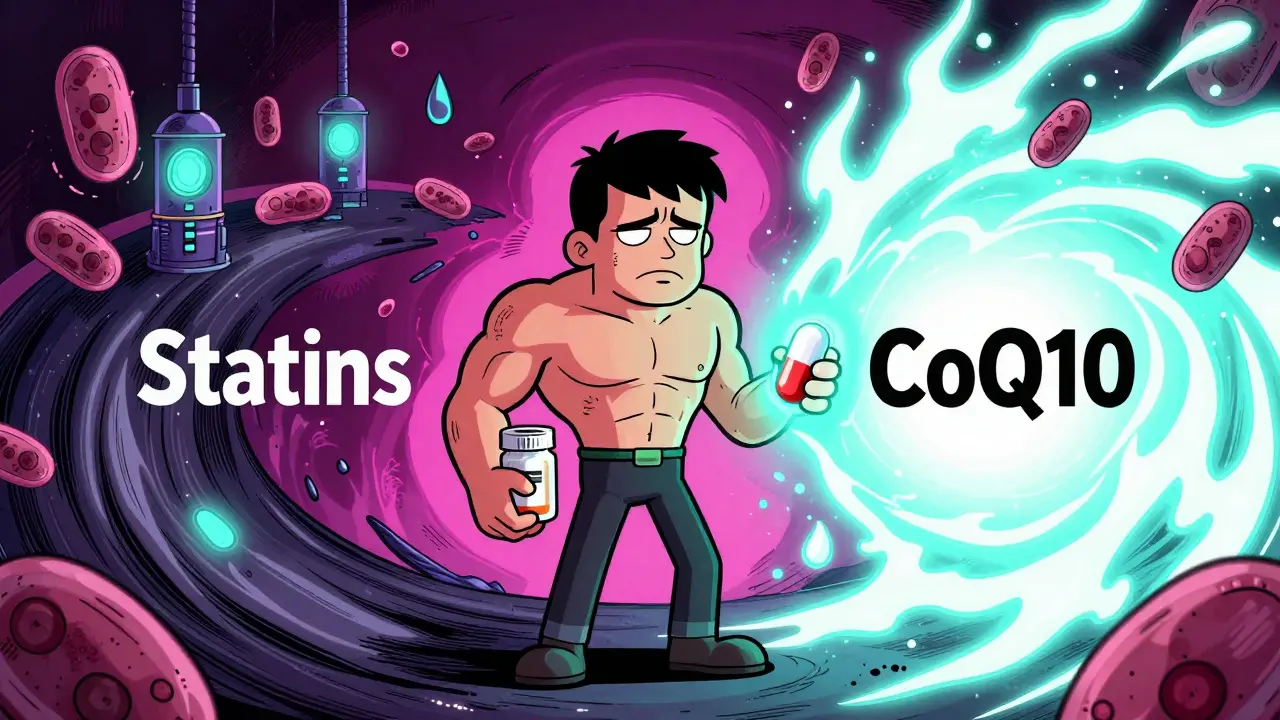
If you're taking a statin and dealing with sore, tired, or cramping muscles, you're not alone. About 1 in 5 people on statins report muscle discomfort-enough to make them consider quitting the medication altogether. That’s a big problem, because statins save lives by lowering bad cholesterol and preventing heart attacks and strokes. So what if there was a simple supplement that could ease those aches without stopping your statin? Enter Coenzyme Q10, or CoQ10. It’s been talked about for years as a possible fix. But does it actually work? Let’s cut through the noise.
Why Statins Might Be Causing Your Muscle Pain
Statins work by blocking an enzyme called HMG-CoA reductase, which your liver uses to make cholesterol. That’s good for your heart. But here’s the catch: that same enzyme is also needed to make CoQ10, a compound your body naturally produces. CoQ10 plays a key role in your cells’ energy factories-the mitochondria. Without enough of it, your muscles may struggle to produce the energy they need, especially during movement or exercise. Studies show statins can drop CoQ10 levels in your blood by 16% to 54%. That sounds alarming. But here’s where it gets tricky: just because your blood levels go down doesn’t mean your muscles are running low. Two studies actually found higher CoQ10 levels in muscle tissue of people on statins. So the connection isn’t as simple as “statins = low CoQ10 = muscle pain.” Still, the theory is strong enough that doctors and patients have tried fixing it with supplements.What Does the Science Say About CoQ10 Supplements?
The research is messy. Some studies say yes, CoQ10 helps. Others say no. A 2018 meta-analysis in the Journal of the American Heart Association looked at 12 trials with nearly 600 people. It found that those taking CoQ10 (usually 100-600 mg a day) reported less muscle pain, less weakness, and less fatigue compared to those on placebo. The differences weren’t huge-about a 1.6-point drop on a 10-point pain scale-but for someone struggling to climb stairs or walk their dog, that matters. Other trials showed even clearer results. One 2014 study gave people 100 mg of CoQ10 daily for a month. Those taking it saw a 33% drop in muscle pain. The placebo group? Almost no change. Another trial in 2021 followed people for 12 weeks and saw steady improvement in muscle symptoms. But then there are the studies that say it doesn’t work. A 2007 trial gave 200 mg of CoQ10 daily for 12 weeks to statin users with muscle pain-and found zero improvement. Even though blood CoQ10 levels went up, the pain didn’t go away. That’s the heart of the controversy: sometimes it helps, sometimes it doesn’t.Who Might Actually Benefit?
It’s not a magic bullet for everyone. But if you fall into one of these groups, CoQ10 might be worth trying:- You have mild to moderate muscle aches-not full-blown weakness or dark urine (signs of serious muscle damage).
- You’ve tried switching statins (like from atorvastatin to rosuvastatin) and still have issues.
- You’re otherwise healthy and not on other medications that interfere with CoQ10.
- You’re willing to wait 4 to 12 weeks to see if things improve.

How to Take CoQ10-Dosing, Form, and Timing
Not all CoQ10 is the same. There are two main forms:- Ubiquinone-the older, cheaper form. Your body has to convert it to the active version.
- Ubiquinol-the reduced, active form. It’s more easily absorbed, especially if you’re over 40 or have trouble converting ubiquinone.
Is It Safe? What About Side Effects?
CoQ10 is one of the safest supplements out there. In over 40 years of use, no serious side effects have been reported-even at doses up to 600 mg a day. The most common complaint? Mild stomach upset, which usually goes away if you take it with food. It doesn’t interfere with statins. It won’t raise your cholesterol or lower your blood pressure too much. It doesn’t interact with most medications. The only caution: if you’re on blood thinners like warfarin, talk to your doctor. One small study suggested CoQ10 might make warfarin less effective, but the evidence is weak. Cost-wise, it’s cheap. A month’s supply of 100-200 mg ubiquinol runs $15-$40. Compare that to switching statins, which can cost $300-$600 a month if your insurance doesn’t cover it. Even if CoQ10 only helps half the people who try it, it’s still a low-risk, low-cost option.What Do Real People Say?
Look at patient forums, and you’ll see two stories. On Reddit’s r/Supplements, 78% of 142 users said CoQ10 eased their statin muscle pain. One person wrote: “After 6 months of leg cramps on atorvastatin, CoQ10 200mg daily eliminated my symptoms in 3 weeks.” On Amazon, CoQ10 supplements average 4.2 out of 5 stars. Over 60% of the 5-star reviews mention “relief from statin muscle pain.” But then there’s the other side. A Drugs.com reviewer wrote: “Tried 3 brands for 4 months. No change.” And in a survey of 1,200 statin users, only 32% said CoQ10 gave them “significant improvement.” That’s the reality: it works for some, not all. And we don’t yet know why.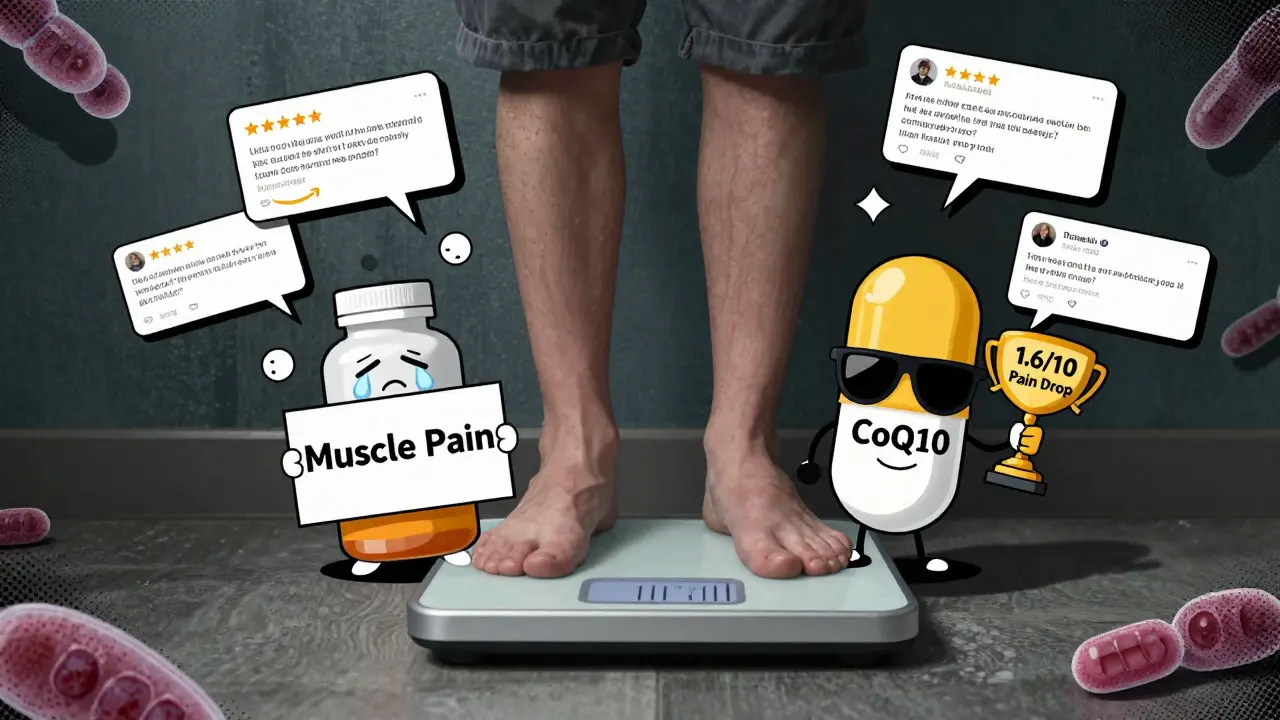
What Do Doctors Really Think?
Most cardiologists aren’t pushing CoQ10 as a proven treatment. The National Lipid Association and the American College of Cardiology both say the evidence is “inconclusive.” But here’s the twist: 42% of cardiologists surveyed in 2021 still recommend it to patients with muscle pain. Why? Because they’ve seen it help. And when the alternative is quitting a life-saving drug, they’re willing to try something safe and cheap. Major clinics like Mayo Clinic and Cleveland Clinic include CoQ10 in their “therapeutic trial” protocols for statin intolerance. That means: if you’re struggling with muscle pain, they’ll ask you to try CoQ10 for 3-6 months while keeping your statin. If it helps, great. If not, you move on.Should You Try It?
Here’s your simple decision tree:- Are you on a statin and getting mild muscle soreness or fatigue?
- Have you ruled out other causes (like low vitamin D, thyroid issues, or overexertion)?
- Are you willing to wait 8-12 weeks to see if it helps?
- Can you afford $20-$30 a month?
The Bottom Line
CoQ10 won’t cure statin muscle pain for everyone. But for a lot of people, it’s a low-risk, low-cost way to keep taking a drug that protects their heart. The science isn’t perfect, but the safety profile is excellent. And if you’re one of the people who finds relief, it could mean sticking with your statin-and staying healthy for years to come.There’s no guarantee. But sometimes, in medicine, the best option isn’t the one with the strongest evidence-it’s the one with the least risk and the most potential payoff.
been on statins for 5 years and my legs felt like lead until i tried coq10. no magic but i can walk my dog now without wanting to cry. 100mg ubiquinol with dinner. took 6 weeks but worth it.
i tried it too. no difference for me. maybe its placebo or maybe my body just dont need it. either way i stopped after 2 months. no harm done i guess
oh please. coq10? really? you people are so gullible. its just a vitamin your body makes. if it worked so well why dont doctors prescribe it? its all scam marketing. youre all falling for the supplement industrial complex 😭
my mom took this after her heart attack and she says she feels like a new woman. not a miracle but she stopped complaining about her knees. if its safe and cheap why not try? life’s too short to suffer in silence 💪
coq10? sure. just like taking aspirin for a broken leg. it wont fix the root problem. statins lower coq10? so fix the statin dose not add a bandaid. also typo: its ubiquinol not ubiquinone for you over 40. just saying.
the irony is breathtaking. we’ve reduced cholesterol to near-zero levels to prevent heart disease… while simultaneously depleting a mitochondrial co-factor essential for muscle energy… and then we hand out supplements like candy. we’ve turned medicine into a puzzle where the pieces are all wrong. coq10 is not a solution. it’s a symptom of our flawed pharmacological paradigm.
you guys are adorable. 78% on reddit say it works? wow. and 32% on drugs.com say it doesnt? oh no. the real question is: why are you so desperate to believe in a pill that fixes your statin side effects instead of asking why you’re on statins in the first place? maybe your diet? maybe your sedentary life? maybe your stress? coq10 is just your emotional crutch. 🙃
i tried it. nothing. but i still take it because i feel better mentally. like i’m doing something. also i use emojis now 🤷♂️💊
i was skeptical but my doctor said try it. took 100mg with avocado toast every morning. after 2 months my legs stopped aching. not gone but better. i dont know why it worked but im not complaining. its cheap and safe so why not
as someone who moved from india to the us, i saw how differently people treat health here. in my village, we used turmeric and rest. here, we take pills for pills. coq10 might help some. but the real fix is movement, sleep, and less processed food. still, if it helps you keep your statin, go for it. just dont forget the basics.
man i tried coq10. nothing. then i started walking 30 mins a day. my legs felt like they were born again. statins? still taking. coq10? still taking. but the real hero? my sneakers. 🏃♂️🔥
i read the studies… the meta-analyses… the patient reports… and i still dont know. but i gave it a shot anyway. 100mg ubiquinol. 3 months. no change. but i dont regret trying. because not trying felt worse. sometimes the answer is… we dont know. and thats okay.