
You might think that liver damage only happens to people who drink heavily for decades, but the reality is more urgent. Your liver is incredibly resilient, but it has a breaking point. For some, the transition from a healthy liver to permanent scarring happens silently, without a single warning sign until it's nearly too late. Understanding the progression of alcohol-associated liver disease (ALD) isn't just about medical terms; it's about knowing when you can still turn the clock back and when the window for recovery is closing.
The Shift in How We Talk About Liver Damage
For a long time, doctors used the term "alcoholic liver disease." However, the American Association for the Study of Liver Diseases (AASLD) updated this to "alcohol-associated liver disease" in 2019. Why the change? It's about removing stigma. The goal is to recognize that alcohol is the cause of the injury, regardless of whether someone struggles with addiction or just has a high-consumption habit. This shift encourages more people to seek help without feeling judged by their healthcare providers.
Stage 1: Hepatic Steatosis (The Warning Phase)
Hepatic steatosis, often called fatty liver, is the first stop on the road to liver disease. It happens when fat builds up in the liver cells, making up more than 5-10% of the organ's weight. The scary part? It's incredibly common. About 90% of people who drink 3-6 standard drinks daily develop this condition. In some cases, fat can start accumulating in as little as 72 hours of sustained heavy drinking.
Most people at this stage feel completely fine. There are no obvious symptoms, which is why it's so dangerous. You might only find out during a routine blood test if your liver enzymes (like AST and ALT) are slightly elevated. The good news is that this stage is fully reversible. If you stop drinking completely for about 4 to 6 weeks, the fat usually clears out, and your liver returns to normal. It's the ultimate "get out of jail free" card for your health.
Stage 2: Alcohol-Associated Hepatitis (The Inflammation Phase)
If you keep drinking despite having a fatty liver, you might move into alcohol-associated hepatitis (AH). This isn't like viral hepatitis; it's a severe inflammation of the liver. This stage typically develops after 5 to 10 years of heavy drinking, but it can also be triggered by a massive binge-sometimes over 100 grams of alcohol in a single day.
Unlike the first stage, AH usually makes itself known. You might notice jaundice (yellowing of the skin and eyes), extreme fatigue, or a swollen abdomen known as ascites. Doctors use the Maddrey Discriminant Function (mDF) to see how serious the situation is. If your score is 32 or higher, it's considered severe, and the short-term risk of death can be as high as 40%. While mild cases can still be reversed by quitting alcohol, severe cases often require steroids like prednisolone to bring down the inflammation.
| Feature | Hepatic Steatosis | Alcohol-Associated Hepatitis |
|---|---|---|
| Symptoms | Usually none (asymptomatic) | Jaundice, fatigue, swelling |
| Prevalence | ~90% of heavy drinkers | ~30-35% of persistent drinkers |
| Reversibility | Highly reversible (4-6 weeks abstinence) | Potentially reversible (depending on severity) |
| Key Marker | Fat accumulation (>5-10% liver weight) | Liver inflammation and cell damage |

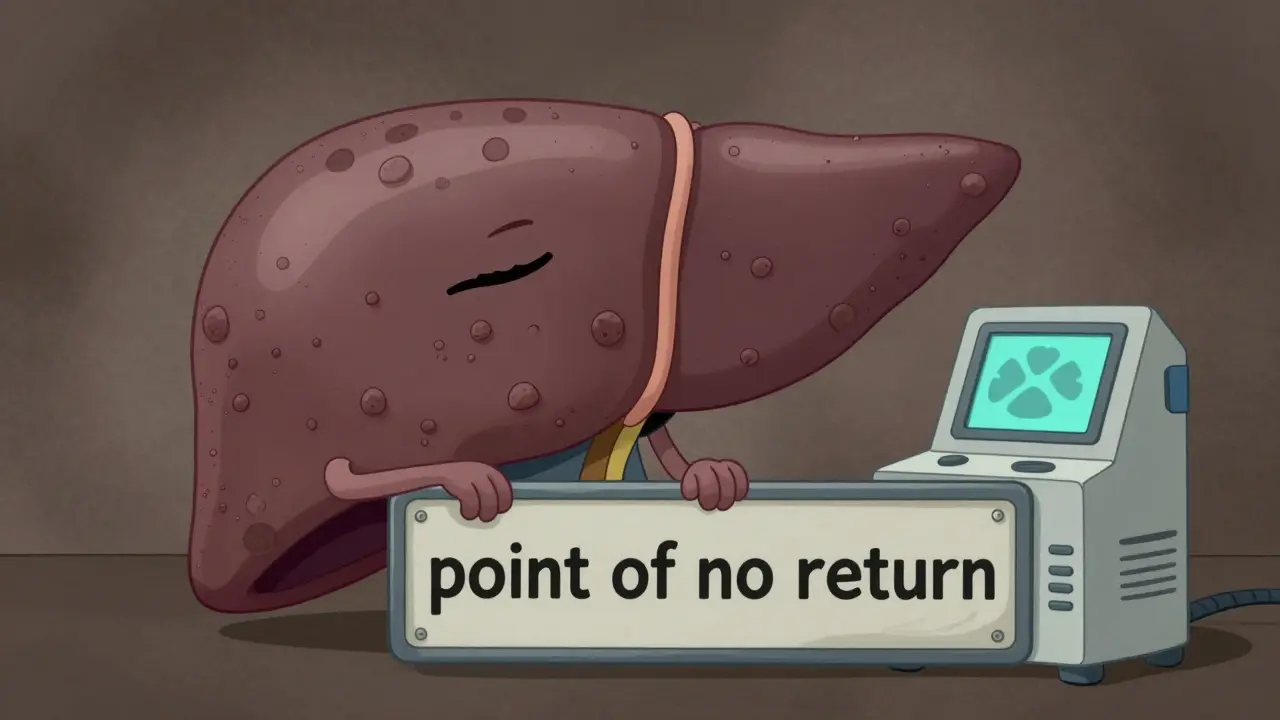
Stage 3: Cirrhosis (The Point of No Return?)
Cirrhosis is the final and most severe stage. At this point, the liver has tried to heal itself so many times that it has replaced healthy tissue with permanent scar tissue (fibrosis). When more than 75% of the liver's architecture is replaced by these scars, the organ can no longer function properly. In medical terms, this is often classified as F4 fibrosis using the Metavir scoring system.
Is it ever too late? While you can't "undo" the scarring, you can stop it from getting worse. For people with "compensated" cirrhosis (where the liver still functions okay), complete abstinence can increase the 5-year survival rate from 30% to as high as 90%. However, if the disease becomes "decompensated," you start seeing life-threatening complications like internal bleeding from esophageal varices or hepatic encephalopathy, where toxins build up in the brain and cause confusion.
Why Some People Progress Faster Than Others
You've probably known two people who drink the same amount, but one develops liver failure while the other seems fine. Why? It's not just luck. Several factors act as accelerators:
- Gender: Women are 2-3 times more likely to develop ALD at lower doses of alcohol due to differences in how their bodies metabolize the drink.
- Genetics: Certain gene variations, specifically PNPLA3 and TM6SF2, make some people significantly more prone to liver scarring.
- Metabolic Health: If you already have metabolic syndrome (high blood pressure, obesity, high blood sugar), your liver is already under stress, making alcohol's impact much worse.
- Age: We are seeing a worrying spike in hospitalizations for people aged 25-34, particularly women, showing that the disease is hitting younger generations harder.
Modern Diagnosis: Moving Beyond the Biopsy
In the past, the only way to know for sure what was happening inside your liver was a biopsy-shoving a needle into the organ to take a piece of tissue. Today, we have transient elastography, better known as a FibroScan. This is essentially an ultrasound that measures the stiffness of your liver. Because scar tissue is stiffer than healthy tissue, the scan can detect fibrosis with 85-90% accuracy without a single incision.
Managing the Damage and Finding a Path Forward
Treatment depends entirely on where you are in the process. For those in the early stages, the only real "cure" is abstinence and weight loss. For those with hepatitis, doctors might use steroids, but these only work in about 40% of patients. For those with cirrhosis, the focus shifts to damage control. Medications like propranolol are used to prevent the veins in the throat from bursting, and lactulose helps clear toxins from the blood to prevent brain fog.
In the most extreme cases, a liver transplant is the only option. This is a life-saving procedure, but it comes with a strict condition: most transplant centers require at least 6 months of documented sobriety before you can even get on the list. This ensures the new liver isn't immediately damaged by the same habits that destroyed the first one.
Can a cirrhotic liver ever fully recover?
Generally, cirrhosis is considered irreversible because the scar tissue (fibrosis) doesn't disappear. However, the remaining healthy parts of the liver can take over the workload if you stop drinking. This is called "stabilizing" the disease. While the scars remain, many people with compensated cirrhosis can live for many years by maintaining total abstinence.
How long does it take for fatty liver to go away?
In most cases, hepatic steatosis can be reversed within 4 to 6 weeks of complete alcohol abstinence. Some clinical trials show that up to 85% of people see a complete resolution of fat accumulation in this timeframe, provided there is no advanced inflammation or permanent scarring already present.
What are the first signs that I might have liver damage?
The early stage (fatty liver) is almost always asymptomatic. You won't feel anything. Warning signs usually appear during the hepatitis stage, such as jaundice (yellow eyes/skin), dark urine, or a swelling in the belly. If you feel unexplained fatigue or notice changes in skin color, it's a sign to see a doctor immediately.
Does drinking "moderately" help if I already have liver disease?
No. For people who already have non-alcoholic fatty liver disease or early ALD, even moderate drinking (20-40g per day) can significantly accelerate the progression of fibrosis. The liver needs a complete break from toxins to heal and stabilize; "moderate" drinking often keeps the inflammation active.
How is alcohol-associated hepatitis different from a normal hangover?
A hangover is temporary dehydration and toxin buildup. Alcohol-associated hepatitis is an acute inflammatory response where the liver cells are actually dying. It involves systemic symptoms like fever, jaundice, and potentially liver failure, which require immediate medical intervention, unlike a hangover which resolves with rest and water.
Next Steps for Recovery
If you suspect you have liver damage, the first step is a simple blood panel and a conversation with a GP. Don't let fear of judgment keep you away; modern medicine treats ALD as a chronic health condition, not a moral failure. If you are struggling to quit alcohol, seek an integrated approach: a hepatologist to manage your liver and an addiction specialist to help you stay sober. Combining these two types of care increases long-term success rates from 35% to 65%.
It is imperative to emphasize that while the liver possesses a remarkable capacity for regeneration, the window for intervention in the hepatitis stage is critically narrow. Many patients underestimate the severity of asymptomatic steatosis, and by the time jaundice appears, the systemic inflammatory response can be profound. I strongly encourage anyone experiencing unexplained fatigue to request a full hepatic panel immediately, as early detection is the only viable path to full recovery before irreversible fibrosis occurs.
Wow this is really scary stuff 😱 hope everyone stays safe! ❤️
Typical pharma push. They change the name to "alcohol-associated" just to get more people into the system for those expensive FibroScans. They don't want you knowing that simple detoxes work, they want you hooked on their "integrated approach" and steroids that just make you a zombie. It's all a racket to keep the clinics full and the profits climbing while they ignore the actual root causes of liver stress.
Changing names is just a trick. Purely a plot to hide the sin of addiction. Pathetic.
listen up you all need to stop being lazy and actually take care of your bodies now stop complaining about the system and just quit the booze if you want to live long enough to see your kids grow up it is not that hard just have some discipline for once in your life and stop making excuses for your own failure to maintain basic health
Basically just stop drinking. Simple as that
the way we perceive the body as a machine to be fixed is so limiting
perhaps the liver reflects the internal chaos we refuse to face in our minds
recovery isnt just about the cells but about the spirit finding a new rhythm without the crutch of a bottle
it is a slow walk back to oneself
This is why American healthcare is a joke compared to the old ways and we are just letting the youth rot with this liberal name changing nonsense
You people are weak and the fact that 25 year olds are hitting the liver failure stage is a national disgrace to the flag and our ancestors
I have seen men drink triple this and live to 90 because they actually had grit and didn't need a fancy FibroScan to tell them they were sick
You need to stop whining about stigma and start taking some personal responsibility for the decay of the West
The only cure is a hard dose of reality and a lot of discipline which is clearly lacking in this generation
It is absolutely pathetic to see the medical industry catering to the feelings of addicts instead of demanding excellence
If you can't handle your liquor you shouldn't be drinking in the first place period
We are becoming a nation of fragile people who need a safe space for their liver disease
Just stop the poison and stop asking for the government or a doctor to hold your hand through it
The sheer audacity of calling it alcohol associated just to be nice is a sign of total systemic collapse
Real men face their demons without a support group or a renamed diagnosis
This whole approach is soft and it is killing our competitive edge as a people
Wake up and stop treating a self-inflicted wound like a chronic illness you didn't choose
Get your act together or just fade away like the rest of the weaklings
America deserves better than this level of fragility