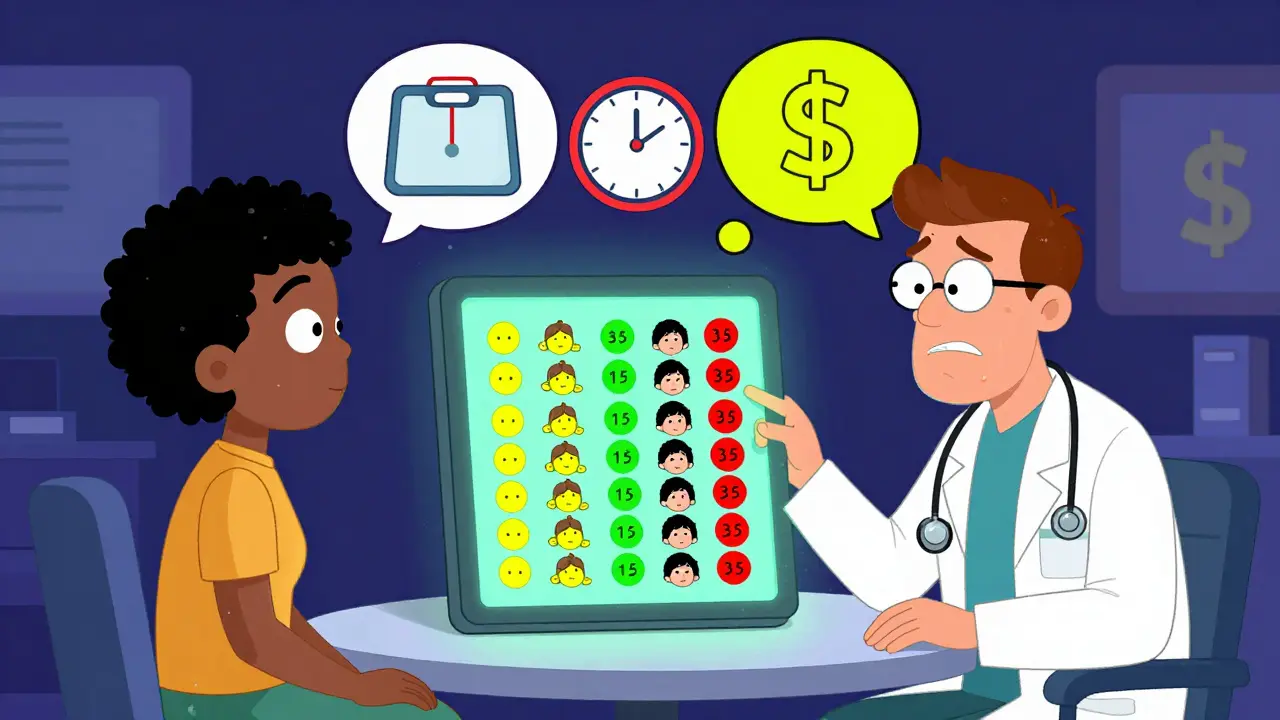
Medication Switch Decision Aid Calculator
Choose Your Medication Options
What Matters Most to You?
Priority Weighting
Adjust what matters most to you
Your Results
Recommended Option: Apixaban (DOAC)
Based on your priorities, Apixaban has the lowest bleeding risk (5%) and requires less monitoring, which aligns with your top concerns.
How this works: This tool uses your priorities to weight the importance of different factors. The more important a factor is to you, the more it influences the recommended option.
Switching medications isn’t just about swapping one pill for another. It’s a decision that can change how you feel every day - for better or worse. Many people stop taking their meds within the first year, not because they’re noncompliant, but because they didn’t fully understand the risks or didn’t feel heard. That’s where decision aids come in. These aren’t just pamphlets or websites. They’re structured tools designed to help you and your doctor make smarter, more personal choices when it’s time to change meds.
What Exactly Are Medication Decision Aids?
Decision aids are digital or printed tools that lay out the real pros and cons of switching medications - no sugarcoating. They show you numbers, not just vague warnings. For example, instead of saying, “This drug might cause weight gain,” they’ll tell you: “Out of 100 people taking this medication, about 30 will gain at least 5 pounds in six months.” That’s concrete. That’s usable.
These tools often include visual aids like icon arrays - little pictures of people with colored dots showing how many experience side effects. If you’re trying to decide between two diabetes drugs, you might see side-by-side charts: one shows a 15% chance of nausea, the other a 35% chance. You also get to rank what matters to you: Is cost more important than dosing frequency? Are you terrified of dizziness, but okay with a little extra weight? The tool helps you sort that out.
They’re built on evidence. The Ottawa Hospital Research Institute and the VA’s MIRECC program have been leading this work for years. Their tools are updated regularly, often every 18 to 24 months, to match new data from drug trials and FDA updates. And they’re not one-size-fits-all. Some support 12 languages and meet accessibility standards so people with vision or cognitive challenges can use them too.
Why Do These Tools Work Better Than a Doctor Saying “Try This”?
Think back to your last doctor’s visit. Did you walk away feeling like you understood why they picked a certain drug? Or did you just nod along because you didn’t want to seem difficult?
Studies show that when patients use decision aids before switching meds, they remember 32% more about their options six months later. They also feel less stressed about the choice - decisional conflict drops by nearly a third. Why? Because these tools force you to face trade-offs head-on.
Take anticoagulants. Switching from warfarin to a DOAC (like apixaban) might sound simple. But the real question is: Are you okay with a slightly higher risk of stomach bleeding if it means fewer blood tests and less dietary restriction? A good decision aid doesn’t tell you what to pick. It shows you what each option really means in plain terms - and then lets you decide.
One veteran on Reddit described how seeing an icon array - 100 people, 3 with bleeding on DOACs, 8 on warfarin - made the choice feel real. “I’d heard ‘lower bleeding risk’ before,” he wrote. “But seeing it as faces made me understand it.”
When Do Decision Aids Fall Short?
They’re powerful, but not magic. These tools don’t help if you’re in an emergency. If you’re having a stroke or a severe allergic reaction, there’s no time for charts and rankings. Decision aids also struggle when patients have serious cognitive issues - like dementia or severe depression - that make it hard to process probabilities.
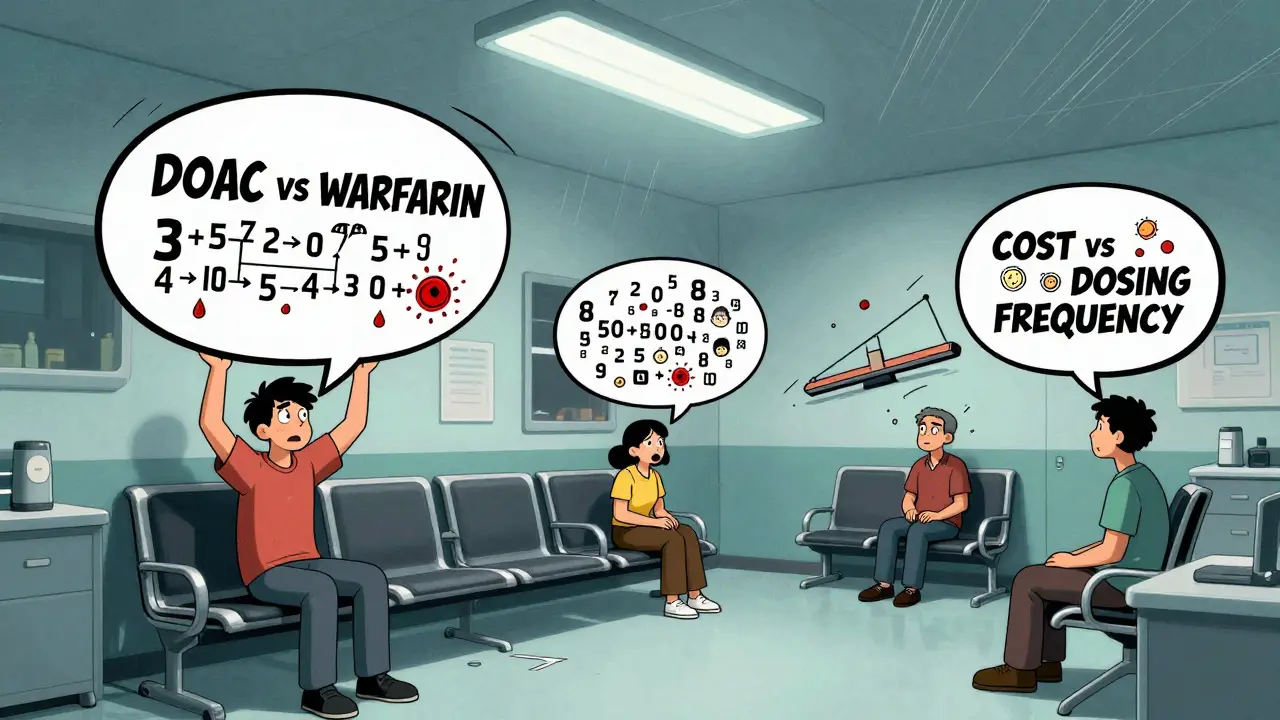
Another problem? Information overload. A 2023 Mayo Clinic study found that 31% of users felt overwhelmed. Too many numbers. Too many options. Some people shut down. That’s why good decision aids don’t dump everything at once. They guide you step by step: first, what are the options? Second, what are the risks? Third, what matters most to you?
And then there’s the tech gap. About 23% of negative reviews mention difficulty accessing digital tools. If you don’t have a smartphone, reliable internet, or confidence using apps, you might be left out. That’s why clinics that use these tools well also offer printed versions or in-person help.
What Do Clinicians Think?
Doctors know these tools work - but many still don’t use them. Why? Time. A 2023 study found that using a decision aid adds 7 to 12 minutes to a typical visit. In a clinic running behind schedule, that’s hard to justify.
Still, adoption is rising. In VA facilities, 68% of mental health teams use decision aids for antidepressant and antipsychotic switches. In primary care? Only 29%. The gap isn’t because doctors don’t believe in them. It’s because they’re not trained to use them, and their systems don’t make it easy.
Training helps. The AHRQ found that after just four hours of focused practice, 87% of clinicians became confident in using these tools. The trick? Learn how to ask the right questions: “What’s your biggest worry about this change?” or “Which side effect would make you say no?” That’s not about giving information - it’s about listening.
Who Benefits Most?
Decision aids shine in situations where there’s no single “best” choice - where the right option depends on your life, your fears, your budget.
- Anticoagulants: Warfarin vs. DOACs - it’s about bleeding risk, monitoring, cost, diet.
- Diabetes meds: Metformin, SGLT2 inhibitors, GLP-1 agonists - each has different side effects, costs, and weight impacts.
- Antidepressants: Switching from SSRIs to SNRIs or bupropion? Side effect profiles vary wildly.
A 2021 study in Diabetes Care found that when patients used decision aids for diabetes meds, 41% more chose treatments that matched their personal priorities. That’s huge. It means fewer people quit their meds because they felt forced into something that didn’t fit.
The Future: AI and Personalization
The next wave? Personalized decision aids. Intermountain Healthcare rolled out a tool in early 2024 that uses machine learning to adjust how risks are shown - based on how you learn. If you respond better to visuals, it shows more charts. If you prefer numbers, it highlights stats. If you’re anxious, it simplifies the language.
The FDA is watching. In 2024, they proposed new rules requiring decision aids to be tested on diverse patient groups - including those with low literacy or limited English - before they’re used widely. That’s a good sign. It means regulators are finally treating these tools like real medical devices, not just fancy websites.
What’s Holding Them Back?
Money. Only 38% of hospitals have dedicated funding to keep decision aids updated. When new drug data comes out, someone has to revise the tool. If no one’s paid to do that, the aid becomes outdated - and worse, misleading.
And then there’s the risk of false equivalence. One case report in the Journal of Patient Experience described a patient who chose a less effective drug because the decision aid made two options look equally valid - even though one had far stronger evidence. That’s why good aids don’t just list options. They rank them by strength of evidence.
What Should You Do?
If your doctor suggests switching meds, ask: “Is there a decision aid we can use?” If they say no, ask why. If they’re unfamiliar with them, suggest the VA’s or Ottawa Hospital’s public tools - they’re free and open to anyone.
Don’t wait for the appointment. Get the tool early. Read it alone. Jot down your concerns. Bring them up. You’re not being difficult - you’re being smart.
And if you’re a clinician? Start small. Pick one high-stakes switch - like anticoagulants or antidepressants - and try the tool with one patient. You’ll see the difference. It’s not about adding work. It’s about making the work you do matter more.
Are medication decision aids only for people with chronic conditions?
No. While they’re most commonly used for long-term conditions like diabetes, heart disease, or depression, they can help anytime a medication switch is optional and has meaningful trade-offs. Even switching pain relievers or antibiotics can benefit from a decision aid if there’s more than one reasonable choice.
Can I use a decision aid without my doctor’s approval?
Yes. Tools from the Ottawa Hospital, VA, and Mayo Clinic are publicly available. You can download, read, and print them anytime. But sharing what you learn with your provider is the next step - these tools are meant to start a conversation, not replace it.
Do decision aids replace the need for a doctor?
Absolutely not. They’re designed to help you talk better with your doctor, not skip the appointment. A decision aid gives you facts, but your doctor adds context: your medical history, lab results, allergies, and other meds you’re taking. You need both.
What if I don’t trust the numbers in a decision aid?
That’s normal. Numbers can feel cold. Ask your doctor to explain how the data was gathered - from which studies, how many people, over what time. Good decision aids cite their sources. If a tool doesn’t, it’s not trustworthy. Stick to those from major medical centers or government health agencies.
How often are these tools updated?
Top-quality decision aids are reviewed every 18 to 24 months, especially when new drug labels come out or major studies are published. Tools from the VA and Ottawa Hospital update regularly. If you’re using a tool that hasn’t changed in over two years, ask if there’s a newer version.
Man, I remember when I first saw one of those icon arrays for anticoagulants. 100 little faces, 3 with red dots for bleeding on DOACs, 8 on warfarin. I’d heard ‘lower bleeding risk’ a hundred times. But seeing it like that? It hit different. I didn’t just understand it-I felt it. Like, suddenly, my anxiety wasn’t abstract anymore. It was a face. A real person. And I could choose which one I wanted to be.
Turns out, I’m the guy who’d rather have a blood test every week than risk a GI bleed. Weird, right? But that’s the thing. The tool didn’t tell me what to pick. It just showed me what I was actually afraid of. And that’s way more powerful than a doctor saying ‘trust me.’
I’ve been using decision aids for my dad’s antipsychotic switch last year. He’s got schizophrenia, and we were stuck between risperidone and olanzapine. One had weight gain written all over it, the other had sedation so bad he’d nap through family dinners.
The tool didn’t sugarcoat. Showed us: 42% chance of >10lb gain on olanzapine. 68% chance of drowsiness >4 hrs/day on risperidone. We ranked what mattered: he cared more about being present than looking a certain way. We went with risperidone. He’s been stable for 14 months now.
But here’s the kicker-it only worked because we printed it out, sat at the kitchen table, and talked through it like a damn game. No rush. No ‘just trust the doctor.’ Just us, the dots, and a whole lot of silence. That’s the magic. Not the tool. The conversation it forced.
YES. YES. YES.
This is the future. Not magic. Not tech. Not AI. Just plain honest talk with numbers. People think meds are about chemistry. They’re not. They’re about *lives*. Weight. Sleep. Money. Fear. Dizziness. Stigma.
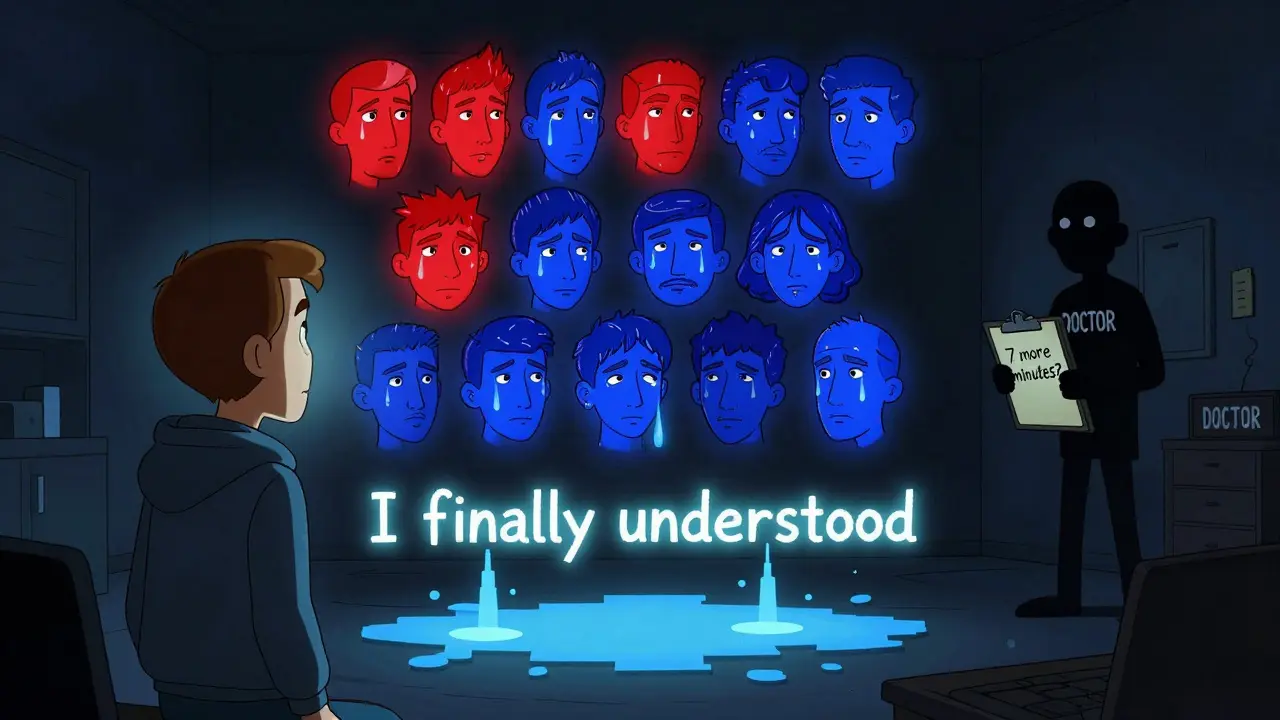
I’ve watched patients cry because they finally understood why their last med made them feel like a zombie. Not because it didn’t work. Because they were never shown the trade-offs. They were told ‘take it’ and left to suffer in silence.
Decision aids don’t just inform. They liberate. And if your doc doesn’t use them? Ask. Push. Demand. This isn’t optional. It’s ethical.
Also-icon arrays? Game. Changer. Stop underestimating visuals. They’re not dumb. They’re democratic.
Oh wow. A tool that actually tells you the truth instead of ‘this drug is safe and effective’ nonsense. Who knew? Maybe next they’ll invent a ‘don’t lie to patients’ button.
Decision aids? More like decision *delays*. You’re telling me we’re gonna hand a 72-year-old diabetic a 12-page PDF with icon arrays and expect them to ‘rank priorities’? Meanwhile, their blood sugar’s at 480 and their kid’s on the phone screaming ‘DAD, YOU NEED TO TAKE THIS MED!’
Also, ‘evidence-based’? Sure. But half the studies are funded by pharma with a vested interest in which side effect gets highlighted. I’ve seen the raw data. The ‘35% nausea’? That’s 6-month data. What about year 2? They don’t show that.
And don’t get me started on the ‘12 languages’ thing. What about the 17% of elderly Americans who speak only Spanish *and* have low literacy? You think they’re reading icon arrays? Nah. They’re nodding and taking the pill they’ve always taken.
This isn’t innovation. It’s performative medicine.
My grandma took a pill for 10 years because the doctor said ‘it’s fine.’ She had a stroke. The decision aid would’ve shown her 1 in 5 had a stroke on that med. She’d have said NO. I hate that no one told her. R.I.P. Nana.
Y’all are missing the point. This isn’t about tools. It’s about *trust*. I’m a Black guy from Detroit. My doc says ‘take this new med’ and I think ‘why? You don’t even know my life.’
But when I saw a decision aid that said ‘22% of people like you had kidney issues on this drug’? That’s different. That’s data that *sees* me.
It’s not about the chart. It’s about the fact that someone bothered to include my demographic. That’s the real innovation. And yeah, I printed it. Took it to my next visit. My doc looked surprised. Then he smiled. We talked for 20 minutes. No rush.
That’s what matters. Not the tech. The humanity behind it.
Okay, but what if you’re a single mom working two jobs and your kid has asthma? You don’t have 12 minutes to sit through a decision aid. You just need to know: ‘Will this make me pass out at work?’ or ‘Will it cost $800 a month?’
Tools are great. But if they’re not embedded in *real* workflows? They’re just another thing that makes healthcare feel like a puzzle you’re not allowed to solve.
And if your clinic doesn’t have a printed version? That’s not a tech gap. That’s a class gap. And we’re still pretending this is about ‘patient empowerment’ when it’s really about who gets time, space, and dignity.
So you’re telling me we’re gonna use a tool that says ‘30% gain weight’ but not tell me that 30% is based on 200 people in a trial where 80% were white, middle-class, and had no kids? That’s not evidence. That’s a fantasy. And now I’m supposed to trust a chart? Lol.
Also, ‘personalized AI tools’? Bro. My phone already thinks I want to buy a new mattress because I sneezed once. I don’t need AI deciding what drug I take.
I just want to say thank you for writing this. I’m a nurse, and I’ve seen so many patients leave the clinic looking confused, scared, or guilty-like they failed because they didn’t ‘just take the pill.’
One patient, Maria, had bipolar disorder. She was terrified of weight gain. Her doctor pushed her onto olanzapine. She quit. Ended up in the ER. We gave her the VA decision aid. She cried. Said she’d never seen anyone talk about how it felt to be ‘too heavy to hold her daughter.’ We switched her. She’s been stable for 8 months.
It’s not about the tool. It’s about listening. The tool just gives you the language to listen better.
Also, if your clinic doesn’t have printed copies? Ask for them. Bring them up. It’s not weird. It’s your right.
From a clinical informatics perspective, the real value lies in the structured outcome data generated by these tools. When integrated into EHRs, they enable real-time risk stratification, predictive modeling of adherence, and cohort-level analysis of preference-based prescribing patterns. The Ottawa model’s use of discrete choice experiments (DCEs) with utility weighting is particularly robust for capturing latent patient preferences-far superior to Likert-scale surveys. The next frontier is dynamic decision trees calibrated to real-time biomarkers, e.g., HbA1c trends triggering adaptive risk visualizations.
When I was deciding between two antidepressants, I didn’t know what ‘serotonin syndrome’ meant. The tool had a simple animation: ‘Your brain’s chemicals are like a bathtub. One med makes the faucet turn up. The other turns the drain bigger.’ I got it. No jargon. Just a picture.
And I didn’t even know I cared about dosing frequency until I saw the options side-by-side. One pill a day vs. two. I picked the one-pill one. Not because it was better. Because I’m bad at remembering things.
Turns out, I’m not weird. I’m normal. And this tool didn’t judge me. It just helped me be honest.
My sister is deaf. She uses ASL. The decision aid had video explanations in ASL. That’s the first time she understood her meds. Not because it was fancy. Because someone thought: ‘Wait. What if they can’t read?’
That’s what I want for everyone. Not just ‘accessible.’ But *thoughtful*.