Every year, millions of people unknowingly take counterfeit medication that could be dangerous or even deadly. In some countries, 1 in 10 medical products is counterfeit. But how can you tell if your medicine is real? The good news is that you don’t need expensive tools to spot many fakes. With a little knowledge and careful checking, you can protect yourself and your loved ones.
Step 1: Start with a Visual Inspection
First, look at the packaging closely. Counterfeiters often make mistakes that are easy to spot with your eyes. Check for:
- Spelling errors - Genuine packaging has perfect spelling. Fakes often have typos or incorrect wording.
- Font inconsistencies - Real medicine packaging uses consistent fonts. For example, in 2023, the FDA warned about counterfeit Ozempic where the lot numbers had uneven font weights. Genuine ones have uniform lettering, while fakes often look blurry or misaligned.
- Color differences - Authentic packaging has precise colors. In one case, counterfeit Lipitor used a blue shade (Pantone 286C) that was discontinued in genuine products after 2002. If the color looks off, it’s a red flag.
Check Security Features Like Holograms and QR Codes
Modern medication packaging includes security features designed to be hard to copy. Here’s what to look for:
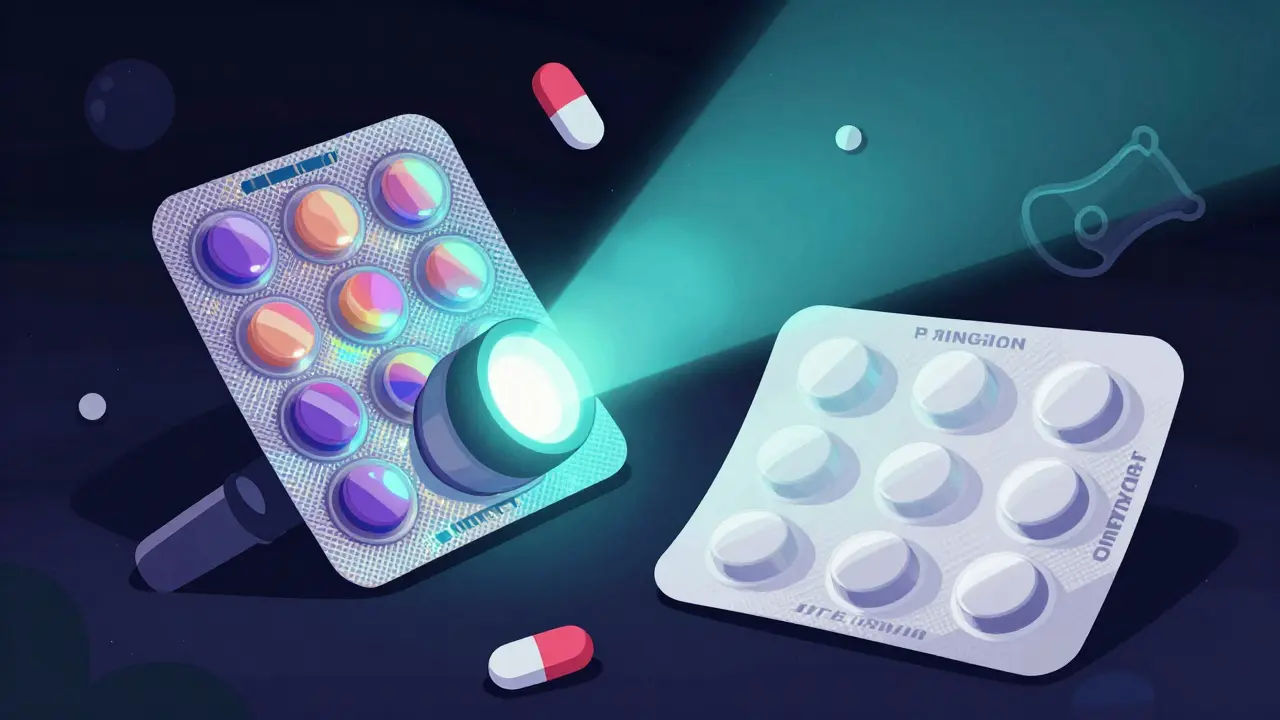
Holograms are special reflective images that change when viewed from different angles. Genuine holograms have crisp details, sharp edges, and smooth color transitions. Fake holograms often look blurry, have jagged edges, or missing elements. For example, counterfeit versions of Levitra blister packs have been found with holograms that don’t shift properly under light.
QR codes should link to official manufacturer websites. Scan the code with your phone. If it takes you to a suspicious site or doesn’t work, the packaging is likely fake. In 2022, a Reddit pharmacy community thread documented counterfeit Adderall with QR codes that led to phishing sites instead of the manufacturer’s page.
| Method | Cost | Accuracy | Accessibility |
|---|---|---|---|
| Visual Inspection | $0 | 12-35% | Anyone |
| UV Light Check | $10-$50 | 60-70% | Consumers |
| Magnifying Glass (Microtext) | $5-$20 | 45-60% | Consumers |
| Raman Spectrometer | $15,000-$25,000 | 98.7% | Pharmacies/Labs |
Use a UV Light for Hidden Details
Many legitimate medications use ultraviolet-reactive ink for security features. You can test this with a simple UV flashlight (available for under $10 online).
UV light can reveal hidden patterns that are invisible under normal light. For instance, genuine pills often have UV-reactive ink that glows under a blacklight, while fakes might not react at all. The FDA’s 2023 report noted that 42% of counterfeit cases involved inconsistent ink fluorescence under UV light. If the glow looks weak or uneven, the product may be fake.
Examine Microtext with a Magnifying Glass
Many authentic packages include tiny printed text too small to read with the naked eye. Use a 10x magnifying glass to check these details.
Microtext is a security feature where text is printed in such small size it’s hard to replicate. Counterfeiters often miss this detail. For example, in a 2022 case, counterfeit Adderall pills had imprints with inconsistent depth (0.12mm vs genuine 0.15mm), which was only visible under magnification. Genuine packaging usually has clear, sharp microtext, while fakes may have smudged or missing lines.
What to Do If You Find a Counterfeit
If you suspect your medication is fake, stop using it immediately. Contact your pharmacist or healthcare provider. Report it to the FDA through their MedWatch program by calling 1-800-FDA-1088 or visiting their website. The FDA processed over 4,872 counterfeit drug reports in 2022 with a 72-hour response time for urgent cases.
Avoid These Common Mistakes
Many people make mistakes when checking for counterfeits. Here’s what to avoid:
- Relying on only one check - The FDA found that 73% of counterfeit detection failures result from overreliance on single verification methods. Always use multiple checks.
- Assuming expensive drugs are always fake - Counterfeiters target both high and low-cost medications. Don’t assume cheap drugs are safe.
- Ignoring packaging differences - Even small changes like paper weight (e.g., 120gsm vs genuine 114gsm) can indicate fakes.
Frequently Asked Questions
Can I use my smartphone to check for counterfeit medications?
Most smartphone apps aren’t reliable for detecting counterfeits. While some QR code scanners can check if the link is legitimate, they can’t verify packaging details like holograms or microtext. Always rely on visual inspections and UV light tests instead of apps.
What should I do if I find a counterfeit medication?
Stop using the medication immediately. Contact your pharmacist or healthcare provider, then report it to the FDA through MedWatch (1-800-FDA-1088). Reporting helps authorities track counterfeit networks and prevent others from being harmed.
Are online pharmacies safe to buy from?
Only buy from pharmacies that require a prescription and are licensed. The FDA warns that 95% of online pharmacies selling prescription drugs are illegal. Check if the site has a verified pharmacy seal like VIPPS.
What’s the difference between counterfeit and expired medication?
Counterfeit medication is fake and made to look real, while expired medication is genuine but past its safe use date. Counterfeits may contain harmful ingredients or no active drug at all. Expired meds lose effectiveness but aren’t necessarily dangerous (unless specified).
How common are counterfeit medications in the U.S.?
In the U.S., counterfeit medications are rare (less than 0.5% of prescriptions) due to strict regulations. However, they become more common when buying from unverified online sources. The Drug Supply Chain Security Act has reduced infiltration to 0.001% in serialized supply chains.
Always check font consistency in lot numbers; it's a dead giveaway for fakes.
Checking packaging weight is another good step. Genuine products have consistent paper quality; fakes feel flimsier.
Yes! 🌟 UV light can reveal hidden details. A cheap flashlight works wonders.
UV light is affordable and effective. I always carry one in my pharmacy kit.
I agree. The 10x magnifying glass is also super useful for microtext. Found a fake Adderall once where the imprint was blurry under magnificat.
Microtext is a complete scam.
The FDA doesn't even require it for most medications.
It's just a way to sell expensive tools to consumers.
Most counterfeiters don't even bother with microtext because it's too hard to replicate.
The real issue is the lack of enforcement.
The FDA processes thousands of reports but does nothing about the root causes.
They're more concerned with protecting pharmaceutical companies than consumers.
The entire system is broken.
You can't trust any medication without extensive testing.
That's why I always use a Raman spectrometer-no one else has access to that kind of equipment.
It's the only reliable way to detect counterfeits.
But since it costs $20,000, most people can't afford it.
The government should fund public access to these devices.
Until then, we're all at risk.
This is why I'm calling for immediate action.
The pharmaceutical industry is in cahoots with the FDA to keep prices high.
They want you to believe counterfeits are rare, but they're everywhere.
Always check the lot number on the website. It's a trap.
The only safe option is to avoid prescription drugs altogether.
They're all part of the conspiracy.
The Drug Supply Chain Security Act has significantly reduced counterfeit medications in the US supply chain. According to the FDA, serialized supply chains have cut counterfeits to 0.001%. However, online pharmacies remain a major risk-95% are illegal and often sell fake drugs. Always verify the pharmacy's license through VIPPS or similar programs. Also, check the packaging for holograms and QR codes. If the QR code leads to a suspicious site, report it immediately. Don't rely solely on one method; combine visual checks, UV light, and magnifying glass for best results. The FDA's MedWatch program is there for reporting. Stay vigilant and protect yourself.
Yeah, but the government is in on it. They let counterfeits in to control the population. The FDA is part of the conspiracy.
Stop wasting time. If you're not a pharmacist, you can't spot fakes. Just buy from licensed pharmacies.
Consumers can learn to spot fakes. The guide covers basics like visual checks and UV light. It's not that hard.
No way. The FDA is lying. They want you to buy expensive drugs. Check lot numbers on the website-it's a trap.
QR codes should link to official sites. I've seen fakes where the QR code led to phishing sites.
I tried the QR code on a fake once. It went to a phising site. Always check the URL. But also, the hologram should shift colors. If it doesn't, it's fake.
The entire process is flawed. Regulatory bodies fail to protect consumers. The only solution is to avoid all pharmaceuticals.