Metoclopramide-Antipsychotic Interaction Checker
Warning: This is not medical advice
This tool helps identify potential drug interactions based on FDA warnings and medical literature. Consult your healthcare provider before making any medication changes.
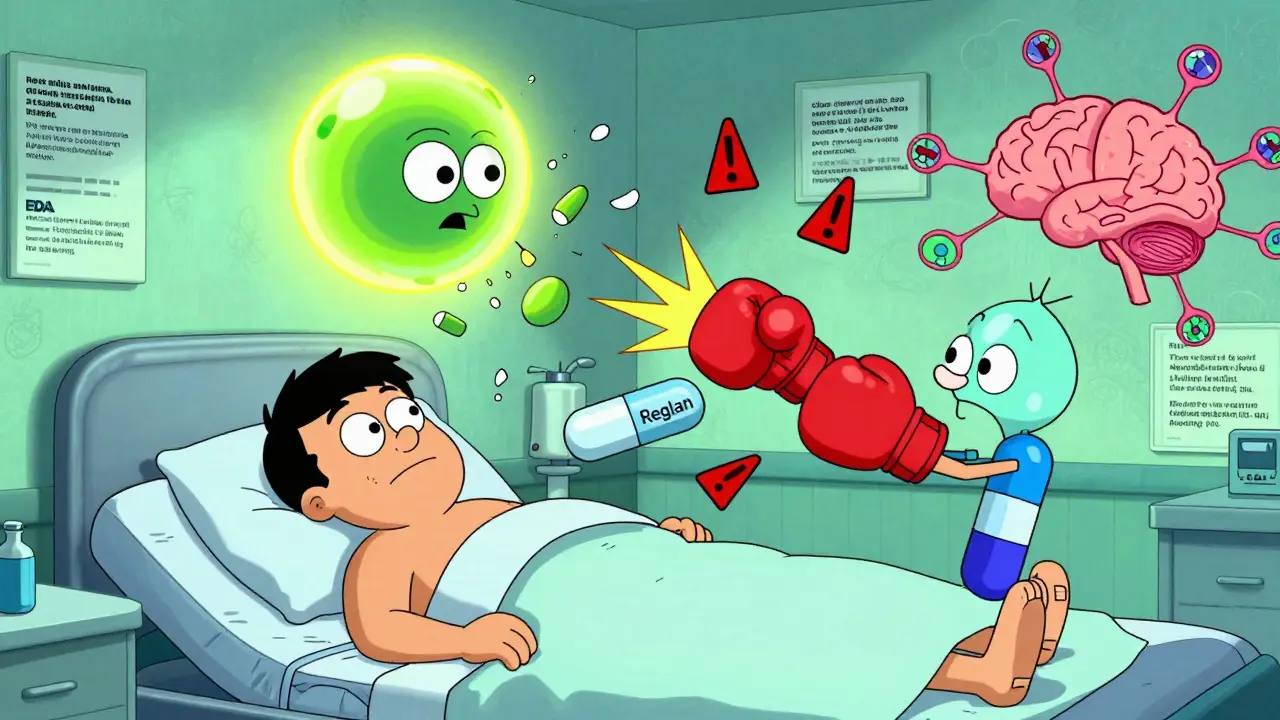
When you're dealing with nausea from chemotherapy, gastroparesis, or a bad reaction to medication, metoclopramide (Reglan) can feel like a lifesaver. But if you're also taking an antipsychotic-like risperidone, haloperidol, or olanzapine-what seems like a simple fix could be pushing your body toward a medical emergency. Neuroleptic Malignant Syndrome isn't just a rare side effect. It's a life-threatening reaction that can develop fast, and the combination of metoclopramide and antipsychotics is one of the most dangerous drug pairings you won't find on most warning labels.
How Metoclopramide and Antipsychotics Work the Same Way
Metoclopramide isn't just an anti-nausea drug. It blocks dopamine receptors in the brain, especially in an area called the chemoreceptor trigger zone. That’s how it stops vomiting. But here’s the catch: most antipsychotics do the exact same thing. They block dopamine receptors too, especially D2 receptors, to reduce hallucinations and delusions. When you take both, you're doubling down on dopamine blockade. It’s not additive-it’s multiplicative.This isn't theoretical. The FDA’s official prescribing information for metoclopramide says clearly: Avoid Reglan in patients receiving other drugs associated with NMS, including typical and atypical antipsychotics. That’s not a suggestion. That’s a red alert. And it’s backed by decades of clinical evidence. Both drug classes interfere with the brain’s dopamine pathways. When dopamine drops too low, too fast, your body can’t regulate movement, temperature, or muscle control. That’s when NMS starts.
What Neuroleptic Malignant Syndrome Actually Looks Like
NMS doesn’t begin with a headache or mild dizziness. It starts quietly-then explodes. The classic signs form a deadly tetrad:- High fever-often above 102°F (39°C), sometimes reaching 106°F (41°C)
- Severe muscle rigidity-so stiff you can’t move your limbs, like a statue
- Altered mental status-confusion, agitation, delirium, or even coma
- Autonomic instability-wild swings in blood pressure, heart rate, sweating, or breathing
These symptoms can show up within hours or take a few days. But once they start, time is critical. NMS has a mortality rate of up to 20% if not treated immediately. And it’s often mistaken for other conditions-like infections, heat stroke, or serotonin syndrome-delaying the right treatment.
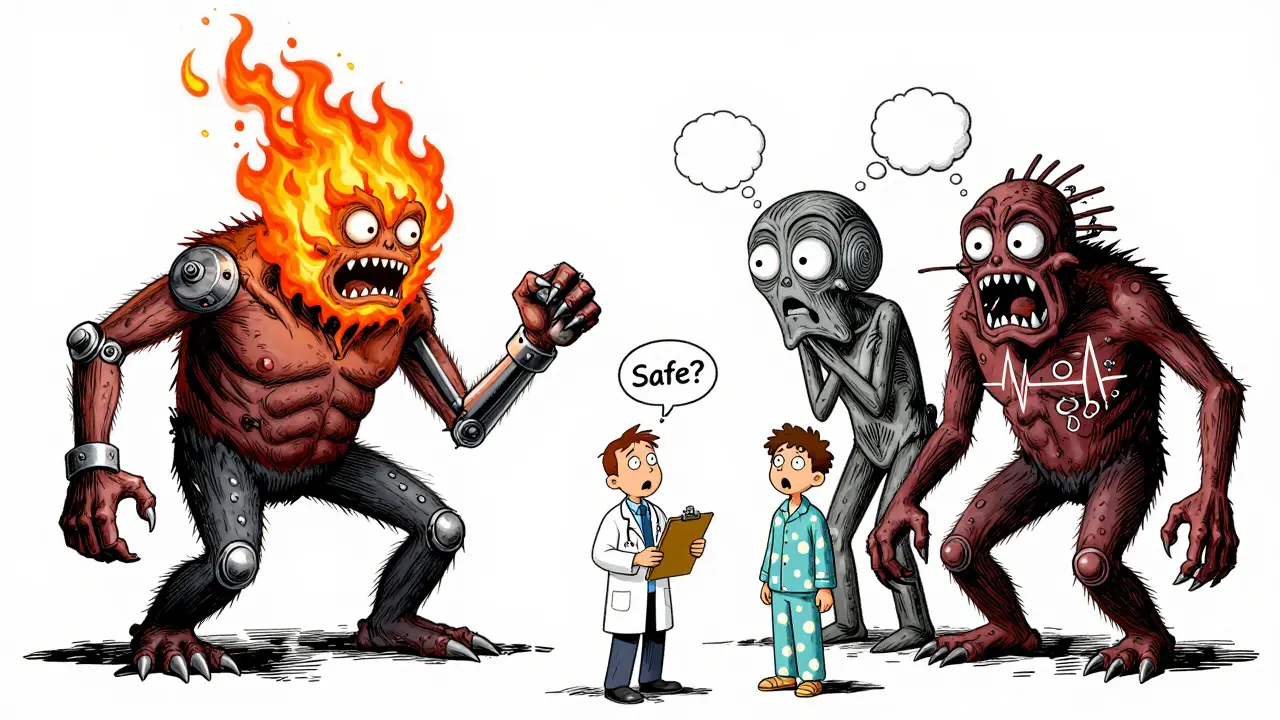
What makes this even scarier is that you don’t need to be on high doses. Even low-dose metoclopramide, taken for a few days alongside a standard antipsychotic, can trigger NMS. There’s no safe threshold when these two drugs meet.
Why This Interaction Is Worse Than You Think
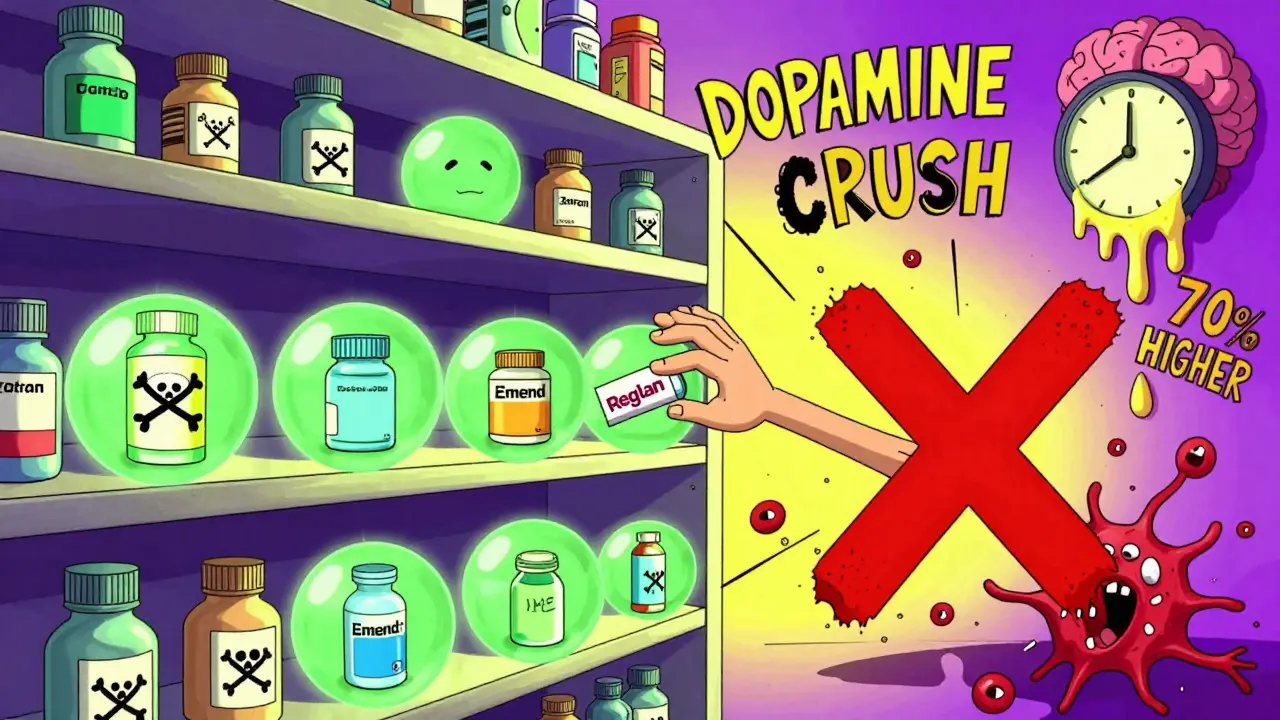
Most people assume drug interactions are about one drug making the other stronger. This is worse. It’s a double punch.First, the pharmacodynamic effect: both drugs block dopamine. Together, they crush dopamine activity far beyond what either would do alone.
Second, the pharmacokinetic effect: many antipsychotics-like risperidone, haloperidol, and aripiprazole-block the liver enzyme CYP2D6. That’s the same enzyme that breaks down metoclopramide. So when you take them together, metoclopramide doesn’t get cleared from your body. It builds up. Your blood levels can spike by 30% to 50%, even if you’re taking the same dose you’ve always taken.
This combination hits hardest in people who already have slower metabolism-older adults, those with kidney problems, or people with a genetic variation in CYP2D6. One study found that people with poor CYP2D6 activity had up to 70% higher metoclopramide levels. Add an antipsychotic? You’re playing Russian roulette with your nervous system.
What You Should Never Mix With Metoclopramide
The FDA doesn’t just warn about antipsychotics. It lists a whole group of drugs that can trigger the same dangerous reaction:- Typical antipsychotics: haloperidol, fluphenazine, chlorpromazine
- Atypical antipsychotics: risperidone, olanzapine, quetiapine, ziprasidone
- Some antidepressants: fluoxetine (Prozac), paroxetine (Paxil), bupropion (Wellbutrin)
- Drugs for Parkinson’s: levodopa, pramipexole, ropinirole
And here’s the kicker: if you’ve ever had movement problems from metoclopramide-like tremors, muscle spasms, or twitching-you’re at even higher risk. The FDA’s boxed warning for metoclopramide says it can cause tardive dyskinesia, a permanent movement disorder. If you’ve already had that, you shouldn’t be taking it at all. And if you’re on an antipsychotic? You’re already in the high-risk group.
Alternatives That Won’t Put You in Danger
You still need to control nausea. But you don’t need to risk your life. Here are safer options:- Ondansetron (Zofran)-blocks serotonin, not dopamine. Safe with antipsychotics.
- Methylprednisolone-used for chemo-induced nausea, no dopamine interaction.
- Prochlorperazine-yes, it’s an antipsychotic, but it’s used in low doses for nausea. Still risky. Avoid if possible.
- Aprepitant (Emend)-for severe nausea, especially after chemo. Works through a different pathway entirely.
There’s no perfect substitute for everyone, but the key is avoiding dopamine blockers. Ask your doctor: Is there a way to treat my nausea without touching dopamine? If they say no, get a second opinion.
What to Do If You’re Already Taking Both
If you’re on metoclopramide and an antipsychotic right now, don’t panic-but don’t wait either.Step 1: Make a list of every medication you take. Include vitamins, supplements, and over-the-counter drugs. Many people forget that some cold medicines or sleep aids contain antihistamines or other CNS-active ingredients that can worsen this interaction.
Step 2: Bring that list to your doctor or pharmacist. Say: I’m on metoclopramide and an antipsychotic. I want to know if this combination is safe. If they hesitate or say it’s "rare," push back. The FDA says avoid it. That’s not rare-it’s a clear warning.
Step 3: If you develop any of these symptoms, seek emergency care immediately:
- High fever (over 101°F)
- Stiff muscles or trouble moving
- Confusion, drowsiness, or sudden change in behavior
- Fast heartbeat or sweating without reason
Don’t wait to see if it gets better. NMS doesn’t resolve on its own. It gets worse.
Why This Isn’t Just About One Drug
Metoclopramide has been on the market since 1980. For decades, doctors assumed it was safe because it was used for nausea. But the science has caught up. We now know that dopamine blockade in the brain-even from drugs not labeled as antipsychotics-can trigger the same deadly cascade.It’s not just about metoclopramide. It’s about how we think about drugs. We treat them like isolated tools. But your body doesn’t work that way. It’s a system. Block dopamine in one place, and it affects movement, temperature, mood, and consciousness. Combine two dopamine blockers? You’re overloading the system.
That’s why the FDA added the boxed warning for tardive dyskinesia. That’s why they explicitly forbid combining it with antipsychotics. And that’s why you need to treat this like a red flag-not a footnote.
What Doctors Should Be Doing
Most prescribers aren’t trained to see this interaction unless they’re psychiatrists or pharmacologists. Primary care doctors, ER staff, and even gastroenterologists may not realize metoclopramide is a dopamine blocker.Best practice? Any patient on an antipsychotic should be screened for metoclopramide use before it’s prescribed. If they need an antiemetic, start with ondansetron. If that doesn’t work, consider non-pharmacological options-acupuncture, ginger, dietary changes-before even thinking about dopamine blockers.
And if metoclopramide is absolutely necessary? Use the lowest dose for the shortest time possible. Never longer than 12 weeks. And monitor closely for any movement changes, fever, or mental shifts.
Final Takeaway: Don’t Assume Safety
You might think, "I’ve been on both for months and I’m fine." That’s not proof it’s safe. It’s proof you haven’t had a reaction yet. NMS can strike suddenly-even after years of stable use.This isn’t about fear. It’s about awareness. Metoclopramide isn’t a harmless nausea pill. It’s a powerful brain-altering drug. And when paired with antipsychotics, it becomes a potential trigger for a condition that kills.
If you’re on either of these drugs, ask your provider: Is there a safer way to manage my symptoms? If they can’t give you a clear answer, get help from a pharmacist or specialist. Your life might depend on it.
So I’ve been on risperidone for years and took Reglan for a week after surgery… no issues. But now I’m second-guessing every sneeze.
Oh honey, this is why I stopped trusting doctors who treat meds like Lego blocks. You stack ‘em, think it’s cute, then boom - your body throws a tantrum and starts running a fever like it’s in a sauna. Metoclopramide isn’t some cute little nausea fairy. It’s a dopamine wrecking ball in a pink pill. And pairing it with antipsychotics? That’s not a cocktail. That’s a suicide pact with your basal ganglia.
I had a cousin who got NMS after just three days of this combo. Three days. She was fine Monday. By Thursday she couldn’t speak, her muscles were like concrete, and they had to intubate her. She’s alive now, but her tremors never left. And guess what? Her PCP swore it was "rare." Rare? That’s not rare. That’s negligence dressed in a white coat.
And don’t get me started on how pharmacies still dispense this without blinking. I’ve seen scripts for metoclopramide get filled next to haloperidol like they’re buying milk and eggs. No warning. No flag. No "hey, your brain might turn into a malfunctioning robot."
It’s not just about the drugs. It’s about the system. We treat patients like data points, not humans with fragile, interconnected biology. Dopamine isn’t some abstract concept - it’s what lets you smile, walk, breathe without thinking. Smash it twice? You’re not just risking side effects. You’re risking your soul’s ability to move through the world.
And yet, here we are. People still get prescribed this like it’s Advil. I wish I could hand every prescriber a copy of this post and make them read it while holding a vibrating muscle from someone with NMS. Maybe then they’d stop treating brains like vending machines.
Also - ondansetron? Yes. Please. More of that. Less dopamine chaos. More serotonin calm. Thank you.
USA doctors always scare people with rare side effects but in Nigeria we just give the drug and hope for the best. This is why your healthcare is so expensive. We don't overthink we just heal
I’m so glad someone finally said this. My grandma was on this combo and no one ever warned us. She got really stiff and confused and we thought it was just aging. Turns out it was NMS. She’s okay now but I’ll never forget how scared we were. Please, if you’re on either of these - ask your pharmacist. They know way more than your doctor sometimes.
Okay so I just Googled this and holy CRAP I’ve been taking Reglan with olanzapine for 18 months??!!?? I thought the tremors were just "side effects"??!! I’ve been sweating like a sauna and my husband says I walk like a robot??!! I’m literally calling my doctor RIGHT NOW!!
This is exactly why I started teaching medication safety workshops in my community. Most people don’t realize that "anti-nausea" doesn’t mean "harmless." I’ve sat with elderly patients who’ve been on metoclopramide for years because their GI doc didn’t know it was a dopamine blocker - and they were also on risperidone for psychosis. No one connected the dots. We need better cross-specialty communication. Pharmacists? You’re the last line of defense. Speak up. Doctors? You’re not the only expert in the room. Listen to your pharmacists. Patients? You are your own best advocate. Ask: "Is this going to block dopamine?" If the answer is yes - and you’re on another dopamine blocker - walk out. Find someone who knows what they’re doing.
I’ve seen too many people suffer because we treat drugs like they’re separate entities. Your body doesn’t care if a pill is labeled "antipsychotic" or "antiemetic." It only cares about receptors. And when you overload dopamine blockade? You’re not just increasing risk. You’re triggering a cascade that your body can’t recover from without intensive care. And even then - it’s not guaranteed.
Let’s stop normalizing dangerous combinations because they’re "common." Common doesn’t mean safe. It just means we’ve been lazy.
Also - if you’ve had tardive dyskinesia? Don’t even think about metoclopramide. It’s not worth the risk. Ever. And if your doctor says "it’s fine" - get a second opinion. Not a third. A second. Right now.
And for the love of all that’s holy - if you’re a student, a nurse, a caregiver, a family member - learn this. Teach this. Share this. Because someone’s life might depend on it. And if you’re reading this and you’re on this combo? Please, please, please - don’t wait for symptoms. Act now.
It’s funny how we’ve built this entire medical system on the assumption that drugs are isolated variables. We run clinical trials on one drug at a time, then slap them together like a science fair project and call it "evidence-based." But the human body isn’t a lab. It’s a symphony. And when you shove two conductors onto the same podium - both screaming at the orchestra to play quieter - you don’t get harmony. You get silence. Or worse - a breakdown. NMS isn’t a side effect. It’s the body screaming that the system is overloaded. We treat symptoms, not systems. That’s why this keeps happening. We’re not fixing the problem. We’re just putting bandages on a ruptured artery.
Stop taking metoclopramide if you’re on antipsychotics. Use ondansetron. End of story. If your doctor disagrees, get a new one.
As a pharmacologist, I can confirm the CYP2D6 inhibition is the real kicker here. Metoclopramide’s half-life doubles when co-administered with risperidone or fluoxetine. The FDA’s warning is conservative. Real-world data shows NMS incidence triples in CYP2D6 poor metabolizers on this combo. And it’s not just genetic - age, liver disease, even chronic alcohol use can mimic poor metabolizer status. This isn’t a "rare" interaction. It’s a predictable pharmacokinetic disaster waiting to happen. We need mandatory CYP2D6 screening before prescribing metoclopramide to anyone on CNS-active meds. Period.
People are dying because doctors are too lazy to read the FDA label. I’m not mad - I’m disappointed. This isn’t a mystery. It’s in the boxed warning. Right there. In bold. And yet? Still being prescribed. This is medical malpractice disguised as routine care. Shame on every prescriber who ignores this.
I appreciate the depth of this post. The pharmacokinetic and pharmacodynamic breakdown is spot-on. I’ve seen this in the ER - patients brought in with rigidity and hyperthermia, and the family says, "But she’s been on this for months." That’s the tragedy. It’s not about duration. It’s about accumulation and synergy. We need better EHR alerts. And we need to stop treating antipsychotics as "just psychiatric" drugs. They’re neuroactive. Period.
Okay so I just looked up my meds and I’m on Zofran and Abilify… wait no, I’m on Reglan and Seroquel. OH MY GOD. I’ve been having muscle spasms and feeling like I’m in a fever dream every night. I thought it was just stress. I just called my doctor. She said "oh that’s normal." I said "NO IT’S NOT" and hung up. I’m going to the ER tomorrow. I’m not dying because someone didn’t read the label.
Also - why does no one talk about this? I’ve been on this combo for 2 years. I’m 34. I have a kid. I’m not ready to become a statue.
This is why I always double-check with my pharmacist. They caught this combo for me before I even started. I’m on olanzapine for bipolar, and they flagged metoclopramide immediately. Said, "Try ginger tea first." I did. It helped. No drama. No NMS. Just common sense. If your provider won’t listen - find one who will. Your nervous system isn’t a gamble.
Good point. I’ve seen people dismiss this because "they’ve been fine." But NMS doesn’t care about your history. It only cares about the chemistry in your brain right now. One extra dose. One missed kidney clearance. One CYP2D6 variant. And boom. It’s not about luck. It’s about risk stacking. And we’re all playing Russian roulette with our meds.