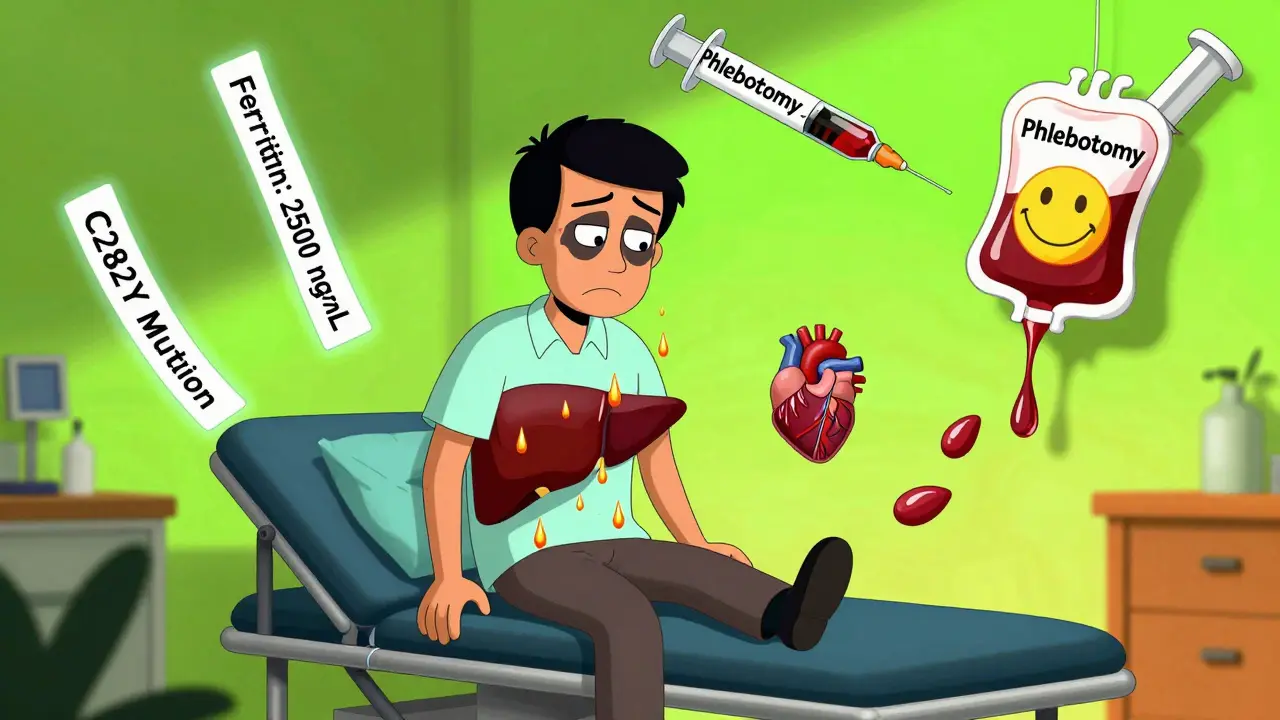
Imagine feeling tired all the time, your joints ache, and you lose interest in sex - but every doctor you see tells you it’s just stress, aging, or depression. For many people with hemochromatosis, that’s their reality. This isn’t just fatigue. It’s iron overload - a silent, genetic condition where your body absorbs too much iron from food, and that extra iron slowly poisons your liver, heart, pancreas, and joints. Left untreated, it can lead to cirrhosis, diabetes, heart failure, or even liver cancer. The good news? There’s a simple, effective, and free treatment: phlebotomy.
What Exactly Is Hemochromatosis?
Hemochromatosis is not a disease you catch - it’s something you inherit. It’s caused by mutations in the HFE gene, most commonly the C282Y mutation. If you get two copies of this faulty gene (one from each parent), your body loses the ability to regulate iron properly. Normally, your liver makes a hormone called hepcidin that tells your gut to stop absorbing iron when you have enough. In hemochromatosis, hepcidin doesn’t work. So your body keeps pulling in iron - even when it’s already full.
That extra iron doesn’t just sit around. It builds up in organs. The liver takes the first hit, but iron also settles in the pancreas (causing diabetes), the heart (leading to arrhythmias), and the joints (triggering pain that feels like arthritis). Men are affected five to ten times more often than women - not because they’re more genetically prone, but because women lose iron through menstruation until menopause. That’s why symptoms usually appear between ages 30 and 50 in men, and later in women.
It’s more common than you think. In people of Northern European descent - especially those with Irish, Scottish, or Welsh ancestry - about 1 in 83 carry two copies of the C282Y mutation. In the U.S., roughly 1 in 200 people have the condition. Yet only 10-15% of them are diagnosed. Why? Because early symptoms are vague: tiredness, joint pain, loss of libido. Easy to brush off.
How Do You Know If You Have It?
Diagnosis starts with two simple blood tests:
- Serum ferritin: This measures how much stored iron you have. Normal levels are 30-400 ng/mL for men, 15-150 ng/mL for women. In hemochromatosis, levels often exceed 300 ng/mL in men and 200 ng/mL in women - sometimes reaching over 1,000 or even 3,000 ng/mL.
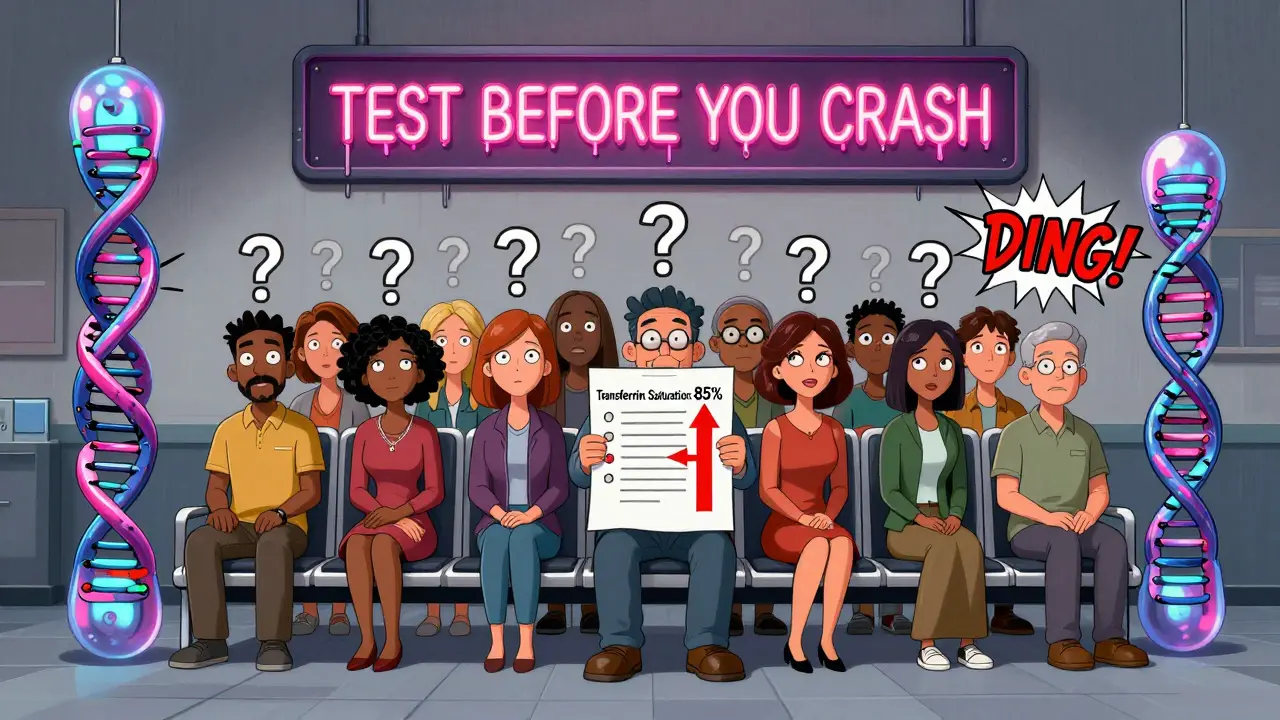
- Transferrin saturation: This shows how much iron is floating in your blood, bound to the protein transferrin. Normal is under 45%. In hemochromatosis, it’s usually over 60%, often above 80%. This is the earliest red flag - it rises before ferritin does.
If both tests are high, genetic testing confirms it. The test looks for mutations in the HFE gene - mainly C282Y homozygosity (two copies), which causes 80-95% of cases. Less common is compound heterozygosity (C282Y/H63D), which accounts for 5-10% of cases. Other rare types exist, but they’re unusual.
Here’s the critical point: if your ferritin is above 1,000 ng/mL, you have a 50-75% chance of already having liver scarring (cirrhosis). Once cirrhosis sets in, your risk of liver cancer skyrockets. That’s why early testing matters. If you have a family member with hemochromatosis, get tested. If you’re over 30 and have unexplained fatigue, joint pain, or diabetes, ask for these two blood tests.
Phlebotomy: The Simple Cure
There’s no pill for hemochromatosis. But there is a treatment older than most modern drugs: phlebotomy - the medical term for removing blood. Think of it like donating blood, but on a schedule. Each 500 mL of blood removed contains about 200-250 mg of iron. That’s how you drain the excess.
The process has two phases:
- Induction phase: You get a phlebotomy every week until your ferritin drops to 50 ng/mL. For someone with ferritin at 2,500 ng/mL, that might take 40-60 sessions over 1-2 years. It sounds intense, but most people feel better within months. Fatigue fades. Joint pain eases. Energy returns.
- Maintenance phase: Once iron levels are normal, you switch to maintenance. Most people need a phlebotomy every 2-4 months to keep ferritin between 50-100 ng/mL. Some need it more often; others less. The goal isn’t to cure - it’s to prevent damage.
Here’s the kicker: this treatment is often covered by insurance. In many places, you can get therapeutic phlebotomy at a blood donation center for free or under $50 per session. Compare that to lifelong diabetes meds, liver transplants, or heart treatments - which can cost tens of thousands a year. Phlebotomy isn’t just effective. It’s affordable.
What Happens If You Don’t Treat It?
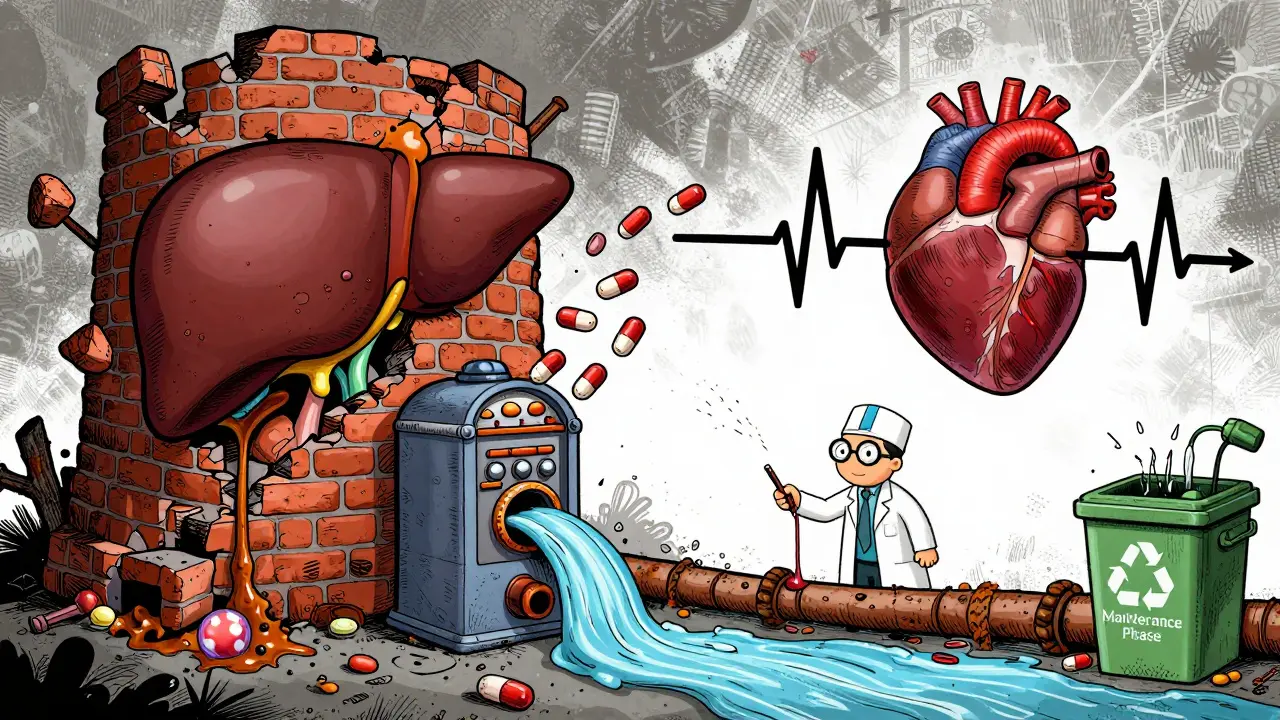
Untreated hemochromatosis doesn’t just sit there. It progresses. Here’s what can happen:
- Liver damage: Iron builds up in liver cells, causing inflammation, fibrosis, and eventually cirrhosis. Once cirrhosis develops, the liver can’t regenerate. Liver cancer risk increases 20-fold.
- Diabetes: Iron damages insulin-producing cells in the pancreas. About 25% of untreated patients develop diabetes - often called "bronze diabetes" because of the skin color change.
- Heart problems: Iron deposits in heart muscle can cause irregular heartbeat, heart failure, or sudden cardiac death.
- Joint and hormone damage: The metacarpophalangeal joints (knuckles) are commonly affected. Men often develop low testosterone, leading to loss of muscle, libido, and mood changes.
- Skin color: Iron deposits in the skin give it a bronze or slate-gray tint - a classic sign.
And here’s the sobering statistic: if you’re diagnosed with ferritin over 1,000 ng/mL, your 10-year survival rate drops to about 60%. If you’re treated before it hits that mark? Survival jumps to 95%. That’s the power of early detection.
Alternatives to Phlebotomy
Not everyone can handle regular blood draws. Some people have small veins, anemia, or heart conditions that make phlebotomy risky. For them, there are iron-chelating drugs like deferasirox or deferoxamine. These bind to iron and flush it out through urine or stool. But they’re expensive - $25,000 to $35,000 a year - and come with side effects like nausea, kidney stress, or rashes.
Phlebotomy is still the gold standard. It’s natural, effective, and free. Chelation is a backup, not a replacement. New drugs are being tested - like hepcidin mimetics - that could one day mimic the body’s natural iron regulator. But they’re still in trials. For now, phlebotomy works.
Living With Hemochromatosis
Once you’re on maintenance, life goes on. You can eat normally - there’s no need to avoid iron-rich foods like red meat or spinach. Your body just won’t absorb it the way it used to. But there are a few things to avoid:
- Vitamin C supplements: Vitamin C increases iron absorption. Avoid high-dose supplements. Eating oranges with a meal? Fine.
- Alcohol: It stresses the liver. If you already have liver damage, alcohol speeds up cirrhosis.
- Raw shellfish: People with liver damage are at higher risk of vibrio infections from raw oysters or clams.
Most patients report high satisfaction. One survey found 89% were happy with treatment. But 42% said they got tired of the routine. After years of feeling fine, it’s hard to keep showing up for a blood draw every few months. That’s why doctor-patient communication matters. You need to understand: this isn’t a cure. It’s lifelong maintenance - like taking blood pressure pills.
Family matters too. If you’re diagnosed, your siblings and children should get tested. About 70% of cases are found through family screening. A simple blood test can save a relative from years of pain - and maybe even their life.
Why Isn’t Everyone Tested?
Here’s the frustrating part: the U.S. Preventive Services Task Force says there’s not enough evidence to recommend screening the general population. But in Europe, guidelines say test anyone with unexplained liver enzyme spikes, diabetes, or heart problems. Why the difference? Because in the U.S., doctors rarely think of hemochromatosis. They see fatigue and order a thyroid test. They see joint pain and refer you to a rheumatologist. The iron tests? Not on the radar.
That’s changing. Labs now charge $150-$300 for HFE genetic testing - down from $1,200 in 2000. And more doctors are learning. The CDC now recommends testing all patients with unexplained cirrhosis. And research is getting better: a 2023 study showed that using 27 genetic markers (not just HFE) can predict who will develop severe overload with 89% accuracy.
So if you’re reading this and you’ve been told your symptoms are "just stress," ask for ferritin and transferrin saturation. If you’re over 30, have a family history, or are of Northern European descent - get tested. It takes five minutes. The results could save your liver - and your life.
Can hemochromatosis be cured?
No, hemochromatosis can’t be cured - it’s a genetic condition you’re born with. But it can be managed perfectly with lifelong phlebotomy. If treatment starts early, before organ damage occurs, you can live a normal, healthy life with no symptoms or complications.
Is phlebotomy safe?
Yes, phlebotomy is very safe. It’s the same procedure as donating blood. Side effects are rare and mild - like lightheadedness or bruising. People with severe anemia or heart failure may need adjustments, but for most, it’s well tolerated. The risk of infection or serious complication is extremely low.
Do I need to change my diet?
You don’t need to avoid iron-rich foods like red meat, spinach, or beans. Your body just won’t absorb it the same way anymore. But avoid vitamin C supplements, which boost iron absorption. Also avoid alcohol - it damages the liver, and if you already have iron buildup, it speeds up scarring.
Can women get hemochromatosis?
Yes, women can get it - but symptoms usually appear later than in men, often after menopause, because monthly blood loss delays iron buildup. Once estrogen levels drop, women start accumulating iron just like men. That’s why postmenopausal women with unexplained fatigue or joint pain should be tested.
If my parent has hemochromatosis, will I get it?
Not necessarily. Hemochromatosis is autosomal recessive, meaning you need two faulty copies of the gene - one from each parent. If one parent has it and the other doesn’t carry the mutation, you’ll likely be a carrier (one faulty gene) but won’t develop the disease. If both parents are carriers or affected, your risk increases. Genetic testing can tell you your status.
How often should I get my ferritin checked?
Once you’re on maintenance phlebotomy, check ferritin every 6-12 months. If it starts creeping above 100 ng/mL, you may need a blood draw sooner. Don’t wait for symptoms - iron buildup is silent. Regular monitoring is the key to staying healthy.
I had no idea this was so common 😭 My dad just got diagnosed last year and I finally understand why he was so tired all the time. Phlebotomy sounds like such a simple fix but so many people miss it. So glad this post exists.
so like... if you're from irish/scottish descent and you're always exhausted and your joints hurt?? like?? maybe it's not just being a millennial?? i had ferritin tested last year bc my dr was like 'huh weird' and it was 1800?? now i get blood drawn every 3 months and i swear i have more energy than i did in college. also i stopped eating steak bc i thought i needed to?? turns out i don't?? 🤯
Of course the USPTF won't recommend screening. Why would they? It's too cheap. Imagine if everyone got tested and we didn't have to pay $300/month for diabetes meds or $200k liver transplants. 🤡 The system doesn't want you healthy. It wants you dependent. Phlebotomy = free. Insurance? Covered. But good luck getting your doctor to order it. 😏
The clinical utility of this condition is underappreciated in non-Western populations due to the skewed prevalence data. While HFE mutations are indeed prevalent in Northern European cohorts, the phenotypic expression in South Asian populations remains grossly understudied. One must exercise caution in extrapolating diagnostic thresholds without validating serum ferritin norms against indigenous genetic backgrounds. The assertion that phlebotomy is universally applicable lacks epistemological rigor.
OMG I'm so glad someone finally said this. My cousin had cirrhosis at 42 and they didn't catch it until it was too late. She's on the transplant list now. I got tested after reading this and my ferritin was 980. I started phlebotomy last week. I'm so emotional. This is literally life-saving info. 🥹❤️
This is an exceptionally well-researched and clinically accurate overview. The distinction between induction and maintenance phases is critical, and the emphasis on early detection before ferritin exceeds 1,000 ng/mL is paramount. I routinely recommend this screening to patients over 30 with unexplained fatigue or elevated liver enzymes. Thank you for providing such a clear, evidence-based resource.
Interesting. I have family from Ireland. My grandfather died of liver failure in the 80s. No one ever said why. I wonder if this was it. I'll ask my doctor for the tests next time I'm in. No rush, but good to know.
This is why America needs to stop being soft. You want to live? Get blood drawn. You don't want to? Then don't complain when your liver turns to mush. This isn't rocket science. It's a simple blood test. If you're too lazy to get tested, don't cry when you die. Stop treating medicine like a luxury. We've got 300 million people out here. Stop coddling.