
Imagine going to the doctor for stomach pain or fatigue, only to be told your liver enzymes are off. You might assume it’s alcohol, stress, or perhaps a viral infection. But what if the real culprit is hiding in plain sight-in your bread, pasta, and beer? For people with Celiac Disease, an autoimmune disorder triggered by gluten consumption that damages the small intestine, this isn’t just a hypothetical scenario. It’s a common reality.
You might know celiac disease as a gut issue. We talk about bloating, diarrhea, and nutrient malabsorption. But here is the twist: your liver is often caught in the crossfire. Recent data shows that between 15% and 40% of untreated celiac patients have elevated liver enzymes. That is one in three people walking around with silent liver stress because their immune system is attacking more than just their intestines. Understanding this link isn’t just academic; it could save your liver from long-term damage.
The Silent Link: Why Your Liver Cares About Gluten
So, how does eating wheat end up hurting your liver? It’s not like gluten travels through your bloodstream and punches your liver directly. The connection is more subtle, involving a chain reaction that starts in your gut and ends in your hepatic system.
First, let’s look at the mechanism. When you have celiac disease, your immune system sees gluten-a protein found in wheat, barley, and rye-as a threat. It launches an attack on the lining of your small intestine, specifically damaging the microvilli (those tiny finger-like projections that absorb nutrients). This damage increases intestinal permeability, often called "leaky gut." Think of your gut lining as a security fence. In celiac disease, that fence has holes.
Because the fence is compromised, toxins, bacteria, and inflammatory molecules slip through into the portal vein, which leads straight to the liver. Your liver acts as the body’s filter, so it gets hit first with this extra load of junk. This constant bombardment causes inflammation, leading to those elevated enzyme levels we see in blood tests. A 2024 study published by BeyondCeliac.org highlights that this extraintestinal manifestation is significant, affecting a large portion of the celiac population.
There’s also an autoimmune angle. If your immune system is already prone to attacking its own tissues (as seen in celiac disease), it’s more likely to target other organs, including the liver. This is why conditions like Autoimmune Hepatitis and Primary Biliary Cholangitis show up more frequently in celiac patients than in the general public.
What Happens Inside the Liver?
When doctors talk about "liver abnormalities" in celiac patients, they aren’t usually talking about immediate failure. They are looking at specific markers and structural changes.
The most common sign is elevated transaminase enzymes. These are proteins released into the blood when liver cells are injured. Specifically, we look at ALT (Alanine Aminotransferase) and AST (Aspartate Aminotransferase). Research from Dr. Daniel Leffler at Beth Israel Deaconess Medical Center showed that 36.7% of celiac patients had abnormal liver function tests (LFTs) compared to just 19.3% of non-celiac controls. That’s double the risk.
| Enzyme Pattern | Percentage of Celiac Patients | Typical Interpretation |
|---|---|---|
| Elevated ALT and AST | 70.1% | General liver inflammation/injury |
| Elevated ALT only | 20.9% | Mild hepatocellular injury |
| Elevated AST only | 9% | Less common, requires investigation |
Beyond enzymes, biopsies reveal physical changes. Steatosis-fatty liver-is found in 25-50% of celiac patients. This happens partly due to malabsorption issues but also because of dietary shifts after diagnosis. Fibrosis, or scarring, occurs in about 10-15% of cases. While these numbers sound scary, there is good news: most of this damage is reversible.
The Gluten-Free Diet: Your Liver’s Best Friend
If you’ve been diagnosed with celiac disease and have abnormal liver tests, the treatment plan is surprisingly simple: go gluten-free. No, really. That’s it.
You don’t need expensive medications or invasive procedures to fix celiac-related liver damage. You need to stop the trigger. Studies show that approximately 79% of celiac patients see their liver enzymes return to normal within 12 to 18 months of strictly avoiding gluten. Dr. Leffler’s work documented that 79.3% of patients achieved normalization after an average of 1.5 years on a strict diet.
Why does it take time? Because your liver needs to heal, and your gut lining needs to regenerate. The microvilli grow back, the "fence" gets repaired, and the flow of toxins stops. Once the insult is removed, the liver’s incredible regenerative ability kicks in.
However, "strictly" is the key word here. Accidental exposure matters. Even a few crumbs can restart the inflammatory cycle. If your liver enzymes haven’t dropped after six months of a gluten-free diet, something else is going on. It might be ongoing accidental gluten ingestion, or it could be a coexisting condition like primary biliary cholangitis. Don’t ignore persistent abnormalities.
The Fatty Liver Paradox: A New Challenge
Here is where things get tricky. In 2023, the medical community reclassified Non-Alcoholic Fatty Liver Disease (NAFLD) as Metabolic Dysfunction-Associated Steatotic Liver Disease (MASLD). This change wasn’t just semantic; it highlighted a metabolic component that affects celiac patients uniquely.
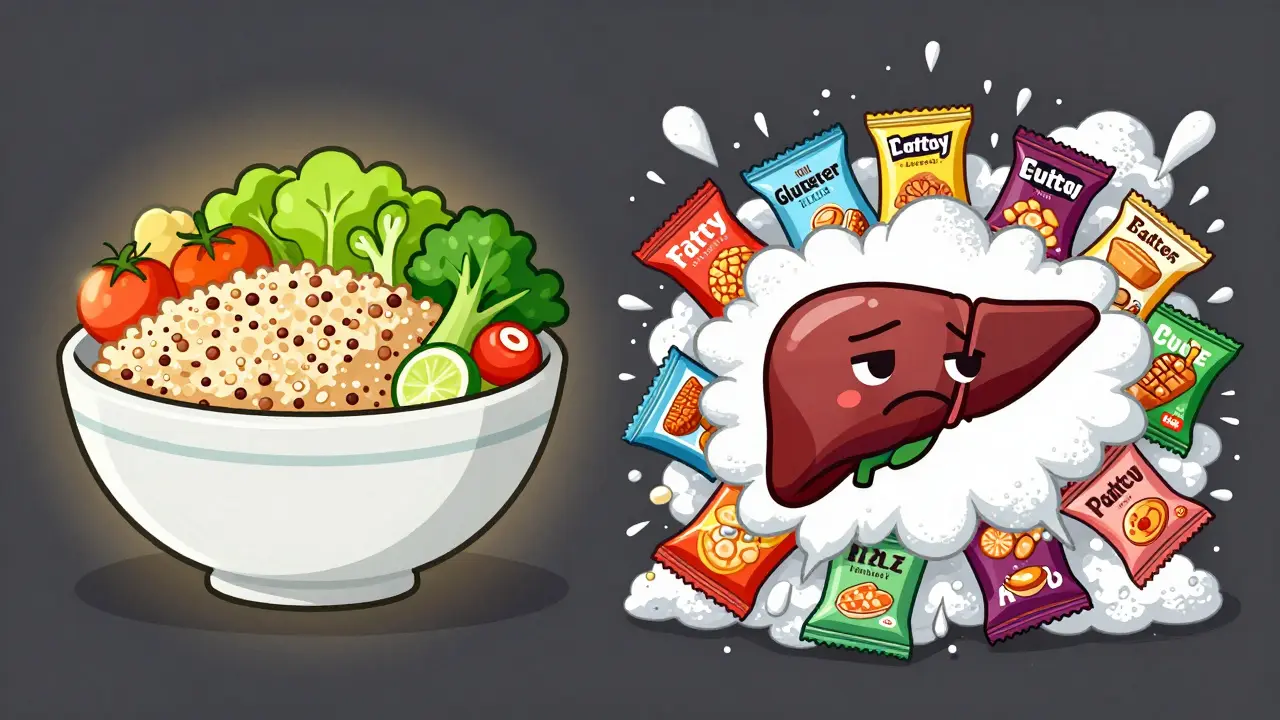
Many people think switching to a gluten-free diet automatically means eating healthy. It doesn’t. Many processed gluten-free products are loaded with sugar, refined carbs, and unhealthy fats to mimic the texture of wheat. If you replace your whole-wheat pasta with sugary gluten-free noodles, you might solve the celiac issue but create a fatty liver problem.
This creates a paradox. The treatment for celiac disease (gluten-free diet) can inadvertently promote MASLD if the diet is poor. Weight gain from these high-calorie gluten-free foods contributes to fat accumulation in the liver. So, while removing gluten heals the autoimmune damage, poor food choices can cause new metabolic damage. The solution? Focus on whole foods. Lean proteins, vegetables, fruits, and naturally gluten-free grains like quinoa and brown rice. Avoid the highly processed gluten-free aisles.

When to Worry: Red Flags and Co-existing Conditions
Most celiac-related liver issues are mild and resolve with diet. But you need to watch out for red flags. If you experience severe fatigue, jaundice (yellowing of skin/eyes), dark urine, or right-sided abdominal pain, seek medical attention immediately. These could signal more serious conditions.
Celiac disease often hangs out with other autoimmune disorders. You are at higher risk for:
- Autoimmune Hepatitis: Found in 4-6.4% of celiac patients.
- Primary Sclerosing Cholangitis: Inflammation of the bile ducts.
- Type 1 Diabetes: Which itself carries liver risks.
If your liver enzymes stay high despite a perfect gluten-free diet for 12 months, your doctor should screen for these co-existing conditions. It’s not uncommon to have two separate autoimmune issues. Treating the celiac won’t fix the autoimmune hepatitis, which may require immunosuppressants.
Practical Steps for Protection
How do you protect your liver while managing celiac disease? Here is a practical checklist based on current clinical guidelines.
- Get Baseline Tests: At diagnosis, ask for a full liver panel (ALT, AST, ALP, GGT).
- Monitor Regularly: Check liver enzymes every 3-6 months until they normalize. Then, annual checks are sufficient.
- Work with a Dietitian: Studies show patients working with celiac-specialized dietitians achieve liver normalization 30% faster. They help you avoid the "processed gluten-free trap" that leads to fatty liver.
- Avoid Alcohol: Your liver is already under stress from inflammation. Give it a break. Alcohol adds toxic load and impairs healing.
- Supplement Wisely: Malabsorption can lead to deficiencies in Vitamin D, Iron, and B12, which affect overall health. Correcting these supports liver function indirectly.
Remember, the goal is not just symptom relief but organ protection. By taking a proactive approach to both your gut and your liver, you ensure that treating one doesn’t harm the other.
Can celiac disease cause permanent liver damage?
In most cases, no. Celiac-related liver damage is typically reversible with a strict gluten-free diet. However, if left untreated for many years, it can lead to fibrosis or cirrhosis in rare instances. Early diagnosis and adherence to the diet prevent permanent scarring.
How long does it take for liver enzymes to normalize after starting a gluten-free diet?
For about 79% of patients, liver enzymes normalize within 12 to 18 months. Some see improvement in as little as 3-6 months. If levels remain high after a year, further investigation for co-existing liver diseases is recommended.
Is fatty liver common in people with celiac disease?
Yes, steatosis (fatty liver) is found in 25-50% of celiac patients. This can be due to malabsorption issues or, increasingly, due to weight gain from consuming high-sugar, high-fat processed gluten-free foods (MASLD).
Should I avoid alcohol if I have celiac disease and liver abnormalities?
It is highly recommended to avoid or strictly limit alcohol. Since your liver is already inflamed due to celiac disease, adding alcohol creates additional toxicity and slows down the healing process.
What symptoms indicate liver involvement in celiac disease?
Often, there are no specific symptoms. Mild elevations in liver enzymes are usually asymptomatic. When symptoms do occur, they may include fatigue, nausea, or vague abdominal discomfort. Severe cases might present with jaundice or dark urine.
Does a gluten-free diet cure autoimmune hepatitis associated with celiac?
No. While a gluten-free diet treats the celiac disease component, autoimmune hepatitis is a separate condition that often requires medication such as corticosteroids or immunosuppressants. Both conditions must be managed independently.