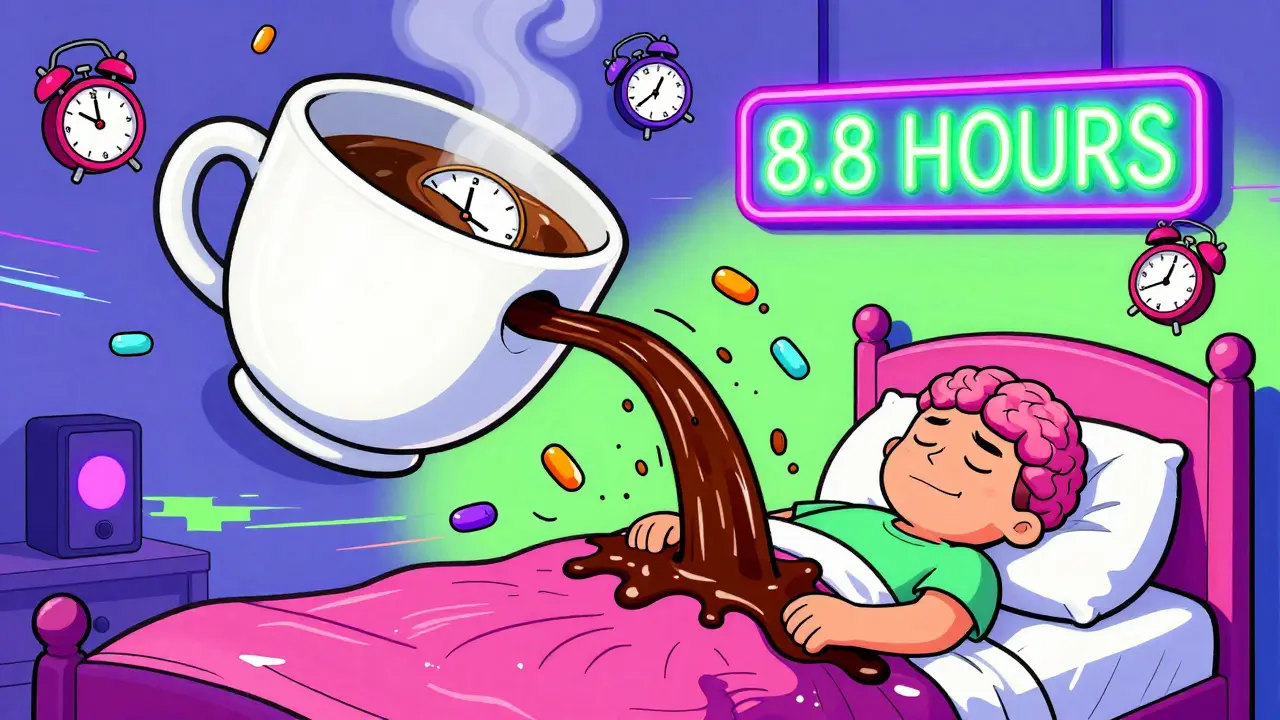
Most people know they shouldn’t drink coffee right before bed. But if you’re still tossing and turning even after cutting out late-night espresso, the problem might not be when you stop - it’s when you started. The idea that you can have your last cup at 8 p.m. and sleep fine at 11 p.m. is a myth. Science shows that for most people, caffeine lingers long after the last sip, quietly sabotaging deep sleep even when you think you’ve fallen asleep just fine.
Why Caffeine Keeps You Awake (Even If You Don’t Feel It)
Caffeine doesn’t just make you alert - it blocks the chemical in your brain that tells you it’s time to sleep. That chemical is called adenosine. As the day goes on, adenosine builds up, and when it binds to receptors in your brain, you start feeling sleepy. Caffeine looks almost identical to adenosine, so it latches onto those same receptors instead. Your brain doesn’t get the signal to slow down. You feel wired. And even after caffeine clears from your bloodstream, its effects can linger in your brain’s sleep architecture. A 2022 review of 18 studies found that consuming caffeine just six hours before bed reduces total sleep time by 45 minutes and lowers sleep efficiency by 7%. That means you spend more time awake in bed, even if you don’t remember it. Sleep onset latency - the time it takes to fall asleep - increases by 9 minutes on average. And here’s the kicker: you probably don’t notice any of this. Your brain adapts. You think you’re sleeping fine. But your body is telling a different story.The 8.8-Hour Rule: It’s Not a Suggestion
You’ve probably heard “stop caffeine by 2 p.m.” That’s a good start. But if you’re drinking a standard 250 mL cup of coffee (about 107 mg of caffeine), the real cutoff time is closer to 8.8 hours before bedtime. This number comes from a 2021 analysis of 24 studies published in Sleep Medicine Reviews. It’s not arbitrary. It’s based on how long it takes for half the caffeine to leave your system - known as its half-life. For most people, caffeine’s half-life is 4 to 6 hours. But that’s an average. If you have a slower metabolism - and about half of adults do - it can take up to 12 hours. The CYP1A2 gene controls how fast your liver breaks down caffeine. If you’re a slow metabolizer, even that afternoon latte could be keeping you awake at 1 a.m. Here’s what that looks like in real life:- Bedtime: 11 p.m. → Caffeine cutoff: 2:12 p.m.
- Bedtime: 10 p.m. → Caffeine cutoff: 1:12 p.m.
- Bedtime: 9 p.m. → Caffeine cutoff: 12:12 p.m.
Not All Caffeine Is Created Equal
You might think a cup of tea is harmless. It’s not. A 250 mL cup of black tea has about 47 mg of caffeine - roughly half of coffee. But here’s the thing: there’s no clear cutoff time for tea because the dose is low enough that most people can handle it later in the day. Still, if you’re sensitive, even that small amount can nudge your sleep cycle. Energy drinks? Don’t even think about it after noon. A 250 mL can of Red Bull contains 80 mg of caffeine - almost as much as a coffee. Pre-workout supplements? Some have over 200 mg. That’s two cups of coffee in one scoop. For a 217.5 mg dose, researchers found you need a 13.2-hour cutoff. If you take a pre-workout at 5 p.m. for a 7 p.m. gym session, you’re basically setting your alarm for 6 a.m. - not because you’re up early, but because you can’t fall asleep. And don’t forget hidden sources. Excedrin, NoDoz, and other pain relievers contain caffeine. A single tablet can have 65 mg - enough to disrupt sleep if taken after 2 p.m. One 2023 study found that 68% of people didn’t realize their headache pills had caffeine in them.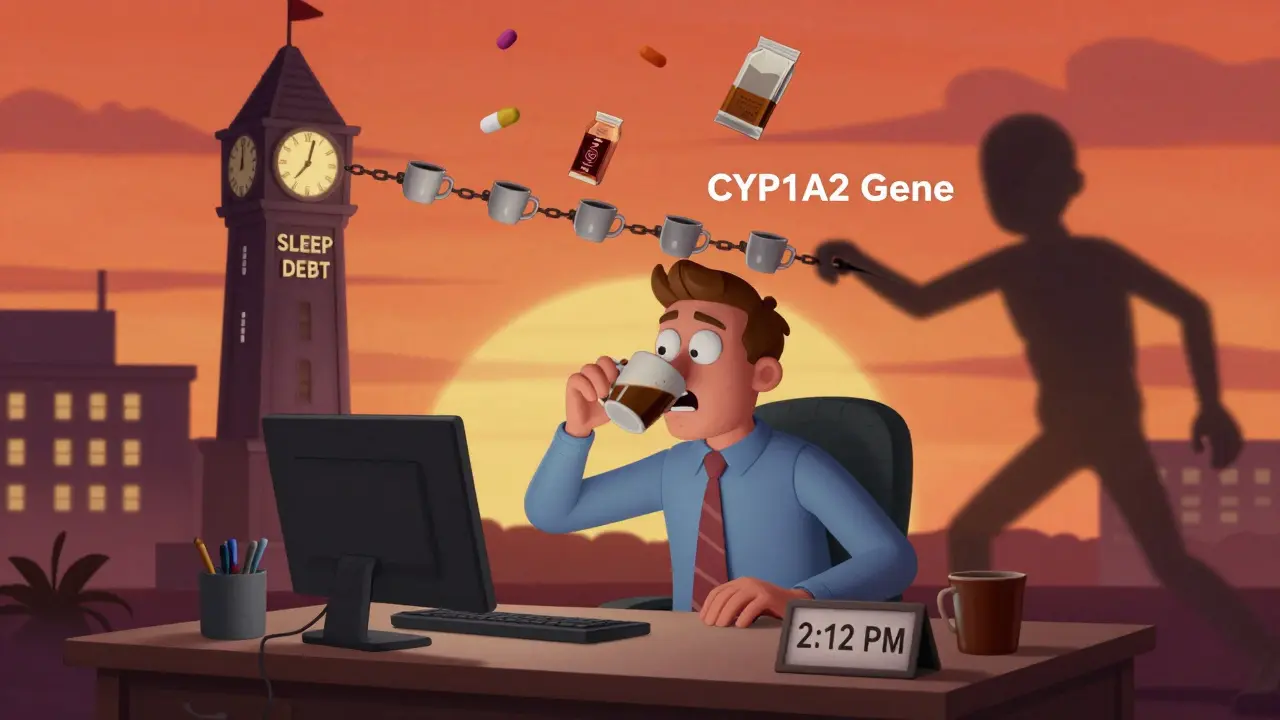
Age Changes Everything
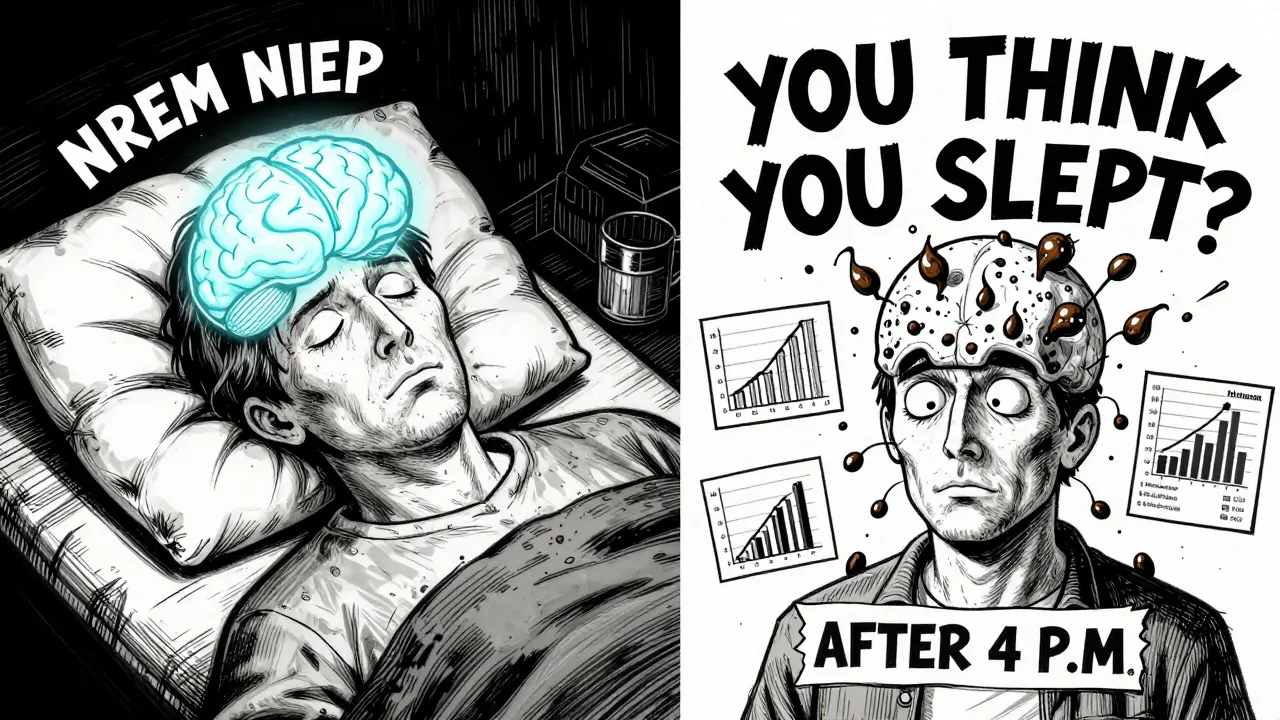
If you’re in your 40s or 50s, caffeine hits harder than it did in your 20s. A 2025 study in Nature Communications found that middle-aged adults (41-58) were more sensitive to caffeine’s effects on sleep latency, duration, and efficiency than younger adults (20-27). Your body doesn’t process caffeine as quickly anymore. The same cup that didn’t bother you at 30 might now be keeping you awake at 45. And it’s not just metabolism - your brain’s sleep regulation changes too. NREM sleep (the deep, restorative stage) gets hit hardest by caffeine, and that’s the stage that declines naturally with age. So you’re losing sleep on two fronts.Real People, Real Results
Reddit’s r/sleep community has over 1,200 posts from people who tried moving their last coffee earlier. 78% said they struggled to fall asleep when drinking after 6 p.m. One user, u/CaffeineStruggles, wrote: “I switched from 4 p.m. to 2 p.m. and gained almost an hour of sleep quality. Eye-opening.” A Sleepopolis survey of 2,150 people found that those who stopped caffeine by 2 p.m. (assuming a 10 p.m. bedtime) got 47 more minutes of sleep and 8% higher sleep efficiency than those who drank after 4 p.m. That’s not just a little better. That’s enough to feel less groggy, more focused, and less reliant on the next cup.How to Actually Stick to a Cutoff Time
Knowing the rule isn’t enough. You need a system.- Track your intake: Use apps like Caffeine Zone or MyCaffeineLog. They let you log coffee, tea, soda, and pills. 73% of users in a 2022 review said these apps helped them stay on track.
- Switch to half-caf: If you need your afternoon ritual, go for half-caffeinated. The AJMC review found this cuts sleep disruption by 32% compared to full-strength afternoon coffee.
- Try herbal or decaf: Decaf coffee still has 5-10 mg of caffeine - but it’s not enough to matter for most people. Herbal teas like chamomile or peppermint are caffeine-free and calming.
- Set a phone reminder: Put a daily alert for 2 p.m. that says: “Last caffeine for today.”
- Test it for two weeks: Give yourself a full 14 days without caffeine after 2 p.m. Then compare how you feel. You might be shocked.
The Future Is Personal
Generic advice like “don’t drink coffee after 2 p.m.” is outdated. The future of sleep hygiene is personalized. Companies like 23andMe now offer genetic testing that tells you if you’re a fast or slow metabolizer of caffeine. If you’re slow, your cutoff might need to be 10 a.m. - not 2 p.m. Wearable sleep trackers like Oura Ring and Fitbit now include caffeine cutoff reminders based on your personal sleep patterns. Oura reported a 41% increase in user engagement after adding this feature in 2021. And in January 2025, the American Academy of Sleep Medicine announced it will update its guidelines to include beverage-specific cutoffs - meaning you’ll soon get advice tailored to your coffee size, not just your bedtime.What If You’ve Been Doing It Wrong for Years?
It’s not too late. Even if you’ve been drinking coffee at 5 p.m. for decades, switching to an 8-hour cutoff can still improve your sleep. You don’t need to quit caffeine. You just need to time it right. The goal isn’t perfection - it’s consistency. One study showed that people who followed the cutoff 5 out of 7 days saw measurable gains in sleep quality. The rest? They were still waking up tired. Start small. Move your last cup from 4 p.m. to 3 p.m. for a week. Then 2:30 p.m. Then 2 p.m. Watch how you feel. Do you wake up less? Are you less reliant on the snooze button? Do you feel calmer in the evening? Those are the real signs it’s working.Final Thought: It’s Not About Willpower
This isn’t about being disciplined. It’s about biology. Your body doesn’t care if you’re “just one cup.” It doesn’t care if you’ve “always slept fine.” Caffeine is a drug. And like any drug, timing matters. If you want to sleep deeply, recover fully, and wake up refreshed - you need to treat caffeine like medicine, not a habit. The clock doesn’t lie. And neither does your sleep data.Can I drink caffeine after 4 p.m. and still sleep well?
For most people, drinking caffeine after 4 p.m. will disrupt sleep - even if you don’t feel it. A 2021 study found that 107 mg of caffeine (one standard coffee) taken 6 hours before bed reduced total sleep time by 45 minutes. If you go to bed at 11 p.m., that means caffeine at 5 p.m. still affects you. The safest cutoff for average coffee drinkers is 8.8 hours before bedtime - which for a 10 p.m. bedtime means 1:12 p.m.
Does tea have less impact than coffee on sleep?
Black tea has about half the caffeine of coffee - around 47 mg per cup - so it’s less disruptive. But it’s not harmless. If you’re sensitive to caffeine, even that amount can delay sleep onset or reduce deep sleep. There’s no official cutoff for tea, but if you notice trouble falling asleep, try switching to herbal tea after 3 p.m. Green tea has even less caffeine (20-30 mg) and contains L-theanine, which may help calm the nervous system.
What if I’m a slow caffeine metabolizer?
About half of adults have a genetic variant (CYP1A2) that slows caffeine breakdown. For them, the half-life can stretch from 5 hours to 12 hours. That means caffeine from a morning coffee might still be in your system at midnight. If you suspect you’re a slow metabolizer - try cutting off caffeine by noon for a week. If your sleep improves, you’re likely one of them. Genetic tests from 23andMe or similar services can confirm this.
Do energy drinks and pre-workout supplements need longer cutoffs?
Yes. A typical energy drink like Red Bull (80 mg per 250 mL) or a pre-workout supplement (200-250 mg) contains far more caffeine than coffee. For a 217.5 mg dose, researchers recommend a 13.2-hour cutoff. That means if you take a pre-workout at 5 p.m., you’re not sleeping well until 6 a.m. - even if you feel fine. These products are designed to be powerful. Treat them like medication, not snacks.
Is decaf coffee safe to drink in the evening?
Decaf coffee still contains 5-10 mg of caffeine per cup - not enough to affect most people. But if you’re highly sensitive, it might. For those with sleep issues, switching to herbal tea or water after 2 p.m. is safer. Decaf is fine for occasional evening use, but don’t rely on it if you’re struggling with sleep. The placebo effect of “it’s decaf” can make you think you’re safe - but your brain still detects trace caffeine.
Caffeine isn't just a stimulant-it's a stealthy saboteur of your circadian rhythm. You think you're sleeping fine because you passed out, but your brain is stuck in low-grade alert mode, cycling through light sleep like a broken record. The science here is brutal: even if you don't wake up, your deep sleep-the kind that actually repairs your body-is getting shredded. I used to drink espresso at 7 p.m. and blame my fatigue on stress. Turns out, it was just my adenosine receptors being held hostage. The 8.8-hour rule isn't a suggestion. It's a biological contract you're violating daily. And no, your ‘I’m not sensitive’ claim is just your brain lying to you to keep the dopamine train running.
I switched to herbal tea after 2 p.m. and honestly? My mornings feel like a different life. No more grogginess. No more 10 a.m. coffee panic. I didn’t even realize how much my sleep was suffering until I stopped. It’s not about willpower-it’s about respecting your body’s rhythm. Also, switching to decaf in the afternoon was a game-changer. I still get my ritual, but now I’m actually rested. If you’re reading this and still drinking coffee at 4 p.m., just try it for a week. You’ll thank yourself.
So let me get this straight-you’re telling me I can’t have my 5 p.m. Red Bull because my brain might, like, function? What’s next, no sunlight after 6 p.m.? I’ve been drinking energy drinks since I was 16 and I still beatbox at 3 a.m. on a Tuesday. This is just science trying to make life boring.
Here’s the thing nobody talks about: if you’re still drinking coffee after 2 p.m., you’re not doing it for focus-you’re doing it because you’re exhausted from poor sleep. It’s a vicious cycle. You drink to compensate for bad sleep, which causes worse sleep, which makes you drink more. Break the loop. Try switching to green tea after noon. The L-theanine calms you without knocking you out. And if you think you’re immune? Try logging your sleep for two weeks without afternoon caffeine. Then come back and tell me it didn’t change everything.
I’ve been doing the 8-hour cutoff for six months now. I used to wake up at 4 a.m. every day, convinced I had insomnia. Turns out, I was just poisoning myself with caffeine. I didn’t realize how much my body was fighting just to rest. Now I sleep through the night. Not perfectly, but better than I have in a decade. It’s not magic. It’s just biology. And your body doesn’t lie.
Simple rule: if you go to bed at 11, cut caffeine by 2:12 p.m. No excuses. Tea? Same deal. Energy drinks? Don’t even go there after noon. Decaf? Fine, but don’t drink it at night if you’re having trouble sleeping. Your body doesn’t care if you ‘always slept fine.’ It’s still getting wrecked. Start tomorrow. Just one day. You’ll feel it.
Decaf at night is fine for me. But I stopped drinking anything after 3 p.m. and my sleep improved instantly. I didn’t even know I was that sensitive. Now I drink chamomile tea. It’s peaceful. And I actually wake up without hitting snooze. Just try it.
Have you considered that this entire narrative is manufactured by Big Sleep? The sleep tracker companies, the wellness influencers, the ‘science’ studies-all funded by herbal tea corporations and meditation apps? They want you to believe you’re broken so you’ll buy their solutions. Caffeine is natural. Sleep is natural. Your body has been regulating itself for millennia. Why are we suddenly told we need a 13.2-hour cutoff? This feels less like science and more like corporate control disguised as self-help.
One must interrogate the ontological foundations of the caffeine-sleep dichotomy. The assumption that temporal ingestion dictates physiological outcome presumes a Cartesian model of the body as a mechanistic system, divorced from the holistic interplay of circadian rhythm, psychological expectation, and environmental context. To prescribe a universal cutoff time is to commit epistemological violence against individual phenotypic variance. One cannot reduce the complex pharmacodynamics of adenosine receptor antagonism to a temporal algorithm. The 8.8-hour rule is not a law-it is a heuristic, and one that risks pathologizing normal human variability. The body, in its wisdom, does not require external calibration.
yo i tried the 2pm cutoff and at first i was like ‘this is impossible’ but then i started drinking sparkling water with lime after 2 and honestly? i feel like a new person. no more 3pm crashes. no more ‘i need coffee or i’ll die’ panic. also i started sleeping like a baby. like, full 8 hours. no alarm needed. i didn’t even know i was that tired. try it. just for 7 days. you’ll be weirded out by how good you feel.
They say caffeine lingers for hours. But what if they’re lying? What if the real issue is the glyphosate in coffee beans? Or the mold? Or the fact that most coffee is grown by corporations that poison the soil? They don’t want you to know that your sleep problems aren’t from caffeine-they’re from toxins. And if you cut out coffee, you’ll just drink tea… which is sprayed with pesticides too. The system wants you addicted to ‘solutions’ that don’t fix the root cause. Wake up.
People who follow these rules are weak. I’ve been drinking coffee at 6 p.m. for 30 years and I run marathons. My sleep is perfect. If you can’t handle caffeine, maybe you should stop being so sensitive. Stop listening to internet gurus and start being a real adult. You don’t need a 2 p.m. cutoff-you need thicker skin.
Look, I’m not saying the science is wrong-I’m saying the vibe is off. You don’t need to be a monk to sleep well. You need to be smart. I drink coffee at 4 p.m. but I also take a 20-minute nap at 5. I don’t stress. I don’t guilt-trip myself. I don’t log every bean. I just vibe. My sleep is solid. Your obsession with perfect timing is what’s keeping you awake-not the caffeine.