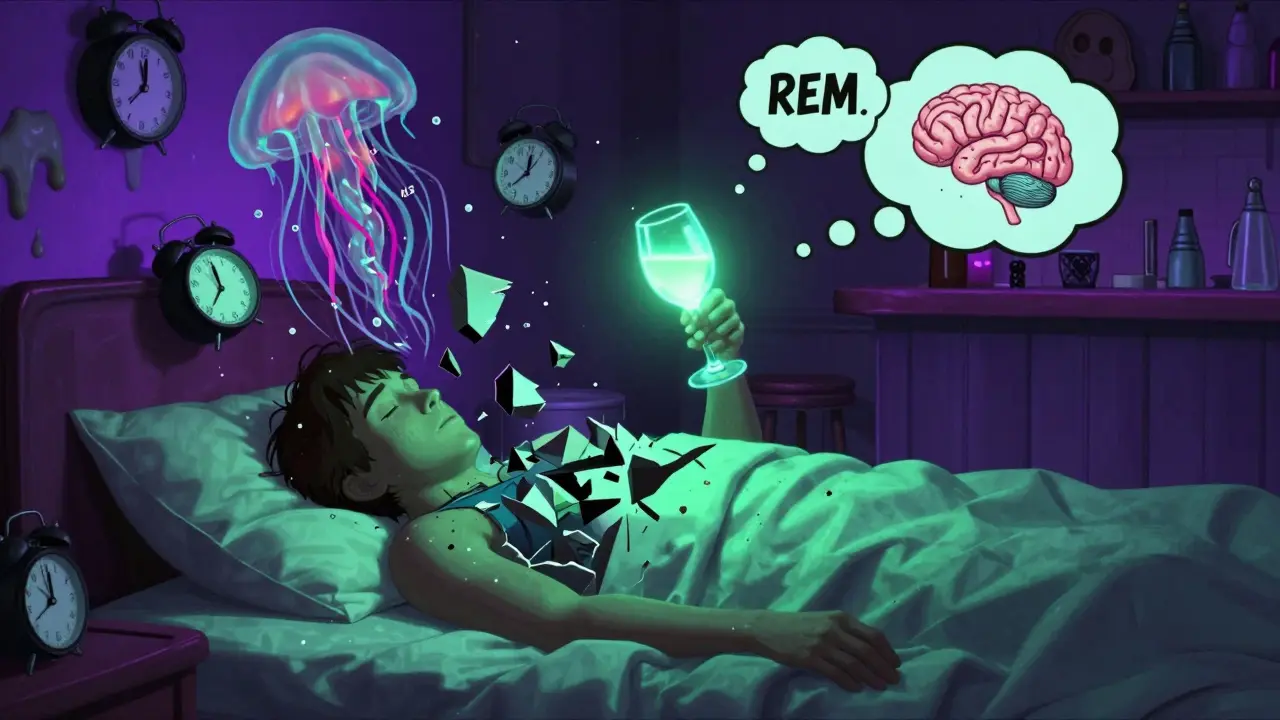
Many people reach for a nightcap because they believe it helps them fall asleep faster. It’s true - alcohol can make you drowsy. But what happens after you drift off is where things go wrong. Alcohol doesn’t improve sleep. It fragments it, worsens sleep apnea, and leaves you feeling drained the next day - even if you slept for eight hours. If you’ve ever woken up at 3 a.m. feeling wide awake after a few drinks, or felt foggy and irritable the next morning despite ‘getting enough sleep,’ this is why.
How Alcohol Breaks Up Your Sleep
Alcohol changes your sleep architecture - the natural cycle of sleep stages that should happen every night. Normally, you move through light sleep, deep sleep, and REM sleep in cycles that repeat every 90 minutes. Alcohol messes with this rhythm. In the first half of the night, it pushes your body into deep sleep (N3) faster. That’s why you might feel like you’re sleeping ‘hard’ right after drinking. But here’s the catch: your body doesn’t get to finish the cycle.
As alcohol leaves your system - about one standard drink per hour - your brain scrambles to rebalance itself. This causes a rebound effect. Deep sleep drops sharply. REM sleep, which was suppressed early on, surges back. But instead of smooth transitions, your sleep becomes choppy. You wake up more often. You might not remember it, but your body is constantly shifting from deep to light sleep. Studies show that people who drink before bed have up to 50% more nighttime awakenings than those who don’t. The National Sleep Foundation found that 67% of people who drink within two hours of bedtime experience at least one full awakening, compared to just 39% of non-drinkers.
This isn’t just about being restless. Deep sleep is when your body repairs tissues, builds bone and muscle, and strengthens your immune system. REM sleep is when your brain processes emotions, consolidates memories, and clears out mental clutter. When alcohol cuts short REM early and then floods it later, your brain never gets the steady, balanced recovery it needs. The result? Sleep that looks long on paper but feels shallow in reality.
Alcohol and Sleep Apnea: A Dangerous Combo
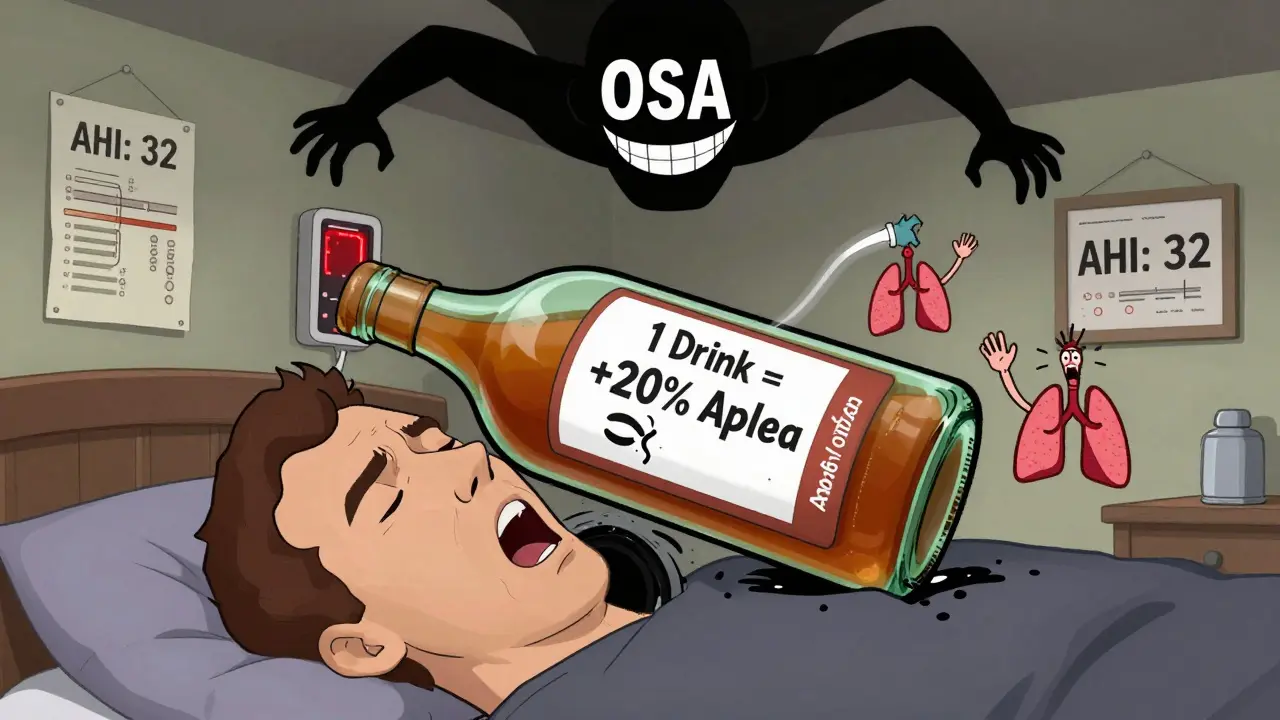
If you snore, or have been told you stop breathing at night, alcohol makes it worse. Alcohol relaxes the muscles in your throat - including the ones that keep your airway open. When those muscles go limp, your airway can collapse partially or fully. This is what causes obstructive sleep apnea (OSA): repeated pauses in breathing that drop your oxygen levels and jolt you awake - often without you realizing it.
A single drink can increase your apnea-hypopnea index (AHI) - a measure of breathing disruptions - by 20%. That means if you normally have mild OSA, one glass of wine could push you into moderate or even severe territory. A 2022 meta-analysis in the Chest Journal found that drinking 2-4 drinks per day increases your risk of moderate-to-severe OSA by 25%. With five or more drinks, that risk jumps to 51%. The American Thoracic Society says people with sleep apnea should avoid alcohol entirely within three hours of bedtime. Why? Because even small amounts can reduce oxygen saturation by 3-5 percentage points during sleep events, putting extra strain on your heart and lungs.
And it’s not just for people already diagnosed. Regular drinkers without OSA are more likely to develop it over time. Alcohol doesn’t just trigger episodes - it can change the structure of your airway muscles over months or years, making you more prone to collapse. If you notice you snore louder after a night out, or wake up gasping, it’s not just ‘bad luck.’ It’s your body signaling that alcohol is interfering with your breathing.
What Happens the Next Day - Even If You Think You Slept Fine
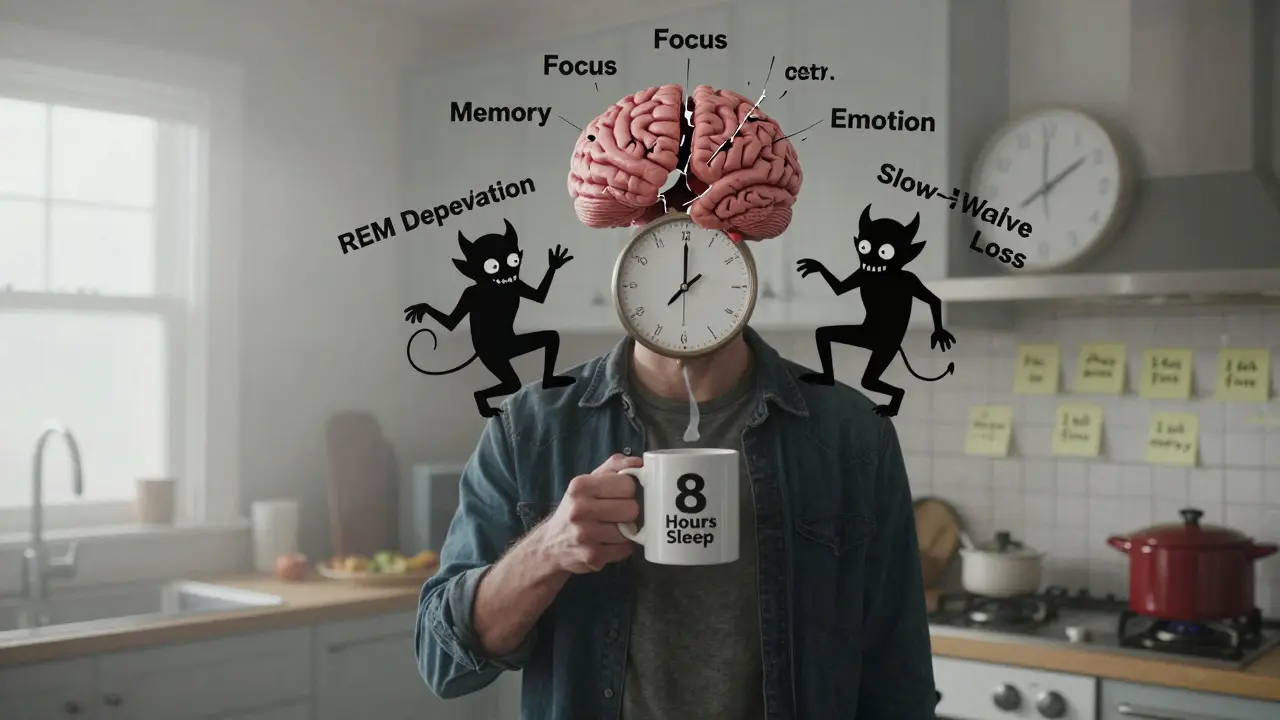
You might think you’re fine if you slept through the night. But your brain and body didn’t. Even when total sleep time looks normal, alcohol steals the most restorative parts of sleep. One study found that sleep after alcohol consumption had 15.3% less slow-wave sleep - the deep, restorative stage your body needs to recover. That’s like running a marathon and only getting 85% of the recovery you need.
The next-day effects are real - and measurable. Cognitive processing speed dropped by 12.7%. Working memory capacity fell by 9.4%. Reaction times slowed. Focus became harder to maintain. In one controlled study, participants performed 8.7% worse on cognitive tasks the morning after alcohol - even though they felt fine. That’s the dangerous part: you don’t realize you’re impaired.
And it’s not just about thinking clearly. Your emotions take a hit, too. A 2022 study from the University of Pittsburgh Medical Center showed that people were 31.2% more emotionally reactive after drinking before bed. They reacted more strongly to negative stimuli - a harsh comment, a frustrating traffic jam, a child’s tantrum. That’s because REM sleep, which alcohol disrupts, is critical for emotional regulation. Without it, your brain can’t process stress properly. You’re more likely to feel anxious, irritable, or overwhelmed - even if you don’t know why.
The Long-Term Cost: Chronic Sleep Problems and Cognitive Decline
One night of drinking might be manageable. But if it’s a habit, the damage adds up. A 36-year longitudinal twin study found that heavy drinkers had 3.37 times higher odds of poor sleep quality than non-drinkers. The link was strongest in people in their 30s - exactly when many start drinking regularly to ‘wind down.’
And it gets worse. Regular alcohol use before bed increases the risk of chronic insomnia by 38%. That’s not just trouble falling asleep - it’s ongoing, persistent sleeplessness that doesn’t go away even when you stop drinking. For people trying to quit alcohol, sleep problems are one of the biggest reasons they relapse. The National Institute on Alcohol Abuse and Alcoholism reports that 50-70% of people in early recovery struggle with severe insomnia, and it can take 3-6 months for sleep patterns to return to normal.
For older adults, the risks are even higher. The American Academy of Neurology warns that chronic alcohol-induced sleep disruption accelerates cognitive decline. Over five years, people who regularly drank before bed showed a 23% faster rate of memory and thinking decline than those who didn’t. It’s not just about feeling tired. It’s about your brain aging faster.
Why ‘Tolerance’ Doesn’t Mean It’s Safe
You might have heard that if you drink regularly, your body gets used to it - and sleep improves. That’s partly true. After 3-7 days of daily drinking, the initial sedative effect wears off. After 3-9 days, the changes in sleep architecture start to normalize. But here’s the twist: that doesn’t mean your sleep is better. It means your brain has adapted to a broken system.
What looks like tolerance is actually dependence. Your body no longer responds to alcohol the way it should. It’s stuck in a cycle: you drink to fall asleep, but sleep gets worse, so you drink more. A 2023 study from the University of Missouri showed that sleep-deprived mice after binge drinking had a stronger urge to consume alcohol - creating a feedback loop that can lead to dependence. This isn’t just about habit. It’s a physiological trap.
And even with tolerance, the damage continues. REM sleep remains suppressed. Apnea risk stays elevated. The next-day fog doesn’t vanish. Your brain is still missing the deep rest it needs.
What Should You Do?
If you drink to help you sleep, you’re using a tool that’s broken. Alcohol doesn’t fix sleep - it hijacks it. Here’s what works better:
- Avoid alcohol within 3 hours of bedtime - even one drink can disrupt your sleep.
- If you have sleep apnea, skip alcohol entirely at night. The risks aren’t worth it.
- Try a wind-down routine instead: dim lights, cool room, 10 minutes of deep breathing, or reading a book.
- Keep a consistent sleep schedule. Your body thrives on routine.
- If you struggle with sleep and alcohol, talk to a doctor. Sleep problems and drinking often feed each other - and both can be treated.
The truth is simple: no amount of alcohol improves sleep quality. Not one. Not even a sip. The sedation you feel is just the first stage of a sleep disruption that lasts all night. The next-day fatigue, brain fog, and emotional sensitivity? Those aren’t ‘normal’ - they’re signs your body didn’t recover. And if this happens often, it’s slowly wearing down your health.
You don’t need to quit drinking forever. But if sleep is your goal, alcohol has no place in your bedtime routine. Your brain will thank you - tomorrow, and for years to come.
Does alcohol help you fall asleep faster?
Yes, alcohol can reduce the time it takes to fall asleep - especially in small to moderate doses. But this sedative effect is temporary and misleading. As alcohol metabolizes, it causes sleep fragmentation, reduces REM sleep, and leads to more awakenings later in the night. The result is less restorative sleep overall.
Can alcohol cause or worsen sleep apnea?
Yes. Alcohol relaxes the muscles in your throat, increasing the likelihood of airway collapse during sleep. Each standard drink before bed can raise your apnea-hypopnea index (AHI) by 20%. People with existing sleep apnea see a 20-30% increase in severity after drinking. The American Thoracic Society recommends avoiding alcohol within three hours of bedtime if you have sleep apnea.
Why do I wake up at 3 a.m. after drinking?
Alcohol is metabolized at about one standard drink per hour. After consuming 2-3 drinks, your blood alcohol level peaks around 1-2 a.m. and then drops sharply. Around 3 a.m., as alcohol leaves your system, your brain rebounds into a hyper-aroused state. This triggers increased wakefulness, lighter sleep, and vivid dreams or nightmares - all signs of REM rebound and disrupted sleep homeostasis.
Does alcohol reduce REM sleep?
Yes. Alcohol suppresses REM sleep during the first half of the night. Studies show even one drink can reduce REM by 9.3%. Later in the night, REM rebounds, but the overall pattern is fragmented and unbalanced. This disrupts memory consolidation, emotional processing, and brain detoxification - all functions tied to healthy REM cycles.
Is there any safe amount of alcohol before bed?
No. A 2023 meta-analysis in Addiction Biology reviewed over 30 studies and found no evidence that any dose of alcohol improves sleep quality. Even one standard drink reduces REM sleep, increases sleep fragmentation, and lowers sleep efficiency. The idea of a ‘nightcap’ helping sleep is a myth - objectively, all alcohol consumption before bed harms sleep architecture.
I used to swear by my nightcap 🍷... until I started waking up at 3 a.m. like a startled raccoon. Turns out, my '8 hours' were just 4 hours of deep sleep + 4 hours of tossing and turning. No wonder I felt like a zombie. Cut it out for a week and my mornings? Like a different person. 🙌
This is spot on. I didn’t realize how much my sleep quality had tanked until I stopped drinking at night. My partner said I stopped snoring. I didn’t even know I was doing it. Now I read before bed. Quiet. Calm. Actually rested. Best change I’ve made in years.
Alcohol = sleep sabotage 🚫😴. One glass and I’m out like a light. Two glasses? Woke up at 2 a.m. sweating and heart pounding like I’d run a marathon. My brain was screaming. I thought I was relaxing. Turns out I was just poisoning my REM. Never again.
Think about it this way: alcohol doesn’t give you sleep. It steals the architecture of sleep and replaces it with a cheap imitation. You’re not resting-you’re surviving a chemical tug-of-war in your brain. Deep sleep? Suppressed. REM? Chaotic. Recovery? Nonexistent. Your body thinks it’s in crisis mode. And you wonder why you’re exhausted, irritable, and foggy? It’s not laziness. It’s neurochemistry. 🤯
You know what’s really happening? Big Pharma and sleep labs are pushing this narrative to sell you melatonin, CPAP machines, and sleep trackers. Alcohol relaxes you. That’s natural. The 'fragmentation' is just your body detoxing. You’re not broken. You’re detoxing. And if you’re not snoring or gasping, you’re fine. Stop buying into fear-mongering.
One drink. 3 a.m. wake-up. Same every time. No more.
I used to think I was a 'functioning drinker.' Then I realized I was just a functioning zombie. My emotional reactions? Wild. My focus? Gone. My 'good sleep' was just a lie I told myself. I quit. My mood improved faster than my sleep. Funny how that works. 😏
Stop lying to yourself. If you drink before bed and wake up tired you’re not sleeping. You’re chemically sedated. Period. No 'but I slept 8 hours' excuses. Your brain was fighting a war. You didn’t rest. You survived.
The whole 'nightcap' thing is just a rich person’s excuse to feel like they’re being cozy while quietly destroying their circadian rhythm. You don’t need wine to unwind. You need a damn TV remote and a pillow. Also, your 'deep sleep' was probably just unconsciousness. Wake up.
Based on empirical data from clinical sleep studies, alcohol ingestion prior to sleep induces significant suppression of slow-wave activity and REM density. The circadian disruption cascade leads to elevated cortisol levels and impaired glymphatic clearance. Recommendation: implement alcohol-free windows of minimum 3 hours pre-sleep to optimize sleep architecture efficiency.
I tried cutting out alcohol for sleep and I felt like I was going to die. Like, real panic attacks at night. I went back. Now I drink one beer. It’s a tradeoff. I sleep worse but I don’t feel like I’m gonna cry every time my cat looks at me. I’m sorry I’m not perfect.
I’ve been reading this whole thing and I’m just wondering… are we really supposed to believe that a single glass of wine is worse than 6 hours of scrolling TikTok before bed? Or that the 12% drop in cognitive speed is more damaging than chronic stress? I mean, come on. We’re all dying a little every day. Wine just makes the ride prettier.
Actually, I’ve read studies that say light alcohol consumption improves sleep continuity in older adults. This article is cherry-picking. You’re not giving the full picture.
I get it. Alcohol messes with sleep. But sometimes, after a brutal week, a glass of red is the only thing that lets me shut off my brain. I’m not saying it’s healthy. I’m saying it’s human. Maybe the real issue is we’re all too stressed to sleep without a chemical crutch.
This is why I started drinking chamomile tea instead. No alcohol, no caffeine, just calm. I still get that cozy ritual. My sleep? 10x better. And I don’t feel like I’m betraying my brain every night. 🌿💤