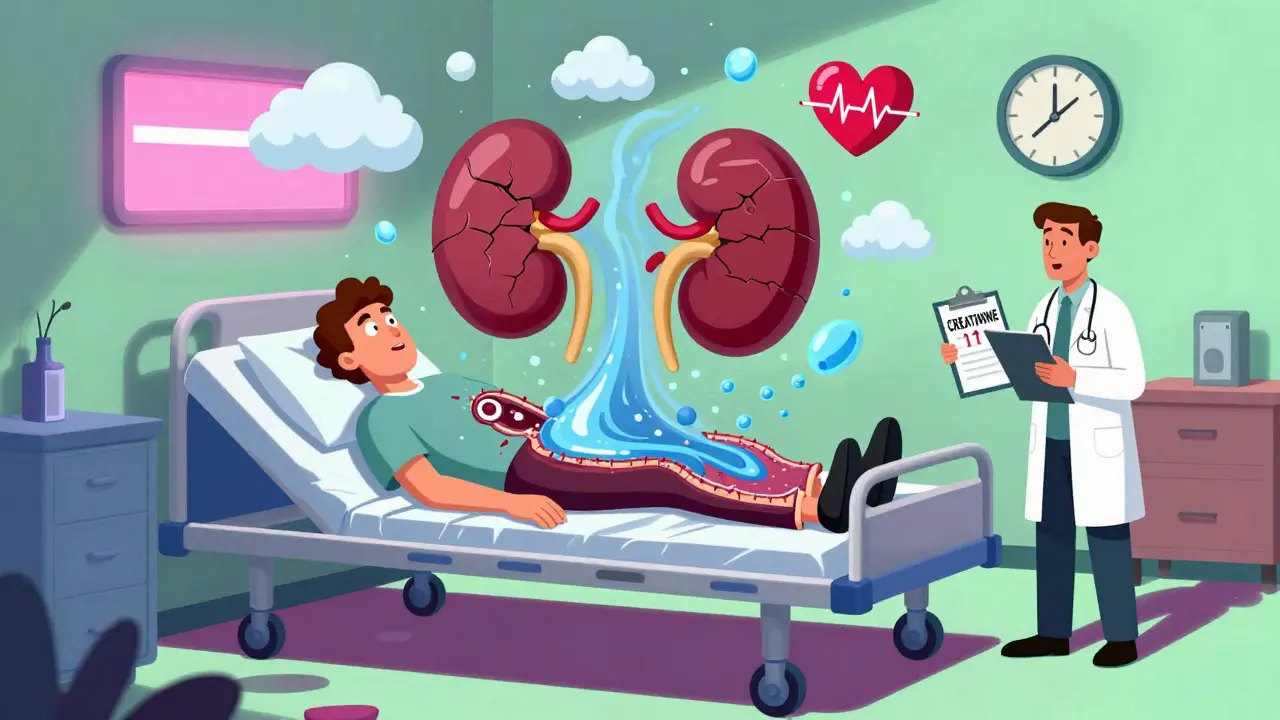
Acute kidney injury (AKI) doesn’t come with a warning sign. One day, you feel fine. The next, you’re in the hospital because your kidneys suddenly stopped working the way they should. It’s not always dramatic - sometimes, it’s just fatigue, a little swelling in your ankles, or no urine output at all. But when your kidneys shut down, even partially, your whole body feels it. This isn’t a slow decline. It’s a sudden, serious event that can kill if not caught fast.
What Happens When Your Kidneys Fail Suddenly?
Your kidneys don’t just make urine. They filter toxins, balance your salts and fluids, regulate blood pressure, and help your bones stay strong. When AKI hits, they lose the ability to do any of this properly - sometimes in just hours. The most common sign? Less urine. If you’re making less than 400 mL a day (about 1.5 cups), that’s a red flag. Some people stop making urine entirely. But here’s the twist: about 1 in 5 people with AKI still pee normally. Their kidneys are damaged, but the output looks fine. That’s why many cases are missed until a routine blood test shows creatinine levels climbing.
Other symptoms pile up fast. Fluid backs up in your lungs, making breathing hard. You feel tired, dizzy, confused. Nausea hits. Your chest might ache if fluid builds up around your heart. And if potassium spikes - which it often does - your heart rhythm can go haywire. That’s when things turn life-threatening.
Three Main Causes - And Why It Matters
Not all AKI is the same. Where the problem starts changes how you’re treated. There are three big categories:
- Prerenal (60-70% of cases): Your kidneys aren’t getting enough blood. This isn’t a kidney problem - it’s a circulation problem. Dehydration from vomiting or diarrhea, heavy bleeding, or heart failure can all cause this. If you’re on diuretics, have low blood pressure, or just didn’t drink enough water after being sick, you’re at risk. The good news? This type often reverses fast with fluids.
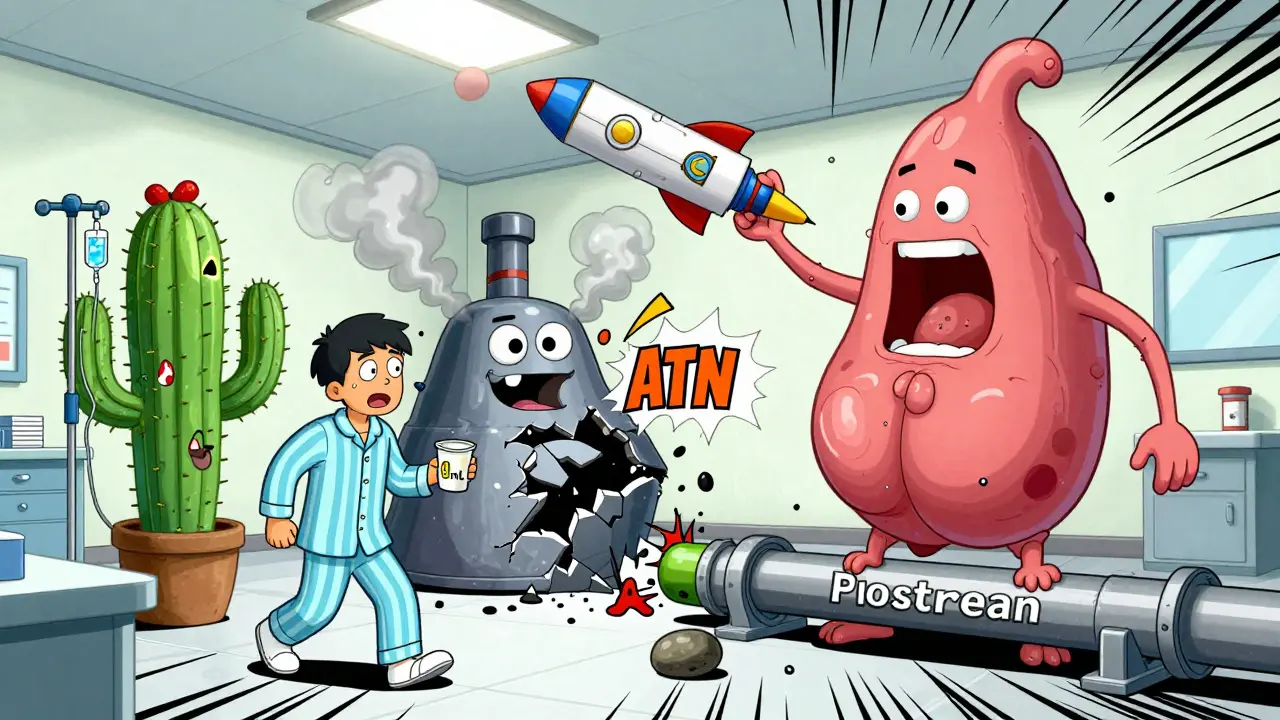
- Intrarenal (25-35%): This is damage inside the kidney itself. The most common cause is acute tubular necrosis (ATN), where kidney cells die from lack of oxygen or toxins. Drugs like certain antibiotics (aminoglycosides), contrast dye used in CT scans, or even heavy metal poisoning can trigger it. Inflammation from autoimmune diseases like lupus can also attack the kidney filters. This type takes longer to heal - sometimes weeks.
- Postrenal (5-10%): Something is blocking urine from leaving the body. In men over 60, it’s often an enlarged prostate. In others, it could be kidney stones, a tumor, or a blood clot in the ureters. If the blockage is cleared fast - with a stent or catheter - kidney function can bounce back in hours.
Knowing which type you have isn’t academic - it’s the difference between giving you IV fluids, stopping a drug, or doing emergency surgery.
How Doctors Diagnose It
There’s no single test. Doctors look at three things together:
- Serum creatinine: A rise of 0.3 mg/dL in 48 hours, or a 50% increase from your baseline over 7 days, means AKI. Normal levels? Around 0.7-1.3 mg/dL for women, 0.8-1.4 mg/dL for men. A jump to 2.0 or higher? That’s serious.
- Urine output: Less than 0.5 mL per kg of body weight per hour for 6 hours counts as AKI. In ICU patients, nurses track urine every hour.
- Ultrasound: Used in 85% of cases. It checks if kidneys are swollen, shrunken, or blocked. If a stone or tumor is clogging the ureter, you’ll see it.
Some hospitals now use urine biomarkers like NGAL or TIMP-2/IGFBP7. These can flag AKI a day or two before creatinine rises. That’s huge - it means treatment can start before damage becomes permanent.
What Happens If It’s Not Treated
Untreated AKI doesn’t just linger - it explodes into complications. Fluid overload leads to pulmonary edema. High potassium can stop your heart. Acid builds up in your blood. Your immune system goes haywire. And if you’re in the ICU? The death rate jumps to 24-37%. Even if you survive, you’re not out of the woods. One episode of AKI increases your risk of needing dialysis in five years by over eight times. One in four survivors develops chronic kidney disease within a year.
And the costs? In the U.S., each AKI episode adds $10,000-$15,000 to hospital bills. That’s billions a year.
Recovery: It’s Not Guaranteed
Some people bounce back in a few days. Others never fully recover.
- Prerenal AKI? If caught early, 70-80% recover fully within a week. Just fluids - no dialysis needed.
- Intrarenal AKI? Recovery is slower. If it’s from a drug, stopping it helps. If it’s from ATN, you might need dialysis for weeks. Only 40-60% regain full function.
- Postrenal? If the blockage is cleared fast, 90% improve immediately. Delayed treatment? Permanent damage.
Age matters. If you’re over 65, your recovery chances drop by 35%. If you already had kidney problems before - say, an eGFR under 60 - your odds of full recovery halve. Need dialysis? Only 25% of those patients get back to normal kidney function within three months.
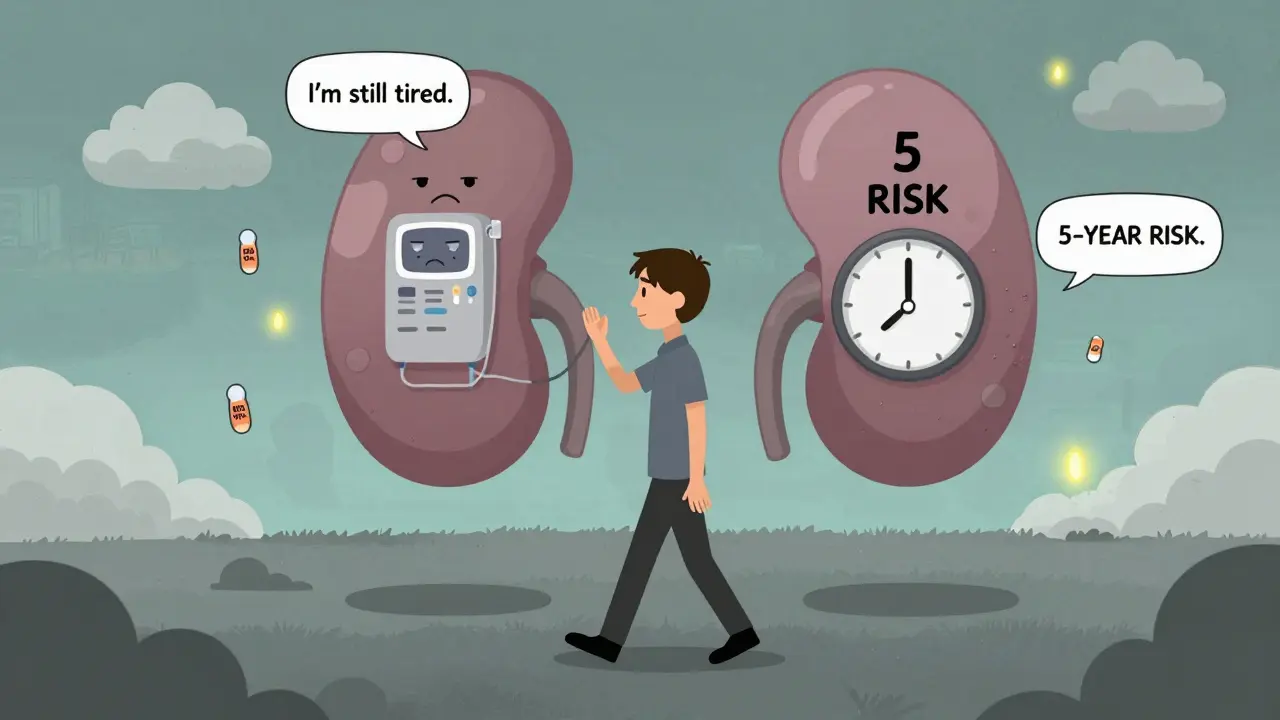
And then there’s the invisible toll. A 2022 survey of over 1,200 AKI survivors found that 68% felt exhausted for months after - not just tired, but bone-deep “kidney fatigue.” 42% lived with constant anxiety about their kidneys. Some couldn’t walk up stairs without gasping. Mental health is part of recovery, too.
Treatment: Fast, Specific, Life-Saving
There’s no one-size-fits-all. Treatment is all about the cause:
- Prerenal: Give 500-1000 mL of IV saline fast. Most improve in 24-48 hours.
- Intrarenal: Stop nephrotoxic drugs. Use steroids for glomerulonephritis. Plasmapheresis for rare conditions like HUS. No drugs? Then support the body - fluid balance, electrolytes, dialysis if needed.
- Postrenal: Remove the blockage. A stent in the ureter? 90% of patients see instant improvement.
If your kidneys are truly failing - with high potassium, fluid in the lungs, or acid buildup - dialysis is life-saving. Hemodialysis is used in 5-10% of cases. In the ICU, continuous therapy (CRRT) is common. Peritoneal dialysis? Rare, but used when veins are too damaged for IV access.
What You Can Do - Before and After
Prevention beats treatment every time.
- If you’re sick with vomiting or diarrhea - drink water. Don’t wait until you’re dizzy.
- If you’re on NSAIDs (like ibuprofen), diuretics, or ACE inhibitors - ask your doctor if they’re safe during illness.
- Hydrate before CT scans with contrast dye. Ask if a low-risk dye is available.
- After AKI? See a nephrologist within six months. Get your kidney function checked. Even if you feel fine.
And here’s the quiet truth: AKI often happens in people who didn’t think they were at risk. A healthy 60-year-old man with prostate enlargement. A diabetic on metformin who got the flu. A woman who took too many painkillers after surgery. None of them expected this. But they all survived - because someone caught it early.
What’s Next for AKI?
Researchers are racing ahead. AI models are being trained to predict AKI 12-24 hours before it happens, using data from electronic records. The STARRT-AKI trial showed that starting dialysis earlier in severe cases cuts death rates by 9%. New biomarkers could replace creatinine - faster, more accurate. And in 2023, the Kidney Precision Medicine Project showed AI could predict risk with 75% accuracy.
But the biggest breakthrough? Awareness. Hospitals that use automated alerts when creatinine spikes cut AKI deaths by 12%. That’s not magic. That’s systems working.
AKI doesn’t care if you’re young or old. It doesn’t care if you’re fit or frail. It strikes fast. But if you know the signs - and act fast - recovery isn’t just possible. It’s common.
So let me get this straight - you’re telling me my kidney just gave up because I didn’t chug enough water after a night of margaritas? I thought my liver was the one that needed babysitting. This is like finding out your car’s engine died because you forgot to check the air filter… but the air filter was fine. It just… quit. Like, thanks for the drama, kidneys.
I just cried reading this. 😭 My mom had AKI after her surgery and they didn’t catch it until her heart started fluttering. She was in the ICU for 17 days. I sat there every day holding her hand while she whispered, 'I just wanted to go to the grocery store.' Don’t let this happen to anyone. Please. Drink water. Stop taking ibuprofen like candy. Your body isn’t a machine you can ignore until it breaks.
The elegance of this post lies not in its clinical precision - though that is impeccable - but in its quiet acknowledgment of the body’s fragility. Kidneys, often taken for granted as mere filters, are in fact dynamic regulators of homeostasis, guardians of electrolytic equilibrium, and silent sentinels of systemic integrity. When they falter, the collapse is not localized; it is systemic, cascading, and terrifyingly swift. The fact that some patients continue to produce urine despite profound parenchymal injury speaks to the organ’s redundancy - and our dangerous overreliance on urinary output as a proxy for health. We must recalibrate our diagnostic intuition.
This is an exceptionally well structured overview of acute kidney injury. The distinction between prerenal intrarenal and postrenal causes is critical for clinical decision making. I appreciate the inclusion of biomarker advances and the emphasis on early intervention. The data on long term outcomes including the increased risk of chronic kidney disease is particularly valuable for patient education and follow up planning. Thank you for sharing this comprehensive resource.
Funny how they never mention that 80% of AKI cases happen to people who were 'just fine' last week. Coincidence? Or is Big Pharma pushing diuretics and NSAIDs so hard that we’re all just walking time bombs? And why is it always 'drink more water' like that’s the magic bullet? Did you know the FDA approved 12 new nephrotoxic drugs last year? No? Of course you didn’t. They don’t want you to know.
In many parts of the world, especially in rural areas, people do not have access to basic blood tests or IV fluids. AKI is often a death sentence not because of the condition itself, but because of systemic neglect. This article is excellent for those who can afford care. But we must also ask: how do we protect those who cannot? The answer is not just medical - it is moral.
I find it deeply troubling that the medical community continues to rely on serum creatinine as the gold standard for diagnosing AKI. Creatinine is an outdated, unreliable metric that is heavily influenced by muscle mass, age, and diet. We are treating patients based on a 19th-century biomarker while ignoring the revolutionary potential of NGAL and TIMP-2/IGFBP7. This is not just negligence - it is institutional inertia masquerading as science.
I had AKI after my C-section and honestly? No one warned me. I thought the pain meds were just making me tired. I didn’t even realize I wasn’t peeing until my nurse noticed my legs were puffier than a marshmallow. I’m 32, fit, never smoked, no diabetes - so why did this happen to me? I’m still tired all the time. My anxiety about my kidneys is real. I check my pee every day like it’s a fortune cookie. And now I’m terrified of ever taking ibuprofen again. I just want to know: is this forever? I’m not okay. I’m not okay.
So basically the whole thing is just 'drink water and don't be dumb'? Like wow. Groundbreaking. I mean, I get it - the science is cool. But this reads like a pamphlet from a 1998 health fair. Everyone already knows you shouldn’t take 10 Advils and then go hiking. This isn't a revelation. It's a PSA. And the 'AI predicts AKI' part? Yeah right. They’ve been saying that since 2015. Still waiting.