
Imagine you’ve been taking your HIV medication for years. Your viral load is undetectable. You feel great. Then, your doctor switches you from a brand-name pill to a generic antiretroviral. It’s cheaper, it looks the same, and it contains the same active ingredients. But suddenly, you start feeling side effects, or worse, your viral load starts creeping up. Is the generic drug failing you? Or is there something else going on?
This is where Therapeutic Drug Monitoring (TDM) comes into play. TDM is like a GPS for your medication levels in your blood. It helps doctors see exactly how much drug is circulating in your system at any given time. The goal? To keep that level in a "sweet spot"-high enough to crush the virus, but low enough to avoid toxicity. For patients on complex regimens or those switching to generics, TDM can be a powerful tool to protect health and ensure efficacy.
The Reality Check: Why TDM Doesn't Work for All HIV Drugs
Before we dive into how TDM protects patients, we need to clear up a massive misconception. Many people assume TDM works for every single HIV medication. It doesn’t. In fact, it is largely useless for one of the most common classes of drugs: Nucleoside Reverse Transcriptase Inhibitors (NRTIs).
NRTIs are often called "nukes." They include drugs like tenofovir, emtricitabine, and lamivudine. Here is the problem: NRTIs are prodrugs. This means they are inactive when you swallow them. Your body must absorb them and then convert them inside your cells into their active form. TDM measures drug levels in your blood plasma, not inside your cells. Because the active ingredient isn't floating around in your blood in a measurable way that correlates with effectiveness, testing plasma levels for NRTIs gives you no useful data. As noted by the International Antiviral Society-USA, NRTIs simply do not qualify for TDM because of this intracellular activation mechanism.
So, if you are on an all-NRTI regimen (which is rare today) or relying heavily on nukes without other drug classes, TDM won't help you monitor adherence or efficacy. This is a critical distinction. If a clinic suggests TDM for an NRTI-based issue, ask why. It might be a misunderstanding of what the test can actually measure.
When Does TDM Actually Help? The Right Candidates
TDM shines when used with drug classes that have a narrow therapeutic index and high variability in how different bodies process them. These are primarily Protease Inhibitors (PIs) and Non-Nucleoside Reverse Transcriptase Inhibitors (NNRTIs), as well as newer Integrase Strand Transfer Inhibitors (INSTIs) in specific scenarios.
Think of PIs like lopinavir or darunavir. They are potent, but they are also metabolized by enzymes in your liver (specifically CYP3A4). If your liver processes these drugs too fast, levels drop, and the virus might replicate. If it processes them too slow, levels spike, and you risk toxicity. TDM measures the trough concentration (Cmin)-the lowest amount of drug in your blood right before your next dose. If that number is too low, the dose needs adjusting. If it's too high, the dose might need lowering.
For generic versions of these drugs, TDM provides peace of mind. While generics must meet strict bioequivalence standards, individual patient physiology can vary. TDM confirms that the generic formulation is delivering the expected exposure for you, specifically.
| Drug Class | Common Examples | TDM Useful? | Why? |
|---|---|---|---|
| NRTIs ("Nukes") | Tenofovir, Emtricitabine | No | Active form is inside cells, not in plasma. |
| Protease Inhibitors (PIs) | Lopinavir, Darunavir | Yes | Narrow therapeutic window; high variability. |
| NNRTIs | Efavirenz, Rilpivirine | Sometimes | Useful for toxicity management (e.g., efavirenz). |
| INSTIs | Dolutegravir, Bictegravir | Selectively | Crucial when combined with interacting drugs (e.g., TB meds). |

Protecting Patients on Generics: The Bioequivalence Question
A major reason patients worry about generic HIV drugs is bioequivalence. Regulatory agencies require generics to have blood levels within 80-125% of the brand name. For most people, this range is fine. But for some, being at the lower end (80%) might mean suboptimal suppression, while being at the higher end (125%) might cause more side effects.
TDM acts as a safety net here. In resource-limited settings, where generic antiretrovirals are the standard, pilot programs have shown promise. A study published in the South African Journal of HIV Medicine (2022) found that using TDM-guided therapy reduced treatment failure by 22% compared to standard care among patients on generic regimens. This suggests that while generics are safe for the vast majority, TDM can identify the outliers who aren't getting adequate exposure due to absorption issues or metabolic differences.
If you switch to a generic and experience new symptoms or rising viral loads, TDM can determine if the issue is the drug's performance or another factor, like adherence or interactions. It removes the guesswork.
The Hidden Enemy: Drug Interactions
One of the strongest arguments for TDM isn't just about generics-it's about drug interactions. Many people with HIV take medications for other conditions, such as tuberculosis (TB), depression, or heart disease. Some of these drugs interfere with how HIV meds are processed.
Take dolutegravir, a popular INSTI. When taken with rifapentine (a TB preventive drug), rifapentine can decrease dolutegravir exposure by 26%. In a JAMA Network study (2023), researchers monitored patients on this combination. Without TDM, clinicians might miss this drop in drug levels until a viral rebound occurs. With TDM, they saw that despite the interaction, 92.6% of participants maintained concentrations above the required threshold. However, for those who didn't, TDM allowed for immediate dose adjustment, preventing treatment failure.
This is where TDM protects patients on generics even more critically. If you are on a generic PI or INSTI and start a new medication that induces liver enzymes, TDM can catch the drop in HIV drug levels before the virus has a chance to replicate. It’s proactive rather than reactive.
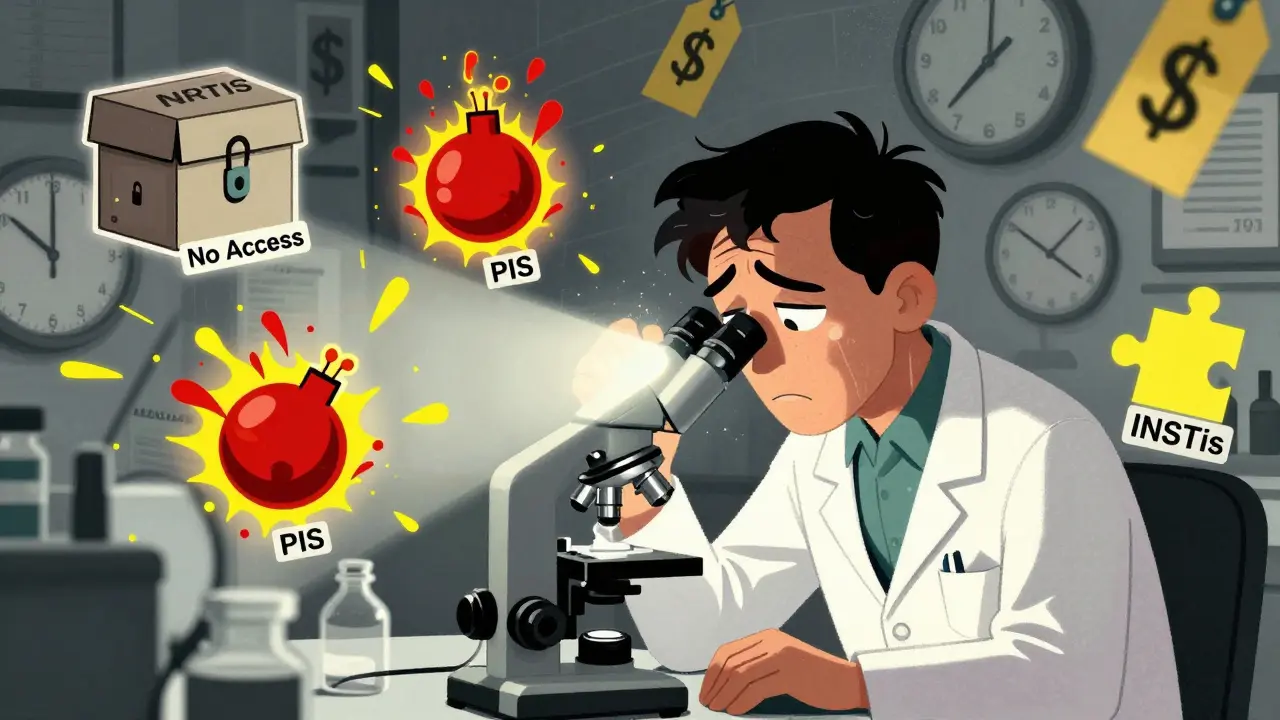
The Practical Hurdles: Cost, Time, and Access
Despite its benefits, TDM is not a magic bullet available everywhere. There are significant practical barriers.
- Cost: In the UK NHS system, a TDM test costs approximately £250-£350. In private US labs, it can run $450-$650 per test. Insurance coverage is spotty and often requires pre-authorization for "complex cases" only.
- Turnaround Time: This is the biggest complaint. Results can take 10-14 days in public systems. By the time you get the result, the clinical situation may have changed. Private labs offer 2-3 day turnaround, but at a higher cost.
- Interpretation Complexity: A number on a page means nothing without context. Clinicians need specialized training in pharmacokinetics to interpret TDM results correctly. Misinterpretation can lead to harmful dose changes. The European Association of Clinical Microbiology and Infectious Diseases notes that proper interpretation typically requires 6-12 months of guided experience.
Because of these hurdles, major guidelines like those from the US Department of Health and Human Services (HHS) do not recommend routine TDM for all HIV patients. It is reserved for specific scenarios: pregnancy, severe diarrhea affecting absorption, known drug interactions, or unexplained virologic failure.
How to Advocate for TDM in Your Care
If you suspect your generic medication isn't working as well as it should, or you are starting a new drug that interacts with your HIV regimen, consider asking your provider about TDM. Here is how to approach it:
- Know your drug class: Ask if your medication is a PI, NNRTI, or INSTI. If it's an NRTI, TDM likely won't help.
- Highlight complexity: Mention any other medications, supplements, or health conditions (like liver or kidney issues) that might affect absorption.
- Ask about timing: Ensure the blood draw is timed correctly (usually just before the next dose) to get an accurate trough level.
- Discuss alternatives: If TDM is unavailable or too expensive, ask if genotypic resistance testing or enhanced adherence counseling might be better first steps.
TDM is a specialized tool, not a routine check-up. But for the right patient, especially those navigating the world of generic antiretrovirals and complex drug interactions, it offers a layer of protection that viral load testing alone cannot provide. It ensures that the medicine in your bottle is doing exactly what it’s supposed to do in your body.
Does Therapeutic Drug Monitoring work for NRTIs?
No. TDM measures drug levels in blood plasma. NRTIs (like tenofovir and emtricitabine) are prodrugs that become active only after entering cells. Therefore, plasma levels do not correlate with efficacy, making TDM clinically useless for this drug class.
Is TDM necessary when switching to generic HIV medications?
Not routinely. Most patients tolerate generics well due to strict bioequivalence standards. However, TDM can be valuable if you experience unexpected side effects, rising viral loads, or have difficulty absorbing medications, ensuring the generic provides adequate exposure for your specific physiology.
What are the main risks of not using TDM in complex cases?
Without TDM, subtherapeutic drug levels may go unnoticed until virologic failure occurs, potentially leading to drug resistance. Conversely, toxic levels may cause severe side effects. TDM helps adjust doses proactively to avoid both outcomes, especially when drug interactions are present.
How long does it take to get TDM results?
In public health systems, turnaround times average 10-14 days. Private specialized laboratories may offer expedited services with results in 2-3 days, though these are significantly more expensive and may not be covered by insurance.
Can TDM replace viral load testing?
Absolutely not. Viral load testing measures the actual amount of virus in your blood and is the gold standard for monitoring treatment success. TDM measures drug concentration. They are complementary tools; TDM helps explain why a viral load might be rising, but it does not replace the need for regular viral load checks.