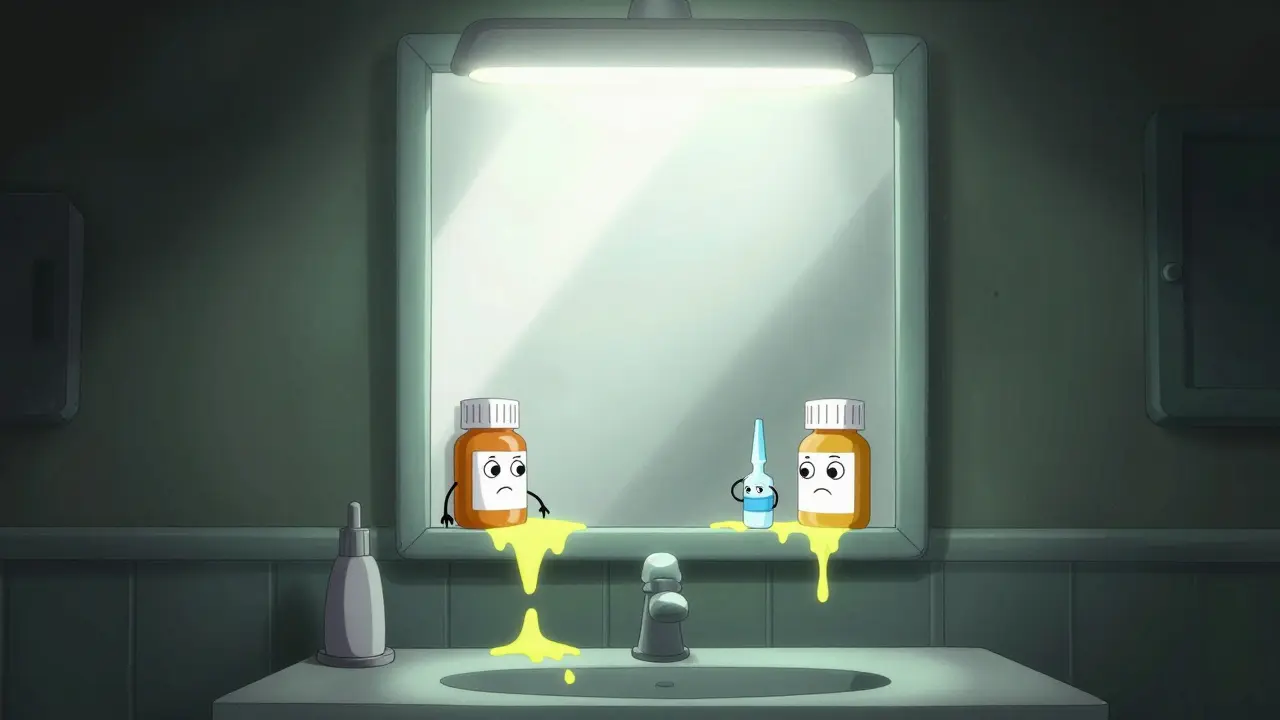
Have you ever noticed your white cream turning yellow or your clear eye drops becoming cloudy? That isn't just dirt. It is a sign that your medicine has broken down. For many of us, the bathroom cabinet is the go-to spot for pills and ointments. But if those medicines are sensitive to light, that bright vanity mirror might be destroying their potency before you even use them.
Light isn't just a nuisance; it triggers chemical reactions called photodegradation. When ultraviolet (UV) rays hit certain drugs, they alter the molecular structure. This can make the drug less effective-or worse, create harmful byproducts. According to data from the United States Pharmacopeia (USP), hundreds of parenteral drugs require specific light protection. Ignoring these needs doesn't just waste money; it risks your health. Let's figure out exactly how to keep your meds safe, starting with understanding which ones need special care.
Identifying Light-Sensitive Medications
Not every pill needs to live in the dark. However, some classes of drugs are notoriously fragile. If you have prescriptions for antibiotics like tetracycline, nitroglycerin for heart conditions, or certain chemotherapy agents, you are dealing with high-risk items. Even common over-the-counter options like vitamin D drops or compounded tretinoin creams can degrade quickly.
The easiest way to know if your medication is light-sensitive is to look at the packaging. Manufacturers are required by the Food and Drug Administration (FDA) to label products that need protection. Look for phrases like "Protect from light" or icons showing a sun with a line through it. About 78% of light-sensitive medications carry this warning. If the bottle is clear plastic or clear glass, check the label carefully. Clear containers offer zero UV protection.
If you are unsure, ask your pharmacist. They can tell you if your specific brand requires an opaque container. Don't guess. The cost of a wasted prescription is higher than the price of a quick phone call.
Why Amber Bottles Are Your Best Friend
You have probably seen those brown or orange plastic bottles at the pharmacy. These aren't just for style. They are engineered to block UV rays. Industry standards mandate that light-sensitive medications be packaged in amber, brown, or opaque containers that block wavelengths below 470 nanometers. This specific range covers the most damaging part of the light spectrum.
Container Type
UV Blockage Rate
Pros
Cons
Amber Glass
98%
Superior protection; durable
Heavier; more expensive
Opaque Plastic
85-100%
Lightweight; shatterproof
Hard to see levels
Clear Plastic/Glass
<10%
Easy to see contents
No UV protection
Aluminum Foil Pouches
100%
Total darkness
Inconvenient; single-use feel
For eye drops specifically, the stakes are high. Ophthalmic solutions are water-based, making them particularly vulnerable to light degradation. A study by Alcon showed that storing certain eye drops in clear containers reduced efficacy by 35% within just two weeks. Always keep eye drops in their original amber or opaque vials. Never transfer them to small, clear travel bottles unless those bottles are specifically rated as UV-blocking.
Temperature Matters Just as Much
Light isn't the only enemy. Heat accelerates the breakdown process. Most oral medications should be stored at room temperature, between 59°F and 77°F (15°C-25°C). This is the "cool, dry place" pharmacists always mention. But what does that actually mean in your house?
It means away from the stove, away from the dishwasher, and definitely not on top of the refrigerator. Extreme temperatures-above 86°F or below 58°F-can alter medication effectiveness. Some drugs, like unopened insulin or certain biologics, need refrigeration at 36°F-46°F (2°C-8°C). However, once opened, some eye drops can be stored at room temperature. Check the leaflet inside the box. If it says "refrigerate," do it. If it says "store at controlled room temperature," leave it out of the fridge. Freezing most liquid medications will destroy them entirely.

The Bathroom Cabinet Trap
Here is a hard truth: your bathroom is likely the worst place to store your medicine. A survey by the National Community Pharmacists Association found that 68% of people store meds in the bathroom. Why? Because it's convenient when you're brushing your teeth. But bathrooms are hot and humid. Showers raise the temperature and humidity levels drastically. Moisture causes pills to crumble and creams to separate. Combined with bright lights, your bathroom cabinet is a recipe for disaster.
Move your medications to a bedroom closet or a kitchen cabinet that stays cool and dry. Avoid the kitchen counter near the sink or stove. A dedicated drawer in a dresser is often ideal. It stays dark, maintains a stable temperature, and is away from moisture sources. If you live in a warm climate, consider using a hygrometer to monitor humidity. You want relative humidity below 60%.
Storing Eye Drops Correctly
Eye drops deserve special attention because they come into direct contact with your eyes. Contamination and degradation are double threats. First, never let the tip of the dropper touch your eye or eyelashes. This introduces bacteria. Second, close the cap tightly immediately after use. Air exposure can also degrade some formulations.
Keep multi-dose eye drops in their original packaging. Many modern eye drop bottles have dual protection: an amber outer layer and sometimes a secondary opaque sleeve. Do not remove this sleeve. Dr. Emily Chew from the National Eye Institute notes that aqueous ophthalmic solutions can lose 40% of their potency after just seven days of light exposure in non-protective containers. If your eye drops change color, become cloudy, or develop particles, discard them immediately. Do not try to filter them. They are no longer safe.
Traveling with Light-Sensitive Meds
Going on vacation doesn't mean you have to compromise your medication safety. Travel introduces variables like car heat, airplane cargo holds, and hotel room lighting. Here is how to handle it:
- Carry-On Only: Never check medications in your luggage. Cargo holds can freeze or get extremely hot. Keep all meds in your carry-on bag.
- Use Insulated Bags: Buy a small insulated medication bag with a UV-blocking lining. These bags maintain temperature stability within 5 degrees of ambient for 8-12 hours. They are cheap and lifesaving.
- Keep Original Packaging: Airlines and customs officers may ask to see your meds. Keeping them in labeled, original bottles proves they are prescribed to you and shows the storage instructions clearly.
- Avoid Direct Sunlight: Don't leave your bag on a windowsill in the hotel room. Place it in a drawer or under the bed.
If you are traveling with insulin or biologics, consider a portable cooler pack designed for medications. Regular ice packs can freeze the drug, so look for ones that maintain a cool, but not frozen, environment.
Signs Your Medication Has Degraded
Even with best efforts, mistakes happen. How do you know if your medicine is still good? Look for these red flags:
- Color Changes: White creams turning yellow or pink, or clear liquids becoming cloudy or colored.
- Texture Issues: Tablets that are cracked, chipped, or sticky. Creams that separate into oil and water layers.
- Smell: Aspirin, for example, develops a strong vinegar smell when it degrades. Any unusual odor is a warning sign.
- Potency Loss: If your blood pressure medication suddenly stops working or your allergy drops no longer relieve itching, the drug may have degraded.
If you suspect degradation, stop using the medication. Consult your pharmacist or doctor for a replacement. Do not double up on doses to compensate for perceived weakness. This can lead to dangerous overdoses if the remaining drug is still potent.
Frequently Asked Questions
Can I transfer light-sensitive pills to a weekly organizer?
Generally, no. Weekly pill organizers are usually made of clear plastic, offering no UV protection. If your medication is light-sensitive, keep it in its original amber or opaque bottle until the moment you take it. If you must use an organizer, choose one made of opaque material or cover the compartments with aluminum foil.
How long do eye drops last after opening?
Most multi-dose eye drops expire 28 days (4 weeks) after opening due to contamination risk, regardless of the printed expiration date. However, light-sensitive drops may degrade faster if exposed to light. Always write the opening date on the bottle with a marker. Discard them after one month unless the label specifies otherwise.
Is my bathroom medicine cabinet really that bad?
Yes, for most medications. Bathrooms experience significant fluctuations in temperature and humidity from showers and baths. These changes accelerate chemical breakdown. Move your meds to a cool, dry drawer in a bedroom or hallway closet for optimal stability.
What should I do if I accidentally left my meds in the sun?
If your medication was exposed to direct sunlight for an extended period, especially if it changed color or texture, it is safest to discard it. Contact your pharmacist for advice on whether a replacement is needed. For minor exposures, monitor for effectiveness, but err on the side of caution with critical drugs like heart or seizure medications.
Do I need special storage for vitamins?
Some vitamins, particularly Vitamin C, Vitamin D, and B-complex, are sensitive to light and air. Store them in their original opaque containers in a cool, dry place. Avoid storing them in the kitchen near the stove or in clear jars on the counter.
As a pharmacist, I see this daily. People bring in yellowed tetracycline or cloudy eye drops wondering why they aren't working. The bathroom cabinet is the number one culprit because of humidity and heat fluctuations from showers. Move your meds to a bedroom drawer immediately.
OMG thank you for this!! i always kept my stuff in the bathrm cuz its convenient but now im so worried lol gonna move it all to my closet right now!!!
Sure, let's all become hoarders of opaque plastic bottles instead of just taking our pills like normal functioning adults who don't have time to monitor humidity levels with a hygrometer. Thanks for ruining my simple life.
The FDA labels are part of the control mechanism. They want you dependent on their specific packaging so you can't switch to generic alternatives easily. Amber glass blocks UV yes but also hides the contents so you never know exactly what you're ingesting. Think about it.
From a thermodynamic perspective, the photodegradation kinetics are accelerated by both photon energy absorption and thermal agitation. The amber container acts as a spectral filter, attenuating wavelengths below 470nm which correspond to the highest energy visible photons capable of breaking molecular bonds in sensitive compounds like nitroglycerin. It is not merely 'storage' but a preservation of chemical integrity against environmental entropy.
It is absolutely appalling that people do not read instructions. 🙄 If you cannot be bothered to store your medication correctly, perhaps you should not be taking it at all. The arrogance of assuming 'it will be fine' is precisely why we have healthcare crises. Read the label. Use the foil pouches. Do not be lazy. 😤
I appreciate the detailed breakdown here. I often feel overwhelmed by medical advice, but this makes sense. I'll make sure to check my wife's eye drops since she keeps them on the counter. Better safe than sorry.
You are wasting your money if you throw away good meds. Just take them. The color change is cosmetic. Stop listening to fear-mongering articles.
This is dangerous advice. Degraded tetracycline can cause kidney damage (Fanconi syndrome). Color changes indicate chemical breakdown, not just cosmetics. Please consult a professional before ignoring safety warnings.
We need stricter regulations on pharmaceutical packaging. If the company knows it degrades, they should provide better default storage solutions. Relying on consumers to buy extra bags is unacceptable. This is a failure of domestic industry standards.
I didn't realize the bathroom was such a bad spot. I guess I'll start keeping my insulin in the dedicated cooler bag even when I'm home. Thanks for sharing this info.
In many cultures, natural remedies are stored in clay pots which offer excellent temperature stability. While modern medicine requires precision, the principle of keeping things cool and dark is universal wisdom passed down through generations. Great article bridging science and common sense!