HIV Medication & Antibiotic Interaction Checker
Disclaimer: This tool is for educational purposes only and provides general information based on known metabolic pathways. It does not replace professional medical advice. Always consult your doctor or pharmacist before combining medications.
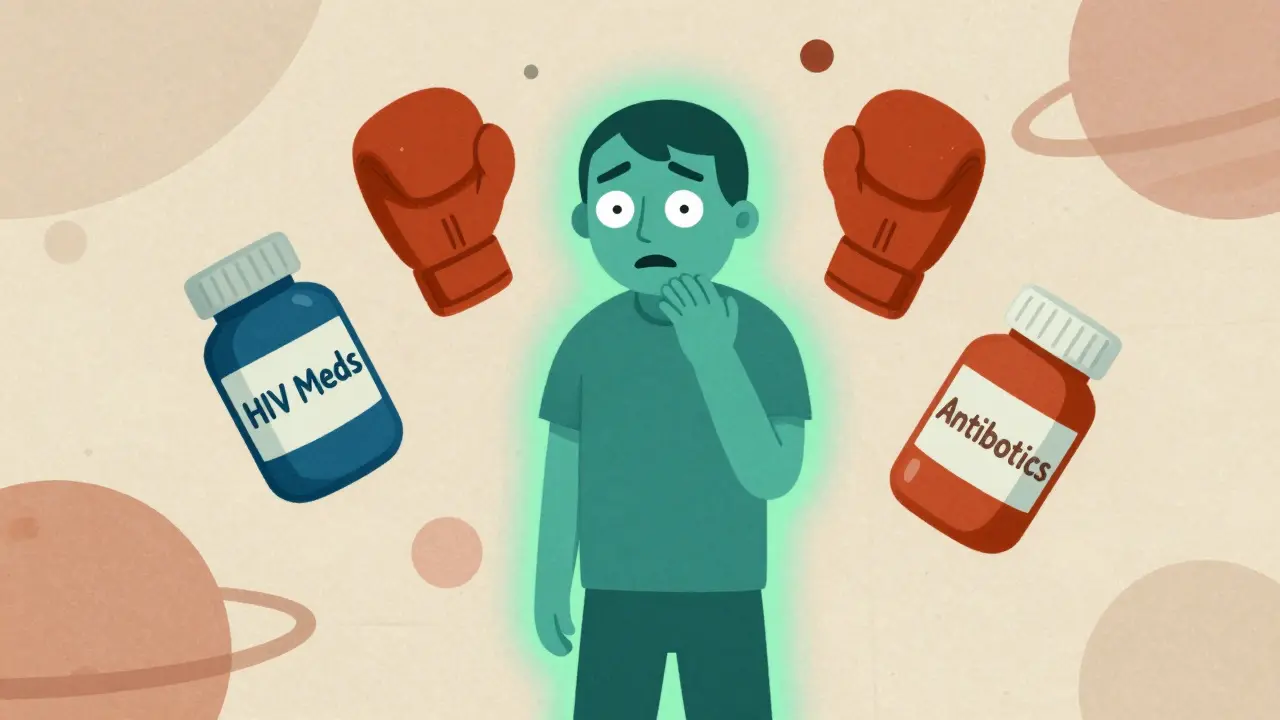
Imagine you’ve got your HIV under control. Your viral load is undetectable, your CD4 count is steady, and life feels normal. Then you catch a chest infection or a urinary tract bug. The doctor prescribes an antibiotic. You take it for a week, feeling better, but then something feels off-maybe nausea, maybe dizziness, or worse, your next lab test shows your HIV meds aren’t working as well as they should.
This isn’t just bad luck. It’s chemistry. Specifically, it’s a clash between the drugs treating your HIV and the antibiotics fighting your new infection. For the 1.2 million people living with HIV in the U.S. alone, this scenario plays out constantly. About 68% of us take at least one antibiotic every year. When these two powerful types of medication meet, they don’t always play nice. Understanding how they interact isn’t just medical trivia; it’s the difference between staying healthy and facing serious complications like kidney damage or treatment failure.
The Hidden Engine: How Your Liver Processes Drugs
To understand why these drugs fight, we have to look inside your liver. Think of your liver as a busy factory with specialized workers called enzymes. The most important crew here is the Cytochrome P450 (CYP450) system, specifically a worker named CYP3A4. This enzyme is responsible for breaking down most antiretroviral drugs so your body can get rid of them safely.
Here’s where it gets tricky. Many antibiotics also use this same CYP3A4 worker to get processed. If you take two drugs that need the same worker at the same time, things get backed up. One drug might hog the enzyme, causing the other to build up to toxic levels in your blood. Or, one drug might speed up the enzyme, causing the other to be broken down too fast, leaving you with no protection against HIV.
Not all HIV meds rely on this system. Some classes, like Nucleoside Reverse Transcriptase Inhibitors (NRTIs), Fusion Inhibitors, and many Integrase Strand Transfer Inhibitors (INSTIs), bypass the CYP450 system entirely. They are generally safer bets when you’re also taking antibiotics. But older classes like Protease Inhibitors (PIs) and Non-Nucleoside Reverse Transcriptase Inhibitors (NNRTIs) are heavily dependent on CYP450. They are the ones most likely to cause trouble.
High-Risk Antibiotics: What to Watch Out For
Not every antibiotic is dangerous when mixed with HIV meds, but some are notorious troublemakers. Knowing which ones require extra caution can save you a trip to the emergency room.
- Rifampin: This is used for tuberculosis. It’s a potent "inducer," meaning it supercharges the CYP3A4 enzyme. If you take rifampin with boosted Protease Inhibitors or most NNRTIs, your liver will break down your HIV meds so fast that their levels drop by up to 80%. This can lead to HIV resistance. Doctors usually switch patients to Rifabutin instead, which is gentler on the system, though dose adjustments are still needed.
- Clarithromycin: Commonly prescribed for respiratory infections. It relies heavily on CYP3A4 for breakdown. If you’re on a boosted PI like darunavir, your body can’t clear clarithromycin fast enough. Levels can spike by 60-80%, leading to severe side effects like hearing loss or heart rhythm issues. Azithromycin is often a safer alternative because it doesn’t use the CYP3A4 pathway.
- Fluoroquinolones: These include drugs like ciprofloxacin and levofloxacin. While they don’t always mess with HIV med levels, they share a different risk. A study published in Clinical Infectious Diseases found that combining fluoroquinolones with tenofovir disoproxil fumarate (TDF) increases the risk of acute kidney injury by 3.2 times. Both drugs stress the kidneys, and together, they can cause lasting damage.

Which HIV Meds Are Safest with Antibiotics?
If you know you’ll need antibiotics soon, or if you have frequent infections, your choice of HIV regimen matters. Modern medicine has moved toward drugs with fewer interactions, making life easier for patients.
| Drug Class | Interaction Risk | Why? | Common Examples |
|---|---|---|---|
| Integrase Inhibitors (INSTIs) | Low | Bypass CYP450 metabolism; minimal enzyme inhibition. | Dolutegravir, Bictegravir |
| Boosted Protease Inhibitors | High | Strongly inhibit CYP3A4; boosters like ritonavir/cobicistat block many drugs. | Darunavir/ritonavir, Atazanavir/cobicistat |
| NNRTIs | Moderate to High | Metabolized by CYP450; can induce or inhibit enzymes unpredictably. | Efavirenz, Rilpivirine |
| NRTIs | Very Low | Renally cleared; do not involve liver enzymes significantly. | Tenofovir, Emtricitabine |
Drugs like Dolutegravir and Bictegravir are now preferred anchors for many regimens precisely because they have few drug interactions. They allow doctors to prescribe common antibiotics without constant fear of a clash. However, even with these safer options, you shouldn’t assume everything is fine. Long-acting injectables like Cabotegravir stay in your system for weeks (up to 56 days half-life), meaning any interaction could linger long after you stop the antibiotic.
Real-World Scenarios: What Happens When Things Go Wrong?
Let’s look at two common situations to see how these interactions play out in real life.
Scenario 1: Community-Acquired Pneumonia You’re on boosted darunavir for HIV. You develop pneumonia. The standard treatment is often clarithromycin. If you take this without adjustment, your clarithromycin levels skyrocket, potentially causing cardiac arrhythmias. Meanwhile, your darunavir levels also rise, increasing the risk of side effects like high bilirubin (yellowing eyes/skin). The solution? Switch to azithromycin, which avoids the CYP3A4 clash entirely, or reduce the clarithromycin dose significantly under strict monitoring.
Scenario 2: Urinary Tract Infection (UTI) You’re on dolutegravir. You get a UTI. Nitrofurantoin is a common UTI drug. It’s generally safe with dolutegravir. However, if your doctor prescribes trimethoprim-sulfamethoxazole (Bactrim), you need to watch your potassium levels. Both drugs can raise potassium, leading to hyperkalemia, which can affect heart rhythm. Regular blood tests are essential here.
How to Protect Yourself: A Practical Checklist
You don’t need to be a pharmacist to manage these risks, but you do need to be proactive. Here is how to stay safe.
- Carry a List: Always keep an updated list of all your medications, including doses. Show this to every doctor, dentist, or specialist you see. Don’t assume they have your records.
- Ask About OTCs and Herbs: Over-the-counter cold medicines and herbal supplements like St. John’s Wort can interact just as badly as prescription antibiotics. St. John’s Wort, for instance, induces CYP3A4 and can crash HIV drug levels.
- Use Reliable Checkers: Before starting any new med, check for interactions. The University of Liverpool’s HIV Drug Interactions checker is widely regarded as the gold standard, with 98% concordance with clinical studies. It’s free and easy to use.
- Monitor Kidney Function: If you’re on TDF and need fluoroquinolones, ask your doctor for baseline and follow-up kidney function tests (creatinine/eGFR).
- Watch for Symptoms: New nausea, rash, extreme fatigue, or changes in urine color while on both meds? Call your provider immediately. Don’t wait for your next appointment.
The Future of Managing Interactions
Things are getting better. The FDA now requires detailed drug-drug interaction data for all new HIV approvals. Since 2019, 78% of new antiretroviral labels include specific antibiotic interaction guidelines, compared to only 42% a decade ago. Researchers are also using machine learning to predict interactions before they happen. The University of Liverpool launched version 10.0 of their database in 2024, which uses AI to predict novel interactions with 89% accuracy based on chemical structures.
Newer drugs like Lenacapavir, a capsid inhibitor approved in late 2022, have minimal CYP450 interactions, offering hope for simpler regimens. Additionally, personalized dosing algorithms based on pharmacogenomics are being developed through NIH-funded projects, aiming to tailor treatments to your unique genetic makeup by 2027.
Until then, communication is your best defense. Your healthcare team wants to keep you healthy. By asking questions and understanding these complex interactions, you take control of your health journey. Don’t let fear stop you from treating infections, but do let knowledge guide your choices.
Can I take amoxicillin with HIV medication?
Yes, generally speaking. Amoxicillin is a penicillin-class antibiotic that does not significantly interact with the CYP450 enzyme system. It is considered safe to take with most antiretroviral therapies, including boosted protease inhibitors and integrase inhibitors. However, always inform your doctor about all medications you are taking to rule out individual allergies or rare idiosyncratic reactions.
What should I do if I forget to tell my doctor about my HIV meds?
Contact your healthcare provider immediately. Do not stop taking either medication unless instructed to do so. Your doctor may order blood tests to check drug levels and organ function. In many cases, no harm is done, but prompt assessment ensures that any potential toxicity or reduced efficacy is caught early.
Are there natural supplements that interfere with HIV drugs?
Yes. St. John’s Wort is the most dangerous common supplement, as it strongly induces CYP3A4 and can drastically lower HIV drug levels, leading to treatment failure. Grapefruit juice can inhibit CYP3A4, potentially raising drug levels to toxic ranges. Always discuss any vitamins, herbs, or supplements with your HIV specialist before adding them to your routine.
How long do drug interactions last after stopping an antibiotic?
It depends on the drug. Most antibiotics leave your system within a few days to a week. However, enzyme inducers like rifampin can keep your liver enzymes "revved up" for several weeks after you stop taking them. Conversely, enzyme inhibitors may take a few days to clear. If you are on long-acting HIV injections, the interaction window is much longer due to the slow release of the HIV medication.
Is it safe to take probiotics with HIV and antibiotic treatment?
Probiotics are generally safe and may help mitigate antibiotic-associated diarrhea. They do not typically interact with HIV medications metabolically. However, if you are severely immunocompromised, consult your doctor first, as there is a very small theoretical risk of infection from live bacterial cultures in probiotics, though this is rare with reputable brands.