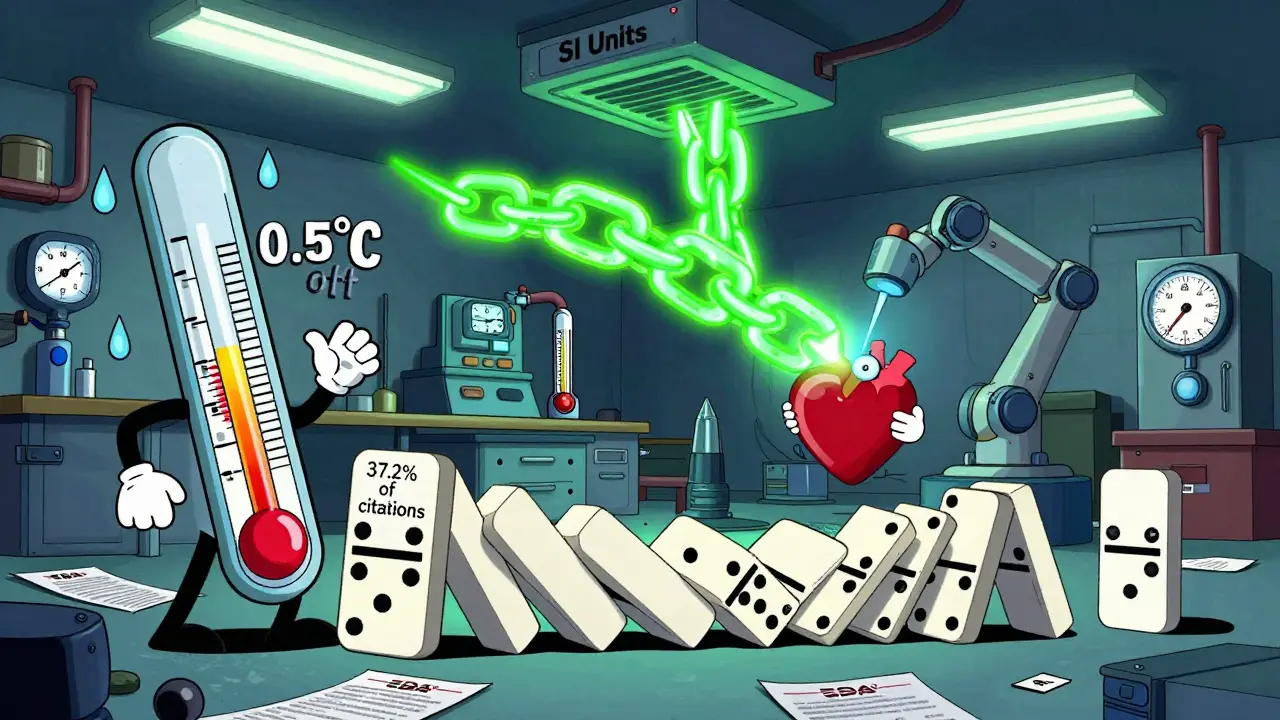
When you're running a manufacturing line that makes medical devices, a thermometer that's off by half a degree isn't just inconvenient-it could mean a batch of life-saving equipment gets rejected, or worse, shipped to patients with faulty readings. This isn’t hypothetical. In 2023, 37.2% of FDA warning letters cited poor calibration practices as a top compliance failure. That’s not a glitch. It’s a systemic risk. And the fix isn’t just doing more calibrations-it’s doing the right ones, at the right time, with the right documentation.
Calibration Isn’t Just a Checklist-It’s a Traceable Chain
Calibration isn’t about tweaking a dial until it looks right. It’s about proving, with data, that your instrument reads accurately against a known standard. That standard? It has to trace all the way back to the International System of Units (SI)-like how a meter is defined by the speed of light, or how a kilogram is tied to Planck’s constant. This traceability chain must be documented, unbroken, and measurable.
ISO 13485:2016 says it plainly: calibration must be done at specified intervals or before use. But here’s what most companies get wrong-they treat all equipment the same. A micrometer used to measure a heart valve component? Calibrated every 3 months. A basic digital scale in the packaging area? Maybe once a year. But if you’re not tracking how each device performs over time, you’re flying blind.
Here’s the rule of thumb: measurement uncertainty must be less than 25% of the tolerance you’re trying to control. If you’re checking a part that must be 10.0 mm ±0.1 mm, your calibration standard must be accurate to within ±0.025 mm. Anything looser and you risk accepting bad parts. NIST Handbook 44 recommends environmental conditions of 20°C ±2°C and 40% RH ±10% during calibration. Skip that, and even a perfectly calibrated tool can give false readings in a hot, humid factory.
Validation: Proving It Works in Real Use
Calibration tells you your tool is accurate. Validation tells you it works correctly in your process. These are not the same thing.
Take a robotic arm that welds surgical implants. You can calibrate its torque sensor to read 5 Nm ±0.1 Nm. But if the ambient temperature swings from 18°C to 32°C during production, the metal expands, and the weld joint weakens. Calibration won’t catch that. Validation will.
Validation follows GAMP 5 guidelines: three phases-Installation Qualification (IQ), Operational Qualification (OQ), and Performance Qualification (PQ). IQ checks that the equipment was installed correctly. OQ tests it under all operating ranges. PQ runs it with real materials under real conditions. For a high-speed packaging machine, this might take 30+ test runs over 3 weeks. The cost? Between $25,000 and $500,000 per system, depending on complexity. But skipping validation? That’s how recalls happen.
And don’t forget software. If your equipment runs on firmware or uses AI to adjust settings, FDA 21 CFR Part 11 requires algorithm validation. An AI that learns from past data can drift. ISO 13485:2016 Amendment 1 (March 2024) now explicitly requires continuous validation for AI-driven measurement systems. You can’t just install it and forget it.
How Often Should You Calibrate? It Depends
Manufacturer recommendations? A starting point, not a rule. A 2024 Reddit thread from r/QualityAssurance had 63 users who extended calibration intervals after proving stability. One lab switched from quarterly to biannual calibration on electronic scales-saving $18,500 a year-because their data showed zero drift over 18 months.
But here’s the flip side: another user reported pH meters in a high-humidity lab needed monthly calibration, even though the manual said 6 months. Why? Environmental stress. Humidity, vibration, dust, temperature swings-they all add up. NIST Technical Note 1900 found that 57.8% of out-of-tolerance failures happened when environmental conditions varied more than ±5°C from calibration settings.
So how do you decide? Use the Method 5 approach from SAE AS9100D:2016. Combine three things:
- Manufacturer’s recommendation
- Your own historical performance data
- Risk assessment (what happens if it fails?)
For example:
- High-risk, high-use: Aerospace micrometers → every 3 months
- Medium-risk, stable: Digital scales in packaging → every 6-12 months
- Low-risk, low-use: Basic thermometers in storage → every 24 months
And always document why. TÜV SÜD’s Dr. Anja Müller says 68.4% of audit failures come from not justifying calibration intervals. If you can’t explain why you calibrated when you did, you’re not compliant.

Regulatory Differences: ISO vs. CLIA vs. FDA
Not all standards are created equal. ISO 13485:2016 demands full traceability to SI units-no exceptions. CLIA, used in clinical labs, is more flexible. If you’re using a point-of-care glucose meter, and the manufacturer validated it, you don’t need to recalibrate it monthly. Just verify it daily with control solutions. That cuts workload by 23.5% for waived tests.
FDA’s 21 CFR Part 820 requires records to be kept for the product lifecycle plus 2 years. That means if you make a hip implant with a 10-year lifespan, you need to keep calibration records for 12 years. Paper files? A nightmare. Digital systems? Essential. The FDA’s 2024 Calibration Modernization Initiative requires all Class II and III device manufacturers to switch to electronic records by December 31, 2026. That’s not a suggestion-it’s a deadline.
And if you sell globally? EU MDR 2017/745 requires traceability to BIPM standards. FDA accepts NIST. So multinational companies now maintain dual calibration systems. McKinsey found that adds 18.7% more cost just for compliance.
The Hidden Cost of Poor Calibration
It’s not just about failing audits. It’s about money, time, and reputation.
Medical device manufacturers spend 8-12% of their entire quality budget on calibration. Small companies (<50 employees) pay 22.3% more per device than big ones because they can’t negotiate bulk rates with calibration labs. And with 47 accredited labs closing in 2023 due to technician shortages (per ILAC), finding someone qualified is getting harder.
Then there’s the documentation burden. A 2024 FDA Small Business Survey found small manufacturers spend 15.2 hours per week just managing calibration records. That’s nearly two full workdays a month. Cloud-based systems like GageList or Trescal cut that to 5-6 hours-by auto-generating certificates, sending reminders, and linking records to equipment IDs.
But even software has limits. 32.7% of negative reviews on G2 Crowd cite integration issues with old ERP systems like SAP ECC 6.0. If your calibration tool doesn’t talk to your inventory system, you’re back to spreadsheets-and spreadsheets fail.

What You Need to Do Now
Here’s your action list:
- Inventory every measuring device and assign a unique ID. No exceptions.
- Classify by risk: High, medium, low. Don’t treat them all the same.
- Set intervals based on data, not just the manual. Use Method 5.
- Control the environment. If your lab swings from 15°C to 30°C, invest in an ISO Class 5 chamber. It costs $85k-$120k-but prevents 41.3% of calibration failures.
- Go digital. Paper records are a liability. Use calibration software that auto-generates certificates and integrates with your ERP.
- Validate, don’t just calibrate. If it’s critical to your process, run IQ, OQ, PQ.
- Train your team. ASQ’s Certified Calibration Technician (CCT) credential is held by over 14,000 pros globally. It’s not just a title-it’s proof they know the rules.
The future? Continuous monitoring. IoT sensors embedded in equipment, sending real-time drift data to a dashboard. Pfizer’s pilot program cut calibration costs by 31.7% using AI-driven scheduling. NIST’s quantum standards will make measurements 100x more precise by 2030. But until then? The rules haven’t changed. Accuracy matters. Traceability matters. Documentation matters. And if you’re not doing this right, you’re not just risking compliance-you’re risking lives.
What’s the difference between calibration and validation?
Calibration checks if a device reads accurately against a known standard-like making sure your scale shows exactly 1.000 kg when a 1 kg weight is placed on it. Validation proves the entire system works as intended in real-world conditions. For example, a robot arm might be calibrated to apply 5 Nm of torque, but validation confirms it consistently welds a joint without cracking, even when the room temperature changes or the material batch varies.
How often should equipment be calibrated?
There’s no universal answer. ISO 13485:2016 says ‘at specified intervals or prior to use,’ but the interval depends on risk, usage, and environment. High-precision tools in aerospace may need monthly checks. Basic thermometers in storage might be fine yearly. The best approach combines manufacturer guidelines, historical performance data, and risk assessment-known as the Method 5 approach. Companies that use this method reduce non-conformances by 27.4% compared to fixed schedules.
Can I extend calibration intervals if the equipment seems stable?
Yes-if you have data to prove it. Many labs extend intervals after 12-18 months of consistent performance. For example, one biomedical lab extended electronic scale calibration from quarterly to biannually after tracking drift over 18 months and finding zero deviation. But you must document the rationale, include statistical analysis, and still monitor for changes. Regulatory auditors will ask for evidence, not just trust.
What happens if I don’t calibrate my equipment?
You risk product failures, regulatory citations, and recalls. In 2023, 37.2% of FDA warning letters cited inadequate calibration. A single out-of-tolerance measurement can lead to defective implants, incorrect dosing, or contaminated products. Beyond compliance, there’s financial risk: recalls cost an average of $10 million per incident, and lost customer trust can be irreversible. Calibration isn’t an expense-it’s insurance.
Do I need to use a certified calibration lab?
Not always, but traceability is mandatory. You can calibrate in-house if you have NIST-traceable standards and documented procedures. However, most manufacturers use accredited labs because they provide certificates with uncertainty values, which auditors require. If you do it yourself, your standards must be recalibrated annually by an accredited lab, and you must maintain full documentation of your chain of traceability.
Is software validation required for digital measuring devices?
Yes, if the software affects product quality. FDA 21 CFR Part 11 and ISO 13485:2016 Amendment 1 (2024) require validation of any algorithm used to measure, adjust, or report data. This includes AI-driven tools that predict drift or auto-calibrate. Validation includes testing the algorithm’s logic, input/output behavior, and long-term stability. You can’t rely on the vendor’s certificate alone-you must verify it works in your environment.
What’s the biggest mistake companies make with calibration?
Treating all equipment the same. Many companies calibrate everything on a fixed calendar, regardless of use, environment, or risk. That wastes money and misses real problems. The biggest failures happen in dynamic environments-like a lab with poor climate control-where equipment drifts faster than expected. The solution isn’t more calibrations. It’s smarter, risk-based scheduling tied to actual performance data.
How can small manufacturers afford compliance?
Start small. Focus on critical equipment first. Use cloud-based calibration software like GageList or Trescal-they reduce documentation time by over 60%. Pool resources with other small manufacturers to share calibration lab contracts. Join industry groups for bulk discounts. And prioritize digital records: paper files are more expensive to manage and harder to audit. Even a basic digital system cuts costs long-term.
Next Steps: Build Your Calibration Program
If you’re starting from scratch, begin with a full equipment inventory. List every tool that measures, monitors, or controls a critical parameter. Assign IDs. Classify by risk. Then pick 3-5 high-risk devices and implement full calibration and validation on them. Track results for 6 months. Use that data to justify intervals for the rest. Don’t try to fix everything at once. Fix the most dangerous things first.
And remember: calibration isn’t about passing an audit. It’s about knowing your product is safe. When a nurse uses your device to deliver medicine, they shouldn’t have to wonder if the reading is right. You owe them certainty.
Calibration isn't just about the tool it's about the context
Been in med device QA for 15 years and the biggest mistake I see is treating all instruments the same
That pH meter in the humid lab? Monthly is smart
That digital scale in dry packaging? Biannual is fine if your data says so
Stop following manuals blindly and start trusting your own measurements
The requirement for traceability to SI units is non-negotiable in ISO 13485. Any deviation undermines the entire quality system. Documentation must be rigorous, auditable, and maintained for the full lifecycle of the product. Failure to comply is not an oversight; it is a systemic failure of governance.
They say calibration is about traceability but let's be real - it's a money grab by third-party labs
Every time a company tries to extend intervals they get screamed at by auditors
Meanwhile the same tools are used in clean rooms with zero environmental variation
Who's really at risk? The people who profit from mandatory recalibration every 90 days
The assertion that 57.8% of out-of-tolerance failures occur due to environmental variation is statistically unsound without citing the original NIST dataset. Furthermore, the assumption that humidity alone causes drift ignores material science fundamentals. Thermal expansion coefficients vary by orders of magnitude across alloys, and calibration intervals must reflect the coefficient of thermal expansion of the instrument's internal components, not ambient conditions. This is basic metrology.
USA leads the world in quality standards and if you're not following NIST to the letter you're doing it wrong
Other countries? They're still using analog thermometers and calling it good
Don't let some Reddit guy from India tell you to stretch your calibration intervals
We have standards for a reason - because we don't cut corners
Validation is where most companies fail catastrophically
They think IQ OQ PQ is a box to check but it's not - it's a living system
I worked on a robotic welder that passed all validation tests in the lab but failed in production because the conveyor belt vibrated at 12Hz and threw off the torque sensor by 0.3Nm
We didn't catch it because we didn't validate under real production noise
Now we run PQ with actual product, real ambient temp, real power fluctuations, real dust levels
It costs more upfront but it's cheaper than a Class I recall
And don't even get me started on AI drift - I've seen models that started out accurate and ended up rejecting 40% of good parts because they 'learned' from bad data
It's not magic - it's math - and math needs constant oversight
I love how people treat calibration like it's one-size-fits-all
My team switched from quarterly to annual on a set of pressure gauges used in non-critical storage
Had 8 years of data showing zero drift
Saved over $20k a year
But we also kept monthly checks on the ones used in sterile filling - because we knew the risk
It's not about being cheap or being strict - it's about being smart
And documenting why you made the call
Because auditors don't care about your gut feeling - they care about your data
What about the people who don't have access to NIST-traceable standards? Not every lab in the world can afford that
Do we just shut down manufacturing in developing countries because they can't meet US/EU standards?
Is compliance a luxury?
The regulatory landscape is complex but not insurmountable. It is imperative to recognize that ISO 13485, FDA 21 CFR Part 820, and EU MDR are harmonized in principle, though divergent in implementation. A multinational enterprise must establish a unified calibration management system that incorporates traceability to both NIST and BIPM, with dual documentation pathways. This requires investment in metrology software, trained personnel, and audit-ready digital repositories. The cost of non-compliance is not merely financial; it is reputational and existential. Therefore, automation and centralized data integrity must be prioritized over manual record-keeping.
They say electronic records are mandatory by 2026 but here's the truth - the FDA doesn't even know how to audit them
I've seen auditors ask for PDFs of digital logs
Meanwhile the real data is in a SQL database with version control and digital signatures
They're still printing out 12-year-old calibration sheets and calling it 'compliance'
It's a circus
And we're all just pretending the system works