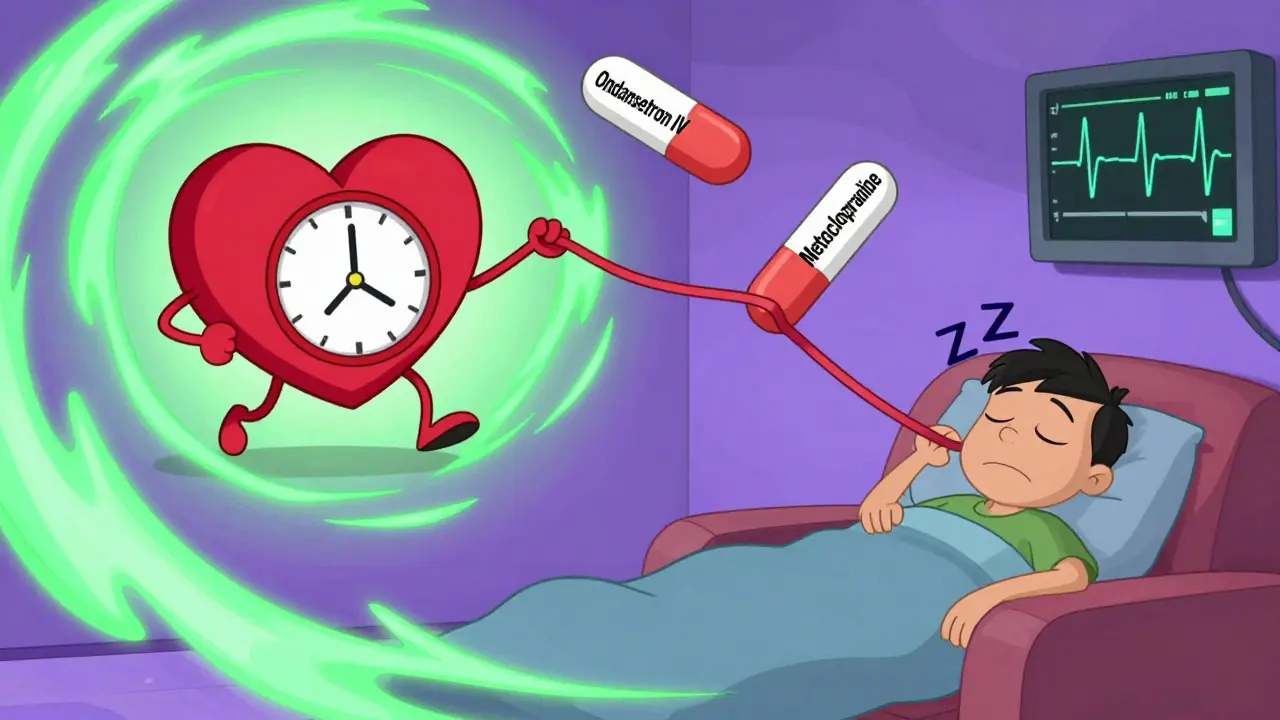
When you’re nauseous or throwing up, an antiemetic can feel like a lifesaver. But not all of them are created equal - especially when it comes to your heart and how sleepy they make you. Some of the most common anti-nausea medications can quietly stretch out your heart’s electrical cycle, raising the risk of a dangerous rhythm called torsades de pointes. And while drowsiness might seem like just an annoyance, it can be dangerous if you’re driving, operating machinery, or already at risk for falls.
What Exactly Is QT Prolongation?
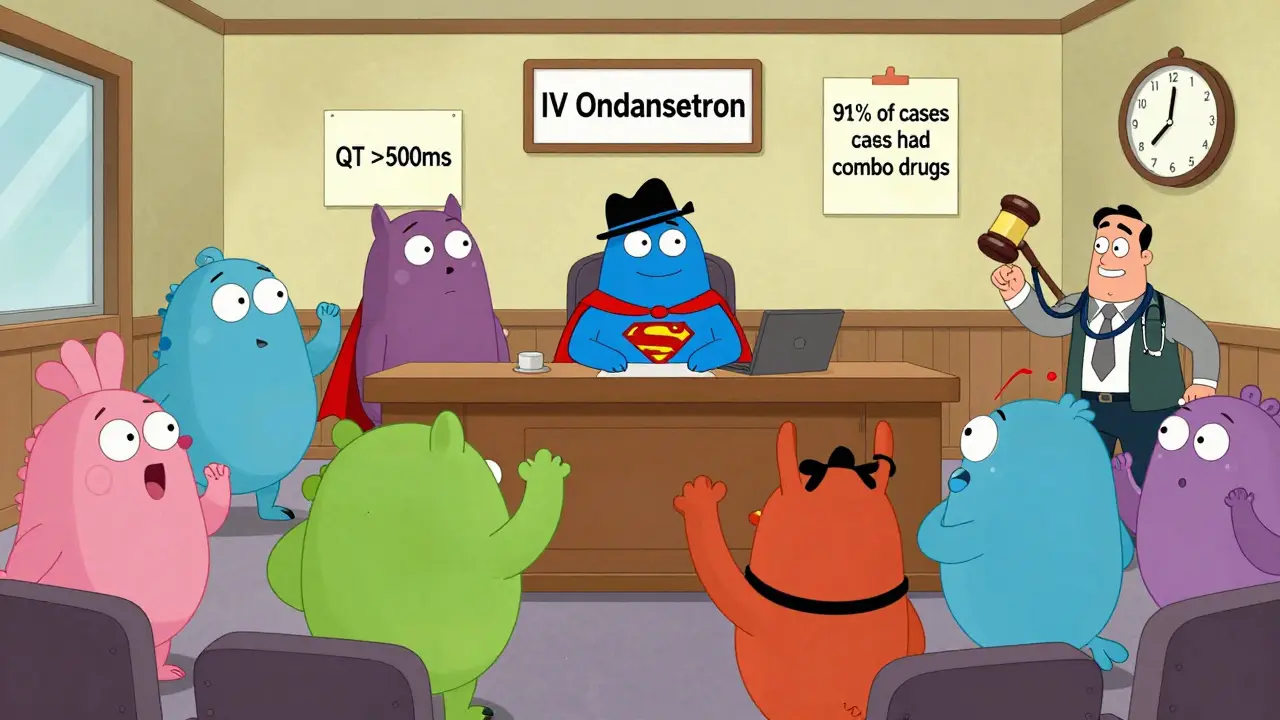
Your heart beats because of electrical signals. The QT interval on an ECG measures how long it takes your heart’s ventricles to recharge between beats. If that interval gets too long - specifically, if it goes over 500 milliseconds, or increases by more than 60 ms from your baseline - your heart can slip into a chaotic rhythm. This isn’t just a lab curiosity. Torsades de pointes can turn into sudden cardiac arrest. And yes, some antiemetics are known to cause this.
Most of these drugs block a specific potassium channel called IKr. Think of it like a valve that helps your heart reset after each beat. When it’s blocked, the reset takes longer. That’s the QT prolongation. It doesn’t always lead to trouble, but in people with heart disease, low potassium, or who are taking multiple QT-prolonging drugs, the risk spikes.
Which Antiemetics Carry the Highest QT Risk?
Not all anti-nausea pills are equal. Some are low-risk. Others? Not so much.
- Ondansetron - This is the most commonly prescribed IV antiemetic. But here’s the catch: at doses above 8 mg IV, it reliably prolongs the QT interval. Studies show it can add 17-20 milliseconds on average. In one trial, 16 patients saw a 17 ms increase. In another with 85 patients, the effect was similar. The risk is higher with IV use - 60% of reported QT prolongation cases involved IV ondansetron. Oral doses rarely cause issues.
- Granisetron - Like ondansetron, it can prolong QT when given IV at doses over 10 mcg/kg. But interestingly, the transdermal patch version doesn’t seem to affect the QT interval at all, while still working just as well for nausea.
- Droperidol - Once feared for causing cardiac arrest, newer studies show that at antiemetic doses (under 4 mg/day), the risk is extremely low. Even at 10-20 mg, most patients show no significant QT changes. Still, it’s often avoided out of habit.
- Haloperidol - The usual antiemetic dose is just 1 mg IV. At that dose, QT prolongation is rare. But if you’re giving multiple doses or combining it with other drugs, the risk builds up. Cumulative IV doses above 2 mg can be problematic.
- Metoclopramide - This one’s tricky. It’s a dopamine blocker, so it can cause movement disorders (like twitching or stiffness) and QT prolongation. It crosses the blood-brain barrier, which means more drowsiness and more heart risk.
- Domperidone - It doesn’t cross the blood-brain barrier, so less drowsiness. But it can still prolong QT - especially in older people or those with kidney problems. Even though a trial showed no effect at 80 mg/day, caution is still advised.
- Palonosetron - This is the quiet hero. It has no effect on the QT interval. It lasts longer (about 40 hours), works better than ondansetron, and doesn’t cause drowsiness. It’s often the best choice if you’re worried about heart risks.
- Olanzapine - A newer option, originally an antipsychotic. It doesn’t prolong QT, has low sedation risk, and works well for nausea. The downside? It’s not as well studied for vomiting as other drugs.

How Much Drowsiness Is Too Much?
Drowsiness isn’t just about feeling tired. It’s about safety. If you’re sleepy, you’re more likely to fall, miss a dose, or not notice early signs of a heart problem. Some antiemetics are notorious for this:
- Promethazine - This one makes you very sleepy. It’s often used in hospitals because it works well, but it’s a bad choice for older adults or people who need to stay alert.
- Prochlorperazine - Less sedating than promethazine. Still, some people feel groggy. It’s often preferred over promethazine for this reason.
- Metoclopramide - Causes drowsiness in about 1 in 5 users. It also carries a risk of movement disorders, especially in younger people.
- Palonosetron and Olanzapine - These two are much better. They rarely cause drowsiness. That’s why they’re gaining popularity in outpatient and palliative care settings.
- Dimenhydrinate and Meclizine - These are OTC options, often used for motion sickness. They’re strong sedatives. Avoid them if you’re driving or working with machinery.
Who’s at the Highest Risk?
Not everyone needs to worry. But if you have any of these, your risk jumps:
- Older adults (especially over 65)
- People with heart disease, especially long QT syndrome or prior arrhythmias
- Those with low potassium or magnesium (common in people who vomit a lot)
- People taking more than one QT-prolonging drug (antibiotics, antidepressants, antifungals, or even some heart meds)
- Patients with kidney or liver failure - their bodies can’t clear the drugs as fast
- Those getting IV doses - oral forms are much safer
Here’s a scary stat: 91% of cases where QT prolongation led to trouble happened in people who were already on another QT-prolonging drug. That’s not coincidence. It’s a recipe for trouble.
What Should You Do Instead?
If you’re at risk, here’s what works:
- Choose palonosetron - No QT effect. Longer action. Less drowsiness. It’s the gold standard if you’re concerned about safety.
- Use olanzapine - Especially for cancer patients or those with chronic nausea. It’s effective and safe for the heart.
- Try transdermal granisetron - If you need a serotonin blocker but want to avoid IV or oral QT risk, the patch is a solid option.
- Stick to low-dose droperidol or haloperidol - At antiemetic doses (1-2 mg), the risk is minimal. Don’t avoid them out of fear - use them wisely.
- Avoid IV ondansetron above 8 mg - If you must use it, keep it under 8 mg IV. Prefer oral if possible.
- Check electrolytes - If you’re vomiting a lot, get your potassium and magnesium checked. Fixing those alone can cut your risk in half.
Final Thoughts: It’s Not About Avoiding, It’s About Choosing
You don’t need to stop using antiemetics. You just need to pick the right one. For a healthy 30-year-old with a stomach bug? Ondansetron is fine. For a 72-year-old on diuretics and an antidepressant? Palonosetron or olanzapine is smarter.
Many doctors still default to ondansetron because it’s cheap and familiar. But the evidence is clear: when you care about safety, not just convenience, palonosetron wins. It’s more expensive, yes - but it’s worth it if it prevents a trip to the ICU.
And drowsiness? Don’t ignore it. A sleepy patient is a vulnerable patient. If your antiemetic makes you feel like you’ve been hit by a truck, there’s probably a better option out there.
Can I take ondansetron if I have a heart condition?
If you have a known heart rhythm disorder, long QT syndrome, or are on other QT-prolonging drugs, avoid IV ondansetron above 8 mg. Oral ondansetron is lower risk, but palonosetron or olanzapine are safer alternatives. Always check your ECG and electrolytes before use.
Is domperidone safer than metoclopramide?
Yes - for heart safety. Domperidone doesn’t cross the blood-brain barrier, so it causes less drowsiness and fewer movement disorders. But it can still prolong QT, especially in older adults or those with kidney problems. Metoclopramide carries both heart and neurological risks. Palonosetron or olanzapine are even better choices.
Why is palonosetron considered the best antiemetic for high-risk patients?
Palonosetron has no effect on the QT interval, lasts 40 hours (so you need fewer doses), and works better than ondansetron for preventing nausea after chemotherapy or surgery. It also causes minimal drowsiness. For patients with heart risks, kidney issues, or who are elderly, it’s the top choice.
Can I use dimenhydrinate for nausea if I’m on heart meds?
Avoid it. Dimenhydrinate (Dramamine) is a strong sedative and can interact with many heart medications. It also has anticholinergic effects that can worsen arrhythmias. Stick to non-sedating options like palonosetron or olanzapine instead.
Do I need an ECG before taking an antiemetic?
If you’re over 60, have heart disease, are on multiple medications, or have low potassium, yes. A simple ECG can catch a prolonged QT before it becomes dangerous. For younger, healthy people with a short-term illness, it’s usually not needed - but always check with your doctor.
Man, I just got prescribed ondansetron after my chemo and didn’t even think about the QT stuff. Thanks for laying this out so clearly. I’m switching to palonosetron now - no way I’m risking a heart glitch while my body’s already fighting hard.
I’m a nurse in oncology, and I’ve seen too many older patients get slammed with IV ondansetron like it’s candy. One 78-year-old woman on furosemide and sertraline? Got a 22ms QT prolongation after a single 16mg IV dose. She coded. We had to do CPR right there in the infusion room. It’s not rare. It’s predictable. We stopped using high-dose IV ondansetron in our unit last year. Palonosetron is pricier, sure - but so is a code blue. And honestly? It works better. Less vomiting. Less drowsiness. Fewer falls. The math is obvious. Stop treating nausea like a trivial side effect - it’s a cardiac minefield in disguise.
As someone from India where domperidone is sold over the counter like cough syrup, I’m horrified by how little awareness there is. My uncle took 40mg daily for months because his stomach "felt weird." He ended up in the hospital with torsades. No ECG. No electrolyte check. Just "take one more pill." We need public health campaigns - not just for doctors, but for pharmacists and families. This isn’t just a hospital issue. It’s a community danger.
So palonosetron’s the gold standard? I’ve never heard of it. I just thought all antiemetics were the same. Thanks for the breakdown - I’m gonna print this out and give it to my mom. She’s 71, on lisinopril and a statin, and she’s always getting sick after chemo. This could’ve saved her a trip to the ER.
OMG I’m so glad I read this before my next round. I’ve been taking promethazine for nausea and it’s like I’m in a zombie movie. I almost fell down the stairs last week. I’m switching to olanzapine. No more being a walking corpse. Also - why is this not on every prescription label?!
There’s a deeper philosophical layer here: medicine often optimizes for convenience, not safety. Ondansetron is cheap, fast, and familiar - so it becomes the default. But when we choose the path of least resistance, we risk the path of greatest harm. The real question isn’t "Which drug works?" - it’s "Which drug honors the complexity of the human body?" Palonosetron isn’t just pharmacologically superior - it’s ethically superior. It respects the patient’s vulnerability. That’s not just clinical wisdom - it’s moral practice.
Y’all need to stop treating QT prolongation like a footnote. It’s not "Oh, just check an ECG." It’s a silent assassin. I’ve seen patients die because someone said "It’s just a nausea pill." The system’s broken. We don’t train residents on this. Pharmacists don’t flag it. Nurses don’t question it. We need mandatory cardiac risk checks before prescribing ANY antiemetic in high-risk groups. No more "I didn’t know." Knowledge isn’t power - it’s a lifeline.
So let me get this straight - the drug that’s most commonly used is the most dangerous? And the safest one costs 5x more? Classic. This isn’t medicine. It’s capitalism with a stethoscope.
Thank you SO MUCH for this!! 🙌 I’m a pharmacist and I’ve been trying to push palonosetron in our formulary for months - no one listens until someone codes. Now I’m printing this and handing it to every MD in the hospital. Also - electrolytes! Always check K+ and Mg++ before giving ANY antiemetic!! 📊❤️🩺 I’ve had patients with 2.9 K+ on IV ondansetron - that’s a ticking bomb. Let’s save lives, not just stop nausea!