
Skipping a pill here and there might seem harmless-maybe you forgot, felt fine, or couldn’t afford it. But when you don’t take your medication exactly as your doctor ordered, the consequences aren’t just minor. They can be life-changing-or life-ending.
Your Body Doesn’t Know the Difference Between ‘Mostly’ and ‘All’
Medications aren’t like vitamins you can take when you feel like it. They’re designed to maintain a precise level in your bloodstream. If you miss doses, skip days, or stop early, that balance breaks. For example, if you’re on blood pressure medicine and skip doses, your pressure spikes unpredictably. That’s not just a headache-it’s a stroke waiting to happen.Same with antibiotics. Stopping early because you ‘feel better’ doesn’t mean the infection is gone. It just means the strongest bacteria survive and multiply. That’s how superbugs like MRSA spread. The World Health Organization says medication adherence affects outcomes more than the drug itself. If you don’t take it right, even the best medicine fails.
More Hospital Visits, More Risk of Death
In the U.S., about 125,000 people die every year because they didn’t take their meds as prescribed. That’s more than traffic accidents. For people over 50, the risk of dying from nonadherence is 30 times higher than the risk of being murdered.One in five Medicare patients gets readmitted to the hospital within 30 days-and half of those readmissions are because they stopped taking their meds. That’s not bad luck. It’s preventable. People with heart failure, diabetes, or asthma who skip doses are far more likely to end up in the ER. In fact, nonadherence causes up to 25% of all hospitalizations in the U.S. That’s not a small number. It’s a system-wide crisis.
The Cost Isn’t Just in Health-It’s in Your Wallet
Skipping meds might save you a few dollars now, but it costs way more later. In 2016, nonadherence cost the U.S. healthcare system $529 billion. That’s not inflation. That’s real money spent on emergency rooms, ICU stays, and surgeries that could’ve been avoided.On an individual level, the extra cost per patient ranges from $5,271 to over $52,000. Think about that. One missed dose of your cholesterol pill might seem cheap. But if that leads to a heart attack? You’re looking at tens of thousands in medical bills-and possibly years of lost income.
And it’s not just hospitals. Out-of-pocket drug costs rose 4.8% in 2021 alone. Many people skip doses because they can’t afford them. The CDC found 8.2% of working-age adults didn’t take their meds because of cost. That’s nearly one in twelve. And for Black, Latino, and Indigenous communities, the numbers are worse-due to systemic barriers like pharmacy deserts, language gaps, and distrust in the medical system.

Chronic Conditions Are the Biggest Victims
If you have a long-term illness-diabetes, high blood pressure, asthma, depression, or even after an organ transplant-you’re at the highest risk. Take transplant patients: if they skip even one dose of their anti-rejection drugs, their body can start attacking the new organ. Many lose their transplant because they thought, “I feel fine, I don’t need it today.”For people with mental health conditions, nonadherence is even more common. Nearly 60% of those prescribed psychiatric meds don’t take them regularly. That’s not because they’re lazy. It’s because side effects like weight gain, drowsiness, or emotional numbness are terrifying. And without proper support, they stop.
And it’s not just the meds. Complex regimens make it worse. Imagine taking seven different pills at three different times a day, with different food rules. No wonder people give up. That’s why adherence drops over time-even if you started strong.
It’s Not Just You-It’s Everyone Around You
When you don’t take your meds, it doesn’t just hurt you. It strains your family, your doctor, your insurance, and the public health system. A single hospitalization from a preventable complication costs taxpayers thousands. Emergency responders get called. Nurses get overworked. Pharmacies get flooded with refill requests because people waited too long.And then there’s the ripple effect. If you have asthma and skip your inhaler, you might end up in the ER on a busy night-delaying care for someone else who’s having a real emergency. If you have high blood pressure and skip pills, you might have a stroke and become dependent on long-term care. That’s a burden on caregivers, on social services, on the whole system.
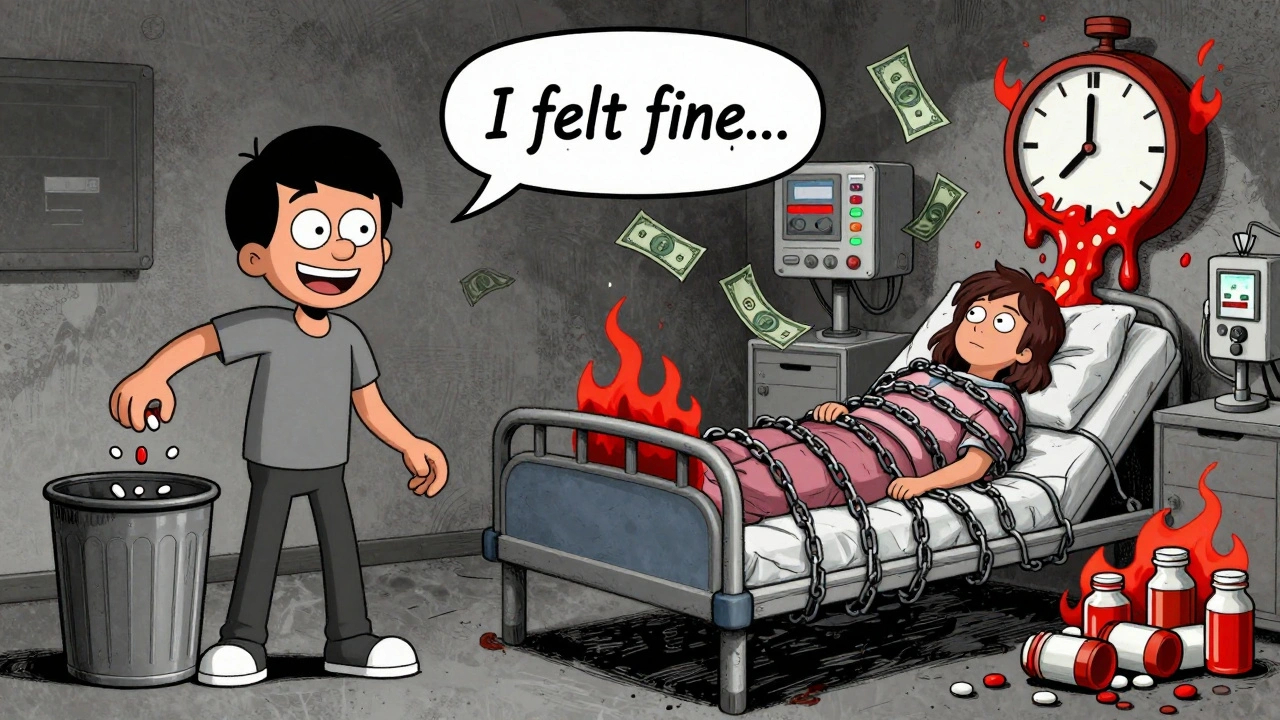
Why People Skip-And What Actually Helps
The reasons are simple: cost, fear, confusion, forgetfulness. But the solutions aren’t complicated.Use a pill organizer. Set phone alarms. Ask your pharmacist for a blister pack that shows which pills to take when. Many pharmacies offer free medication therapy management-where a pharmacist sits down with you and simplifies your whole regimen. That’s not a luxury. It’s a lifesaver.
Text reminders work. Studies show they improve adherence by 12-18%. Talking to your doctor about side effects? That works too. If your antidepressant makes you nauseous, don’t quit. Ask for a different one. There are dozens of options. You don’t have to suffer to get better.
And if cost is the problem? Ask about patient assistance programs. Many drugmakers offer free or low-cost meds to people who qualify. Community health centers often have sliding-scale pharmacies. Don’t assume you can’t afford it-ask.
You’re Not Alone. But You Are Responsible
It’s easy to feel guilty for missing a dose. But shame doesn’t fix this. What fixes it is action. Talk to your doctor. Tell them you’re struggling. Bring your pill bottles to your next appointment. Write down your concerns. Ask: “What happens if I don’t take this?”Doctors don’t judge. They want you to live. But they can’t help if they don’t know you’re having trouble. Most don’t even ask-because they’re rushed. So you have to speak up.
Medication adherence isn’t about being perfect. It’s about being consistent. Even 80% adherence is the minimum for most drugs to work. That means missing one dose a week might be enough to make your treatment useless.
And if you’re taking three or more prescriptions-which 36% of adults do-this isn’t optional. It’s survival.
Okay but have you ever thought that maybe the meds are the real problem? 🤔 I mean, why do we just assume Big Pharma isn’t poisoning us slowly with these pills? I skipped mine for a week and suddenly I had more energy than ever… coincidence? I think not. 💊💀
Life is a wave, and medicine is just a rope trying to tie it down. When we resist the flow, we break. But when we surrender… maybe the body knows better than the doctor. 🌊🪢
125,000 deaths? That’s nothing. You know how many people die from being told they need meds? That’s the real epidemic. People don’t die from skipping pills-they die from being told they’re broken. 🤷♂️
Yo-this is SO important. If you’re on a multi-drug regimen, you’re basically running a micro-pharmacy in your kitchen. 🧪💊 Use pill organizers, set alarms (Google Calendar + SMS reminders = game changer), and DON’T be shy about asking your pharmacist for a med therapy consult. It’s FREE. Seriously. They’re trained for this. And if cost’s an issue? Call the drug company. Most have patient assistance programs. You’d be shocked how many people qualify. You’re not lazy-you’re just under-resourced. Let’s fix that. 💪
Medication adherence is not about perfection. It is about presence. It is about showing up for yourself-even on the days you feel like giving up. You are not a burden. You are a human being trying to survive in a system that makes it hard. Speak up. Ask for help. Write it down. Bring your bottles. You are worthy of health. And you are not alone. 🌻
You people are pathetic. Skipping meds is not a lifestyle choice its a death wish. If you cant follow basic medical instructions you dont deserve to live. The fact that you think its ok to risk other peoples lives because you cant afford a pill is disgusting. Stop being a burden on society. You think your feelings matter? Your death will save money. Good riddance
YEAH RIGHT! I got my blood pressure meds from the pharmacy in Mexico for 10 bucks a month! Why pay $400 here? And now I’m fine! The system is rigged! You think they care about you? Nah! They just want your SSN and your insurance! I’m not taking their poison anymore! 🇺🇸🔥
It’s not about skipping pills. It’s about the failure of modern medicine to treat the soul. You can’t chemically fix a life lived in fear, poverty, and isolation. Your body rebels because your spirit is starving. No pill can heal that. And yet, here we are-prescribing more drugs instead of asking: why are you suffering? The real crisis isn’t nonadherence. It’s the absence of care.